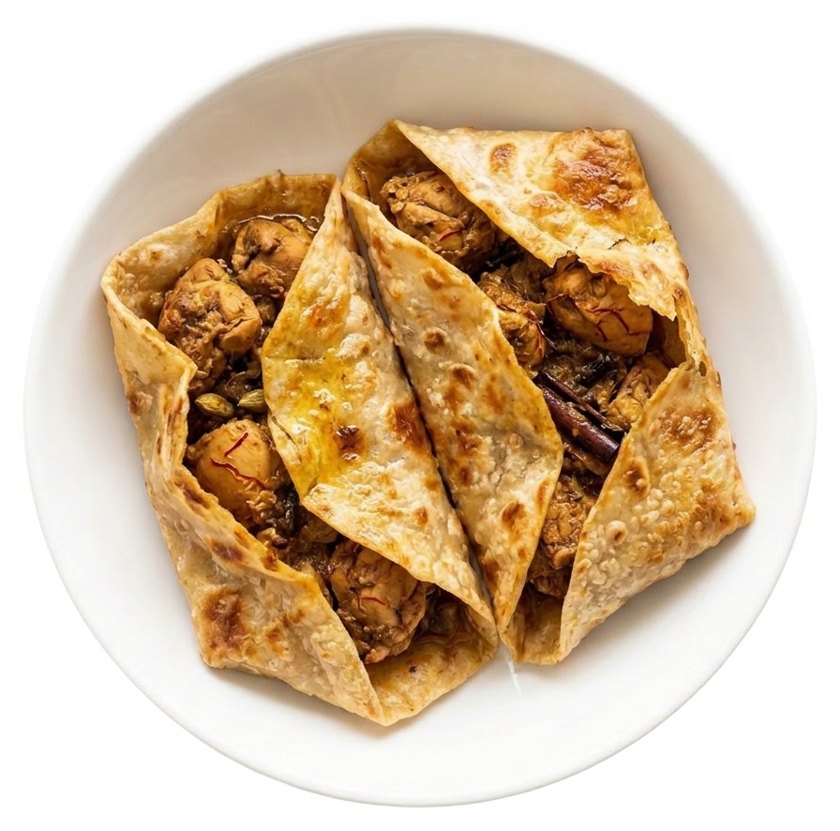
Khad Murg
Chicken is marinated in spiced aromatics, braised in a fragrant whole-spice broth, and wrapped in thin flatbreads before a final bake. The result is tender, deeply savoury meat infused with saffron and citrus, encased in crisp, buttery bread.
Marinade spices and pastes
79 gWhisked into the marinade base (step 1)Saffron
0.3 gSteeped in milk (step 2)Whole spices for the stock
8 gSimmered in the stock (step 3)Everything else

Method
- Prick 1000 g chicken thoroughly with a fork and arrange it in a shallow container. In a mixing bowl, blend 66 g ghee, 61.2 g lemon juice, to taste salt, and the marinade spices and pastes. Rub this paste evenly over every piece of chicken, cover, and chill in the refrigerator for 3 to 4 hours.
- Place the saffron into 15.3 g milk and set aside to infuse. Heat the oven to 200°C (400°F).
- Pour 500 g stock into a sturdy saucepan and drop in the whole spices for the stock. Bring the liquid to a boil, then cover with a lid, turn down the flame, and simmer for 15 minutes.
- Spread the chilled chicken pieces in a single layer across a roasting tin and pour the spiced stock over them. Bake for about 30 minutes, spooning pan juices over the meat at regular intervals, until the chicken is tender and all liquid has evaporated. Remove the tin, set aside the rendered surface fat, and leave the oven on.
- Lightly grease a baking sheet with vegetable oil. Lay 4 of the 8 roomali roti on the sheet with their edges overlapping by 3 cm (1 inch) to form a large base. Brush a layer of the reserved cooking fat over the flatbreads. Scatter the steeped saffron milk over the cooked chicken, then place half of the chicken along the middle of the bread layer and spoon over half of the 152 g plain yogurt. Wrap the sides of the flatbreads firmly over the meat to enclose it into a parcel. Repeat the process with the remaining 4 roti, the rest of the chicken, and the remaining yogurt to assemble a second parcel.
- Transfer both bread parcels to the hot oven and bake for 15 minutes until crisp and heated through.
Don't have something?


 Boneless chicken
Use the same weight; cut to the same size and cook as directed. Skinless boneless chicken is simply the skin-free version.
 Boneless chicken thigh
Use the same weight; it is juicier and slightly fattier, so simmer 3–5 minutes longer and skim excess fat if needed.
 Boneless chicken breast
Use the same weight; it is leaner and dries out faster, so reduce the simmering time by 3–5 minutes.


 Ground turmeric
Use 15% of the saffron's weight. Replicates the bright yellow colour well, but lacks the floral, earthy depth; use sparingly to avoid bitterness.
 Screwpine water or rosewater
Use a few drops combined with a tiny pinch of ground turmeric to mimic both the regal floral aroma and the golden hue.



 Whole milk
Use equal weight; provides the standard rich dairy fat and body expected in creamy Indian bases.
 Single cream
Dilute 3 parts cream with 1 part water to match the weight; yields a richer, glossier gravy that resists curdling.
 Plain yogurt
Whisk thoroughly and use equal weight; adds extra body and a mild pleasant acidity, best added off the heat.


 Chicken stock
Use the same weight; skim if cloudy and adjust salt only at the end.
 Vegetable stock
Use the same weight; it is lighter, so add a little ghee or butter if the dish needs richness.
 Water
Use the same weight plus extra salt and a pinch of sugar; only for thin gravies, as it lacks body.


 Green cardamom seed
Use 35 to 40% of the total pod weight; lightly bruise the seeds before frying in oil to release their essential oils.
 Ground green cardamom
Use 20 to 25% of the pod weight (about 1 generous pinch per pod); stir in toward the end of cooking so the delicate floral notes do not dissipate.
 White cardamom pod
Use 1:1 by pod count or weight; crack gently before using, though it is slightly less intensely floral.


 Ceylon cinnamon
True cinnamon: thinner, papery quills, milder and sweeter. Use about 1.5 times the weight, and taste.
 Ground cinnamon (cassia)
Use about a third of the weight (0.5 g ground for a 2.5 cm piece), stirred in with the ground spices rather than fried whole, since the powder burns quickly.
 Cassia buds
Use 60-70% of the weight; stronger and more peppery, so taste before adding more.


 Ground cloves
Use 1 g ground for 4 g whole (or 1 small pinch per 2 to 3 whole cloves). Add with spice powders; disperses intense warmth quickly, so use with restraint.
 Allspice berries
Use 100% of the weight whole in tempering. Imparts a warm, clove-like aromatic profile combined with hints of nutmeg and cinnamon.
 Black cardamom pod
Use 1 pod for 3 to 4 cloves in whole tempering. Shares a camphor-like warmth and medicinal depth, though it introduces a distinct smoky undertone.


- Cinnamon stick
Use a 2 cm piece (about 1 g) for every 1 to 2 bay leaves. Fry in whole-spice temperings; provides the cassia-like warmth typical of Indian tejpatta.
- Ground cinnamon (cassia)
Use 0.5 g per leaf. Stir into the sauce during simmering; gives the same warm woodiness but darkens the colour slightly.

 Ground black cardamom
Use 0.5 g of ground seeds for each whole pod. Stir directly into the curry base; delivers identical smoky flavour without woody husks.
- Green cardamom pod
Use equal pod count or weight. Crack slightly and fry whole; tastes sweet, menthol-fresh, and floral rather than dark and smoky.


 Handkerchief flatbread
Use the same weight; effectively the same bread. Warm before folding.
 Chapati
Use the same weight. Thicker and less pliable; warm well before serving.
- Paratha or naan
Use the same weight. Richer and heavier; reduce other fat in the meal.


 Yogurt
Use equal weight, whisked thoroughly until smooth before adding to hot dishes to prevent curdling.
 Coconut milk
Use equal weight with 1 teaspoon lemon juice mixed in. Provides rich creaminess in curries, but adds a noticeable coconut flavour.
- Single cream
Use 80% of the weight plus a squeeze of lemon juice for acidity. Enriches sauces nicely, though it is richer and less tangy.


 Peanut oil
Use 1:1 by weight. Handles high-heat frying identically and introduces a very subtle, pleasant nuttiness.
 Ghee
Use 1:1 by weight. Yields a much richer, authentic aroma and a glossy, heavier mouthfeel.
 Mustard oil
Use 1:1 by weight. Heat until smoking, then cool slightly before cooking to temper its intensely pungent, sharp mustard kick.


 Unsalted butter
Use 120% of the weight; melt gently over low heat to avoid burning the milk solids, which will yield a softer, creamier richness rather than a nutty aroma.
- Vegetable oil
Use 85% of the weight; holds high cooking temperatures without smoking, but the final dish will lack traditional dairy depth.
- Mustard oil
Use equal weight; heat to smoking point and cool slightly before cooking, bearing in mind it introduces an assertive, pungent edge.


 Blanched almond paste
Use the same weight; same flavour and texture. Break up lumps before mixing.
 Ground almonds
Use the same weight with 25–30% caster sugar and a little water; less smooth and sweeter.
 Cashew paste
Use the same weight; softer and milder, with less almond flavour. Good in creamy gravies.


 Garlic
Use equal weight; crush or finely grate to a smooth pulp to replicate the same fresh, pungent moisture in your base gravy.
 Garlic powder
Use 20 to 25% of the weight; mix with a teaspoon of water before adding to oil so it does not burn, noting it lacks the fresh bite.


 Fresh ginger
Use equal weight; peel and grate very finely on a microplane or pound to a fine paste in a mortar.
 Ginger
Use equal weight; mince finely and crush with the flat of a knife before frying.
 Ground ginger
Use 20% of the weight; add directly with the dry spice powders, though it yields an earthier, less pungent profile.


 Red chilli powder
Use 100% of the weight. Provides direct, sharp heat and red colour in equal measure.
 Kashmiri chilli powder
Use 150% to 200% of the weight if matching colour, but add a pinch of black pepper or hot chilli if you need equivalent fiery heat.
 Cayenne pepper
Use 75% to 100% of the weight. Offers a sharp, clean heat with slightly less earthy depth and less crimson colour.


 Lime juice
Use equal volume or weight; delivers almost identical sharp acidity with a faintly more aromatic, bitter-edged profile.
 Dried mango powder
Use 25% of the weight (about 1 g amchoor for 4 g juice); provides clean fruity tartness without thinning the sauce.
 White vinegar
Use 75% of the volume; gives direct sourness without any citrus floral fragrance.


- Green cardamom seed
Grind freshly extracted inner black seeds finely; use equal weight (1:1). Greatly superior aroma with potent eucalyptus and citrus notes.
- Green cardamom pod
Lightly crack whole pods and simmer them in the gravy; use 150% of the weight of ground cardamom. Fish out the pods before serving.
 Ground nutmeg
Use 50% of the weight. Delivers warm, sweet aroma, but lacks cardamom's cooling, citrusy top notes.
Similar dishes
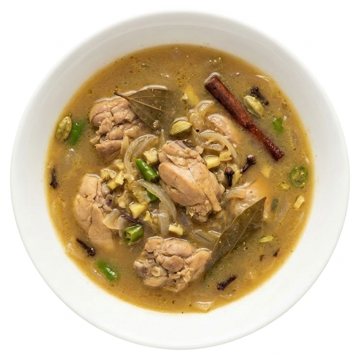
- Same: Chicken Ishtoo also braises chicken with warm aromatics including ginger, garlic, bay leaves, cinnamon, cloves, and green cardamom.
- Different: Chicken Ishtoo is cooked entirely as a stovetop stew with lots of sliced onions and fresh green chillies, omitting the yogurt, lemon juice, saffron, ghee, and roomali roti wrapper used in this dish.
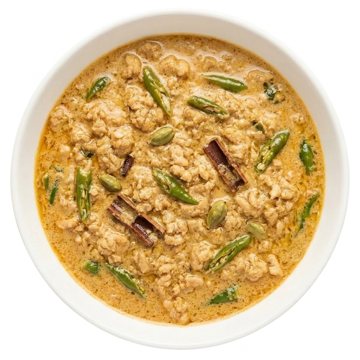
- Same: Murg Rezhala also prepares chicken with yogurt, milk, saffron, ginger, garlic, cinnamon, and green cardamom.
- Different: Instead of being braised, wrapped in flatbread, and baked with ghee, it is cooked as a stovetop curry using minced chicken, green chillies, sugar, and vegetable oil, omitting the lemon juice, black cardamom, cloves, and bay leaf.

- Same: Shahi Qorma also prepares chicken with ghee, saffron, ginger, garlic, chilli powder, green cardamom, cinnamon, cloves, and bay leaves.
- Different: Instead of being braised, wrapped in flatbread, and baked, Shahi Qorma is cooked as a stovetop curry using onions, mace, coriander, and kewra water without milk, black cardamom, or lemon juice.

- Same: Thengakkai Kori shares chicken, plain yogurt, chicken stock, garlic and ginger pastes, chilli powder, vegetable oil, salt, and whole spices including green cardamom, clove, and cinnamon with this dish.
- Different: Thengakkai Kori adds turmeric, onion, coconut milk, and coconut and uses chicken breast, while it lacks this dish's saffron, milk, almond paste, lemon juice, ghee, handkerchief bread, and bake-and-wrap method, being a strained curry instead.