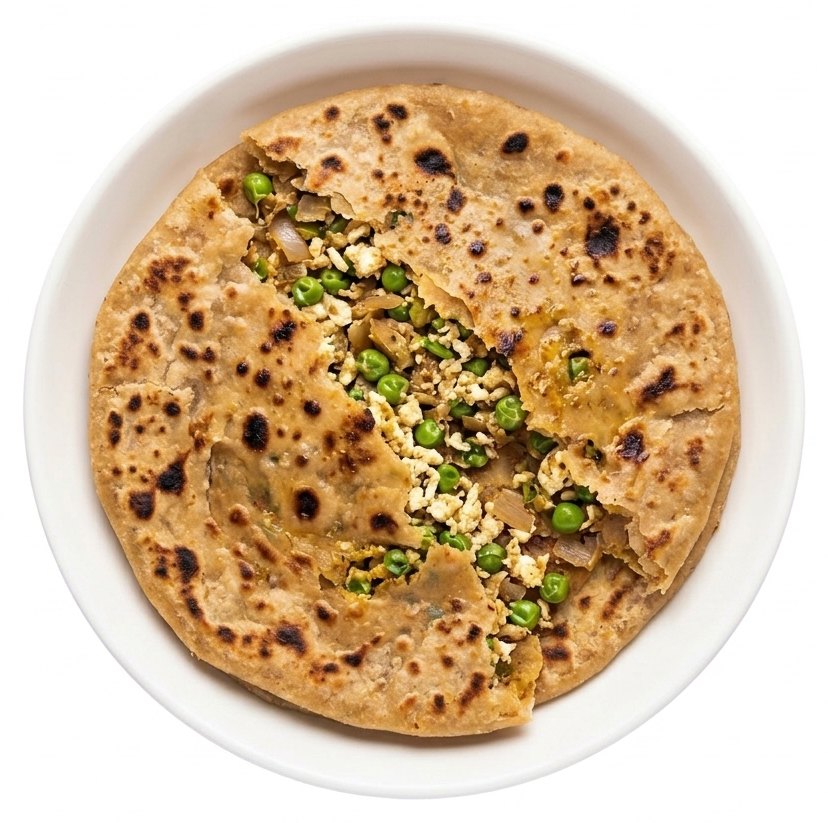
Punjabi Matar Paneer Paratha
A Punjabi flatbread layered around a stuffing of crumbled paneer, peas, ginger and warm spices, then fried in butter or ghee until crisp and browned. The filling tastes savoury, tangy and lightly hot.
Stuffing spices
8 gAdded to the fried onion, ginger and chilli (step 5)Everything else


Method
- Put 320 g atta, 40.5 g vegetable oil, 248 g water and 0.3 g salt in a large bowl and mix until a dough forms.
- Knead the dough for 1–2 minutes until smooth, cover and leave to rest.
- Warm 27 g vegetable oil in a large frying pan over medium heat.
- Add 50 g onion and fry for 6 minutes until it begins to soften.
- Add 12 g ginger and 4 g green bird’s eye chilli and fry for 1 minute.
- Add the stuffing spices (the masala) and salt to taste; stir well, then take the pan off the heat.
- Stir in 250 g paneer and 80 g frozen peas for about 2 minutes, then add 1 g chopped coriander and leave to cool a little.
- Divide the dough into 8 balls. Flatten each ball and roll it on a surface dusted with extra atta into a 10 cm (4 inch) disc.
- Put two heaped tablespoons of stuffing in the centre of each disc, bring the edges up and pinch to seal, then press the paratha flat.
- Heat a dry frying pan over medium heat.
- Dust one stuffed paratha with extra atta and roll it into an 18 cm (7 inch) disc, keeping the filling inside.
- Put it in the hot pan and cook for 3 minutes, then turn it and cook for 3 minutes more, brushing the top with melted butter or ghee.
- When it starts to colour light brown, turn again and fry for 2 minutes, brushing the top with butter or ghee.
- Turn once more and fry for 1 minute.
- Set the cooked parathas aside covered to keep warm while you cook the rest the same way.
Don't have something?


 Wholemeal flour
Use the same weight; it is very close, but add water slowly as it can be coarser and absorb more.
 Plain flour
Use the same weight but reduce water by about 10%; the dough is softer and the flavour less nutty.
 Flour
Use the same weight as a plain-flour swap; reduce water slightly and expect a lighter, less wheaty result.


 Peanut oil
Use 1:1 by weight. Handles high-heat frying identically and introduces a very subtle, pleasant nuttiness.
 Ghee
Use 1:1 by weight. Yields a much richer, authentic aroma and a glossy, heavier mouthfeel.
 Mustard oil
Use 1:1 by weight. Heat until smoking, then cool slightly before cooking to temper its intensely pungent, sharp mustard kick.


 Stock
Use the same weight in savoury dishes; it adds body, so adjust salt.
 Milk
Use the same weight only in doughs or creamy dishes; it makes the result richer.
 Coconut water
Use the same weight in curries or rice; it adds sweetness and a faint coconut taste.


- Ghee
Use the same weight. Gives a richer aroma and nuttier taste; if the dish already uses butter for finishing, ghee can make it slightly heavier.
 Butter
Use the same weight. Lower smoke point than ghee, so keep the heat moderate; if unsalted, add a small pinch of salt.
 Vegetable oil or ghee
Use about 90% of the weight. Less rich flavour; good when you want a lighter result.






 Ginger paste
Use equal weight. Sauté in hot fat until the raw allium smell disappears; slightly wetter, but provides identical warmth and pungency.
 Ground ginger
Use 20% to 25% of the weight (1 g for every 4 to 5 g fresh). Stir into the gravy; adds peppery heat and warmth, though it misses the crisp, zesty kick of raw root.


- Bird's eye green chilli
Use the same weight; heat and flavour are very close.
 Green chilli
Use 1.5 to 2 times the weight; deseed for less heat. Larger chillies are more watery.
 Fresh green chilli
Use 1.5 to 2 times the weight; chop finely and adjust heat by tasting.


 Ground dried mango powder
Use the same weight; same sour mango flavour. Add early so it can soften into the dish.
 Dried mango powder
Grind to a powder and use the same weight. Slightly coarser unless finely ground.
 Lemon juice
Use 5–6 times the weight, e.g. 1 tsp powder to about 5 tsp juice; add off the heat. Wetter and fresher-tasting.


 Ground cumin
Use 70% of the weight; add with ground spices or sauce bases rather than hot oil tempering, where it scorches quickly and turns bitter.
 Black cumin seeds
Use equal weight for oil tempering. Delivers an earthy profile with an additional musky, smoky, and slightly bitter edge.
 Fennel seed
Use 60% of the weight for tempering; offers comparable warm aroma, but leans sweet and liquorice-like rather than savoury and earthy.


 Dried kashmiri chilli
Grind deseeded dried pods to an equal weight of powder; gives identical vivid red colour and gentle warmth.
 Red chilli powder
Use 25% of the weight mixed with sweet paprika for colour; straight red chilli powder is substantially hotter and will make the dish fiery.
 Chilli powder
Use one-third of the weight; the sauce will be less intensely red and notably sharper in heat.


 Tandoori snack spice mix
Use the same weight; taste first as it can be smokier and saltier. Add lime or amchoor if the dish needs more tang.
- Dried mango powder
Use about half the weight, mixed with black salt and a pinch of ground cumin. It gives tang and saltiness but lacks the minty, asafoetida notes.
 Black salt
Use about half the weight and add lime juice to taste. It gives the salty, sulphurous edge but not the full tangy blend.



 Extra-firm tofu
Use equal weight, pressed well to remove excess moisture and cut into cubes. Pan-fry lightly before adding; absorbs sauces similarly, though it lacks dairy sweetness.
 Halloumi
Use equal weight, soaked in warm water for 20 minutes to leach out excess salt. Holds shape during frying, but has a denser, saltier chew.




Similar dishes

- Same: Paneer Kulcha and this dish are both stuffed paneer flatbreads seasoned with green chilli, ginger, chaat masala, cumin and kashmiri chilli, and both are cooked with butter.
- Different: Paneer Kulcha uses plain flour with baking powder, sugar, yoghurt and milk for a soft dough, while this dish uses atta with oil and water and is layered; its filling has coriander and mint but no peas, onion or dried mango powder, and it cooks on a dry pan with butter rather than as a crisp layered paratha.

- Same: Punjabi Achari Paneer shares paneer, peas, fresh ginger, green bird’s eye chilli, cumin seed, Kashmiri chilli powder, vegetable oil, coriander and salt with this dish.
- Different: Punjabi Achari Paneer is a tomato-onion yoghurt curry soured with lime pickle and made with garlic, whole coriander, fennel, cumin, black mustard, nigella and fenugreek seeds plus kasuri methi, while this dish is an atta dough flatbread stuffed with paneer and peas, soured with dried mango powder and chaat masala, and cooked crisp in butter or ghee.
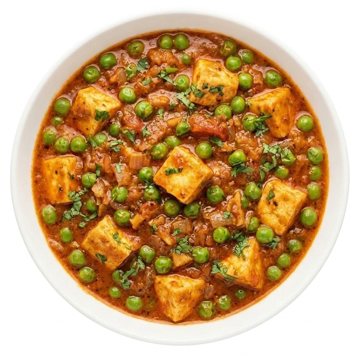
- Same: Punjabi Matar Paneer shares paneer, green peas, ginger, kashmiri chilli and cumin seed with this dish.
- Different: Punjabi Matar Paneer is a tomato-onion gravy with garlic, turmeric, sugar, garam masala and coriander, while this dish is an atta flatbread stuffed with a paneer-pea filling and uses chaat masala and dried mango powder.

- Same: Paneer Bhurji shares paneer, onion, fresh ginger, green bird’s eye chilli, cumin seed, vegetable oil, salt and coriander leaf with this dish.
- Different: Paneer Bhurji crumbles and stir-fries paneer with tomato, red bell pepper, turmeric, garam masala and lemon juice, while this dish is an atta dough paratha stuffed with paneer, peas, chaat masala and dried mango powder and cooked crisp in butter or ghee.