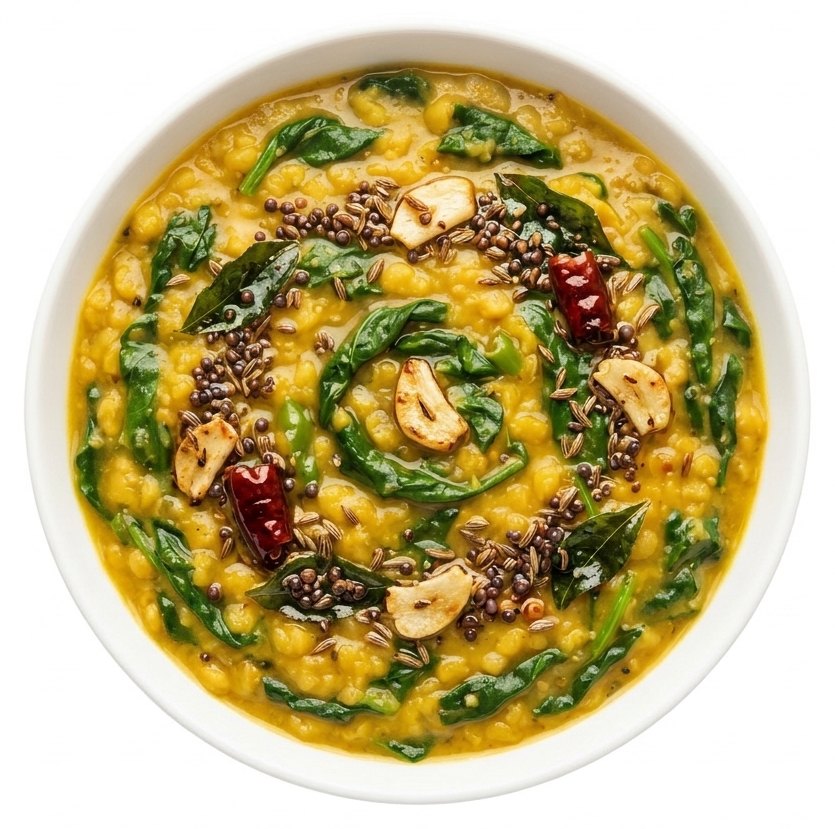
Moog aur Palak ki Dal
A nourishing yellow lentil stew folded with wilted spinach, finished with fresh citrus and a fragrant garlic-and-spice tempering.
Turmeric
0.8 gStirred into the boiling water with the lentils (step 1)Ginger-garlic pastes
10 gSautéed in the hot fat (step 2)Tempering spices
7 gBloomed in the hot oil (step 4)Everything else

Method
- Bring 500 ml water to a rapid boil in a broad, heavy saucepan. Tip in 250 g toor dal along with the turmeric and salt to taste, drop the flame to low, and cook gently for roughly 20 minutes until the pulses soften thoroughly. Strain out any remaining cooking liquid, return the lentils to the pot, crush them lightly using a wooden spoon, and take the pan off the heat.
- Warm 54 g vegetable oil or ghee in a skillet set over medium-low heat. Add the ginger-garlic pastes and fry for 1 minute, then toss in 250 g spinach and cook until wilted and nearly tender.
- Scrape the cooked spinach into the mashed lentils, splash in a little water, and return the pot to medium heat for 5 to 10 minutes. Stir through 24 g green chilli, 1 g coriander leaves, and the juice of 1 lemon.
- Heat 13.5 g vegetable oil in a small frying pan over medium heat. Tip in the tempering spices along with 15–18 g garlic and curry leaf to taste, frying for 1 to 2 minutes until the seeds crackle and the dried chillies deepen in colour. Pour the sizzled oil immediately over the dal, cover with a lid, and simmer for 2 minutes until heated through.
Don't have something?


 Red lentils
Use equal weight. Cooks considerably faster and breaks down into a softer, creamier consistency with an earthier taste.
 Chana dal
Use equal weight. Requires longer soaking and cooking; remains firmer with a nuttier bite and less starchy thickening.
 Split mung beans
Use equal weight. Cooks quickly to a lighter, more delicate, and silky texture.


 Ground ginger
Use 50% of the weight. Mimics turmeric's warm, earthy, rhizome background, but provides none of the golden-yellow colour.
 Saffron
Steep a tiny pinch (0.1 g per 2 g turmeric) in 2 tbsp warm water; use to match the rich golden hue. Contributes an aristocratic, honeyed floral flavour rather than earthy bitterness.


 Peanut oil
Use equal weight; handles high tempering heat well and keeps flavours neutral.
 Butter
Use equal weight; cook over gentle heat to prevent browning the milk solids too quickly.


 Fresh ginger
Use equal weight; peel and grate very finely on a microplane or pound to a fine paste in a mortar.
 Ginger
Use equal weight; mince finely and crush with the flat of a knife before frying.
- Ground ginger
Use 20% of the weight; add directly with the dry spice powders, though it yields an earthier, less pungent profile.


 Garlic
Use equal weight; crush or finely grate to a smooth pulp to replicate the same fresh, pungent moisture in your base gravy.
 Garlic powder
Use 20 to 25% of the weight; mix with a teaspoon of water before adding to oil so it does not burn, noting it lacks the fresh bite.


 Amaranth leaves
Use equal weight; trim tough stems and cook as directed. Yields a very similar melting texture, though red varieties will tint the dish.
 Radish leaves
Use equal weight, finely chopped. Slightly more peppery, so sauté for two minutes longer to soften the bite.
 Mustard greens
Use 75% of the weight, finely shredded. Adds a robust, peppery bitterness; balance with a tiny pinch of sugar if needed.


 Chilli powder
Use 10 to 15% of the weight (about 1/4 teaspoon per chilli); imparts dry pungent heat and reddens the dish without the grassy crunch.
 Dried red chilli
Use 1 dried pod per fresh green chilli; snap in half and temper in hot oil for a deeper, toastier heat.


 Coriander leaf
Use equal weight, chopped fresh and stirred in off the heat or used as garnish. Matches the citrus-herbal profile identically.
 Mint
Use 40% to 50% of the weight; chop finely and add at the very end. Adds fresh herbal brightness, but shifts the aroma toward cool menthol.


 Lime
Use the same weight or juice amount; sharper, so taste before adding all the juice.
 Lemon juice
Use about 45–50 ml for 1 lemon; add off the heat to keep the freshness.
 Dried mango powder
Use 1 tsp for the juice of 1 lemon; add early. Sourness is flatter and less fresh.


- Peanut oil
Use 1:1 by weight. Handles high-heat frying identically and introduces a very subtle, pleasant nuttiness.
 Ghee
Use 1:1 by weight. Yields a much richer, authentic aroma and a glossy, heavier mouthfeel.
 Mustard oil
Use 1:1 by weight. Heat until smoking, then cool slightly before cooking to temper its intensely pungent, sharp mustard kick.


 Dried kashmiri chilli
Use equal weight whole. Fry in hot oil or ghee as tempered spice; gives a richer red colour with slightly milder heat.
 Red chilli powder
Use 50% to 70% of the weight. Stir into the oil with ground spices; distributes heat evenly throughout the dish without whole chilli skins.


 Black mustard seed
Use the same weight. The seeds are smaller and hotter; fry in hot oil until they pop, about 20–30 seconds, and reduce the heat if they darken too fast. The dish will be a little sharper.
 Yellow mustard seeds
Use the same weight. They are milder and larger; fry a few seconds longer until they pop. The finished dish will have less pungency.
 Ground mustard seed
Use 70% of the weight of whole seed, added with the other ground spices rather than fried whole. You lose the popping texture and the heat comes through more evenly.


 Ground cumin
Use 70% of the weight; add with ground spices or sauce bases rather than hot oil tempering, where it scorches quickly and turns bitter.
 Black cumin seeds
Use equal weight for oil tempering. Delivers an earthy profile with an additional musky, smoky, and slightly bitter edge.
 Fennel seed
Use 60% of the weight for tempering; offers comparable warm aroma, but leans sweet and liquorice-like rather than savoury and earthy.


- Garlic paste
Use equal weight. Fry gently in oil or ghee with the ginger; incorporates smoothly into curries without visible minced bits.
- Garlic powder
Use 15% to 20% of the weight (about 1 g for every 5 to 6 g fresh cloves). Whisk into sauces; gives a savoury, toasted garlic flavour without raw pungency.
 Shallot
Use 1.5 times the weight, very finely minced. Sauté until golden; provides savoury allium sweetness, though it lacks garlic's pungent sulphur bite.


 Bay leaf
Fry 1 bay leaf for every 5 curry leaves in hot oil; imparts a warm, woodsy background note, but misses the citrus-sulphury punch entirely.
 Lime juice
Add a small squeeze (about 5 ml per sprig of curry leaves) right before serving; provides sharp citrus top notes without the toasty, herbal aroma.

Similar dishes

- Same: Keoti Dal shares a toor dal base seasoned with ginger, garlic, turmeric, and green chillies, topped with a garlic, mustard seed, cumin seed, and curry leaf tadka.
- Different: Keoti Dal mixes in masoor dal and includes chopped onion and lemon juice, but drops the spinach and dried red chillies used in this dish.

- Same: Both dishes combine toor dal and spinach cooked down and finished with a tempering of vegetable oil, mustard seeds, curry leaves, and chillies.
- Different: Masiyal uses double the spinach, mashes the lentils and greens together, and adds tamarind extract and sambar masala while omitting the garlic, ginger, and cumin used here.

- Same: Rajasthani Palak Dal shares with this dish the spinach-lentil base, turmeric, garlic, mustard seed, cumin seed, lemon souring, salt, and a ghee or oil tempering.
- Different: Rajasthani Palak Dal uses moong dal instead of this dish's toor dal, only 100 g spinach instead of 250 g, and 2 g green bird's-eye chilli instead of 24 g green chilli plus dried red chilli; its tempering is just black mustard seed, cumin seed, and garlic, so it lacks this dish's ginger paste, coriander, curry leaf, and dried red chilli, and it lists 40.5 g ghee or sunflower oil and 895 g water.

- Same: Moong Dal aur Palak also pairs yellow lentils with spinach, using cumin seeds, ginger, green chillies, turmeric, and a finish of citrus.
- Different: Moong Dal aur Palak uses moong dal instead of toor dal, includes asafoetida, and omits the garlic, mustard seeds, curry leaves, and dried red chillies used in this dish's tempering.