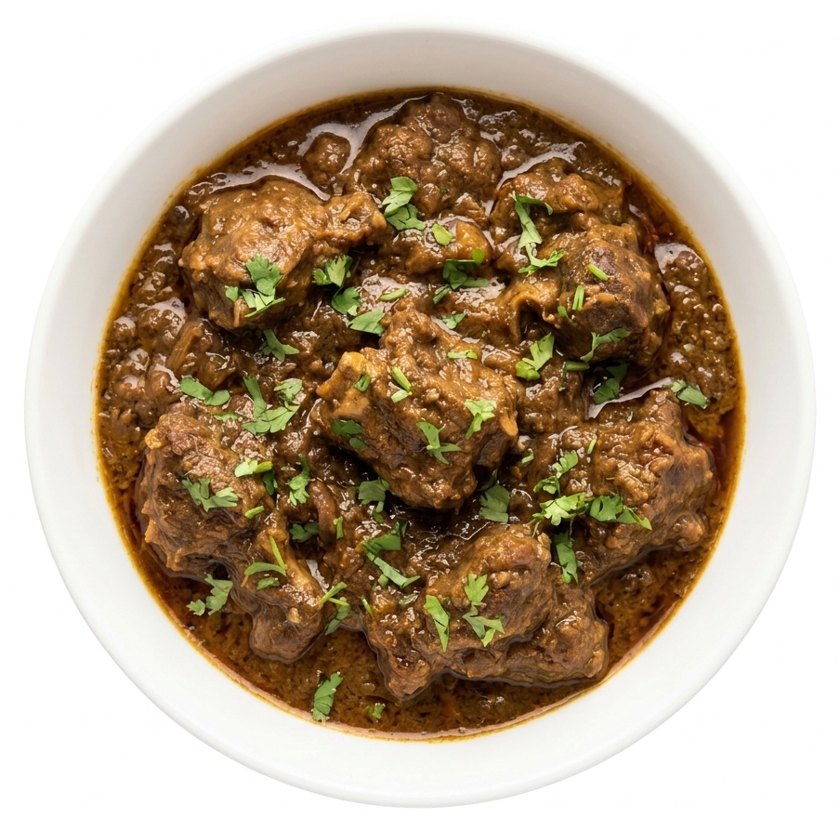
Kossha Mangsho
A rich, slow-cooked Bengali-style lamb curry simmered in mustard oil and yogurt until the sauce is deeply savoury, thick, and clinging to tender meat.
Marinade spices
4.1 gWhisked into the marinade (step 1)Ginger-garlic paste
47 gFried with the green chillies (step 3)Sauce spices
8 gAdded to the pan with the yogurt and meat (step 4)Finishing spice
5 gStirred into the curry at the end of simmering (step 6)Everything else


Method
- In a wide bowl, combine 259 g yogurt, 27 g mustard oil, 4.2 g granulated sugar, and the marinade spices. Add 1000 g lamb, turning to coat every piece thoroughly, then cover and chill in the fridge for 1 hour.
- Warm 114 g mustard oil in a large kadhai or deep frying pan set over medium heat. Add 300 g sliced onion and cook, stirring frequently, for 5 to 7 minutes until richly browned.
- Add the ginger-garlic paste and 6.6 g chopped green chilli, frying for 2 to 3 minutes until the raw smell dissipates.
- Raise the heat to high. Tip in 517 g yogurt, 12.6 g granulated sugar, the sauce spices, the marinated meat along with all of its marinade, and salt to taste. Cook vigorously, stirring continuously, for 5 to 10 minutes.
- Pour in 1 litre of water. Bring to a gentle boil, then cover with a tight lid, reduce the heat to low, and simmer for 1 to 1½ hours until the meat is completely tender and the sauce has reduced to a thick coating.
- Fold in the finishing spice, taste to adjust the salt, and scatter 1 g chopped coriander leaf over the top.
Don't have something?


 Boneless lamb shoulder
Use same weight; shoulder is well marbled and best for slow curry, with similar cooking time.
 Boneless leg of lamb
Use same weight; leg is leaner, so simmer 10 minutes less to avoid dryness.
 Boneless lamb fillet
Use same weight but simmer 15–20 minutes less; fillet is tender and cooks quickly.


 Peanut oil
Use equal weight. It handles high-heat cooking well, but lacks the signature pungent, nasal heat of mustard oil.
 Vegetable oil
Use equal weight. Neutral in flavour, so your curry will lack the characteristic Bengali or North Indian pungent punch.






 Fresh ginger
Use equal weight; peel and grate very finely on a microplane or pound to a fine paste in a mortar.
 Ginger
Use equal weight; mince finely and crush with the flat of a knife before frying.
 Ground ginger
Use 20% of the weight; add directly with the dry spice powders, though it yields an earthier, less pungent profile.


 Garlic
Use equal weight; crush or finely grate to a smooth pulp to replicate the same fresh, pungent moisture in your base gravy.
 Garlic powder
Use 20 to 25% of the weight; mix with a teaspoon of water before adding to oil so it does not burn, noting it lacks the fresh bite.


 Chilli powder
Use 10 to 15% of the weight (about 1/4 teaspoon per chilli); imparts dry pungent heat and reddens the dish without the grassy crunch.
 Dried red chilli
Use 1 dried pod per fresh green chilli; snap in half and temper in hot oil for a deeper, toastier heat.


 Plain yogurt
Use 100% of the weight. Whisk thoroughly until smooth before stirring into warm gravies to prevent curdling.
 Single cream
Use 90% of the weight combined with 10% lemon juice to replicate the lactic tang and rich body in marinades and curries.


 Red chilli powder
Use 100% of the weight. Provides direct, sharp heat and red colour in equal measure.
 Kashmiri chilli powder
Use 150% to 200% of the weight if matching colour, but add a pinch of black pepper or hot chilli if you need equivalent fiery heat.
 Cayenne pepper
Use 75% to 100% of the weight. Offers a sharp, clean heat with slightly less earthy depth and less crimson colour.


- Ground ginger
Use 50% of the weight. Mimics turmeric's warm, earthy, rhizome background, but provides none of the golden-yellow colour.
 Saffron
Steep a tiny pinch (0.1 g per 2 g turmeric) in 2 tbsp warm water; use to match the rich golden hue. Contributes an aristocratic, honeyed floral flavour rather than earthy bitterness.


 Jaggery
Use equal weight; grate or shave finely so it dissolves rapidly, giving a warm, caramel-like sweetness and slightly darker sauce.


 Black cardamom seeds
Use equal weight; grind freshly in a mortar or spice mill for an even more vibrant camphor-and-smoke aroma.
 Black cardamom pod
Use 2.5 times the weight in whole pods; crack open, extract the sticky seeds, and grind to a fine powder, discarding the husks.
 Garam masala
Use 60% of the weight; provides some warm resinous smokiness if it contains black cardamom, though it adds cinnamon and clove notes.


Similar dishes

- Same: Bhuna Keema also uses lamb cooked with onions, ginger, garlic, ground turmeric, chilli powder, green chillies, and fresh coriander.
- Different: Bhuna Keema dry-fries minced lamb in vegetable oil with lemon juice and mint, whereas this dish slow-cooks lamb in mustard oil with a large amount of yogurt, sugar, and ground black cardamom.

- Same: Bhuna Gosht (I) shares the slow-cooked method of reducing spiced onion, ginger, garlic, turmeric, and chilli powder until a thick coating clings tightly to the lamb.
- Different: Bhuna Gosht (I) cooks with neutral vegetable oil instead of mustard oil and omits the yogurt, black cardamom, sugar, green chillies, and fresh coriander used in this dish.

- Same: Both dishes feature lamb seasoned with ginger, garlic, chilli powder, and turmeric.
- Different: Tala Gosht is pan-fried in vegetable oil without the onions, yogurt, sugar, green chillies, black cardamom, or mustard oil used in this slow-cooked curry.
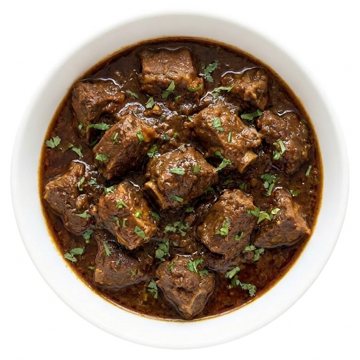
- Same: Both are slow-cooked lamb curries prepared with ginger paste, garlic paste, turmeric, and chilli powder.
- Different: Chippa Gosht is cooked in an earthenware pot using neutral vegetable oil and finished with lemon juice, omitting this dish's yogurt, onions, mustard oil, sugar, and black cardamom.