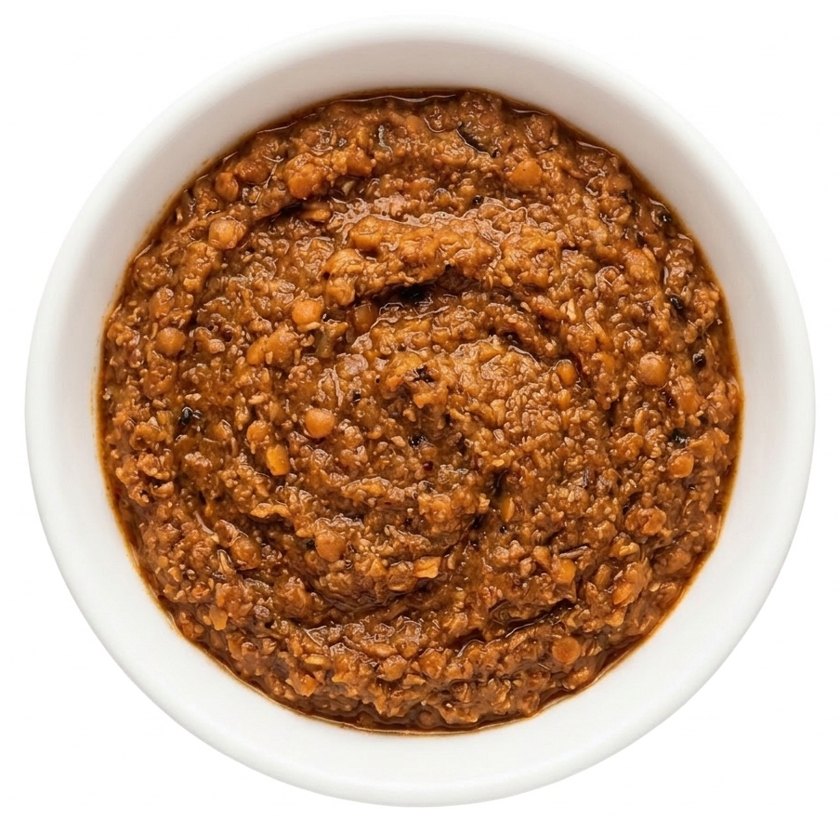
Masoor ki Chutney
A tangy, savoury condiment made from roasted red lentils, coconut, and tamarind, finished with an aromatic mustard and onion tempering.
Chutney base spices
7 gFried after the lentils (step 2)Garlic paste
2.6 gAdded to the blender (step 3)Tempering spices
3.6 gBloomed in hot oil (step 4)Everything else

Method
- Warm 13.5 g vegetable oil in a frying pan over medium heat, stir in 4 tablespoon red lentils, and cook for 1 to 2 minutes until they turn lightly golden, then transfer them to a plate.
- Add the chutney base spices to the remaining oil in the skillet and toast for about 1 minute until the seeds crackle, then scrape into a blender.
- Place the cooked lentils, 132 g tamarind extract, 120 g dried coconut, the garlic paste, and salt to taste into the blender, then grind until smooth and transfer the puree to a bowl.
- Heat 4.5 g vegetable oil in the pan over medium heat, then fry 1.5 g curry leaf along with the tempering spices for 1 to 2 minutes until they darken in colour.
- Mix in 150 g chopped onion and sauté for around 5 minutes until browned.
- Tip the hot tempering into the lentil chutney, mix completely, and allow to cool before chilling in an airtight container for up to 2 days.
Don't have something?


 Peanut oil
Use 1:1 by weight. Handles high-heat frying identically and introduces a very subtle, pleasant nuttiness.
 Ghee
Use 1:1 by weight. Yields a much richer, authentic aroma and a glossy, heavier mouthfeel.
 Mustard oil
Use 1:1 by weight. Heat until smoking, then cool slightly before cooking to temper its intensely pungent, sharp mustard kick.


 Whole brown lentil
This is the same lentil under another name; use the same weight and soak and cook as directed.
 Red lentils
Use the same weight; split red lentils cook faster and break down more, so reduce water and check after 15 minutes.
 Pigeon peas
Use the same weight; it holds its shape better and needs 10–15 minutes longer, with a milder, less earthy flavour.


 Dried kashmiri chilli
Use equal weight whole. Fry in hot oil or ghee as tempered spice; gives a richer red colour with slightly milder heat.
 Red chilli powder
Use 50% to 70% of the weight. Stir into the oil with ground spices; distributes heat evenly throughout the dish without whole chilli skins.


 Ground coriander
Use 75% of the weight; stir in along with wet masala or tomato purée rather than frying in hot oil, as the fine powder burns instantly.
 Cumin seed
Use 50% of the weight for tempering in hot oil. Lacks the floral, sweet citrus flavour of coriander, introducing warm, pungent earthiness instead.
 Fennel seed
Use 50% of the weight in tempering; provides pleasant aromatic sweetness, though noticeably aniseedy rather than citrusy.


 Ground cumin
Use 70% of the weight; add with ground spices or sauce bases rather than hot oil tempering, where it scorches quickly and turns bitter.
 Black cumin seeds
Use equal weight for oil tempering. Delivers an earthy profile with an additional musky, smoky, and slightly bitter edge.
- Fennel seed
Use 60% of the weight for tempering; offers comparable warm aroma, but leans sweet and liquorice-like rather than savoury and earthy.


 Garlic powder
Use double the weight. Stir into hot oil just before adding wet ingredients; mimics the allium savoury background without the sulphurous edge.
 Garlic paste
Use 2 g for every 0.5 g of asafoetida. Sauté in oil until the raw smell clears; adds moisture and sweet allium depth.


 Tamarind
Use 180% of the weight of compressed tamarind; soak in three times its weight of boiling water for 15 minutes, knead, and strain out the thick pulp.
 Dried mango powder
Use 35% of the weight dissolved in two tablespoons of warm water. Provides sharp tang, though the resulting sauce will be lighter in colour.
 Lemon juice
Use equal weight, added right at the end of cooking. Adds sharp acidity without the deep brown hue or pulpy thickness.


 Desiccated coconut
Use equal weight; texture is much finer, so roast very cautiously over low heat if the recipe requires browning for spice pastes.
 Fresh coconut
Finely slice or grate and use 140% of the weight to offset the extra water, or dry-roast in a bare pan until moisture evaporates completely.


 Garlic
Use equal weight; crush or finely grate to a smooth pulp to replicate the same fresh, pungent moisture in your base gravy.
- Garlic powder
Use 20 to 25% of the weight; mix with a teaspoon of water before adding to oil so it does not burn, noting it lacks the fresh bite.


 Bay leaf
Fry 1 bay leaf for every 5 curry leaves in hot oil; imparts a warm, woodsy background note, but misses the citrus-sulphury punch entirely.
 Lime juice
Add a small squeeze (about 5 ml per sprig of curry leaves) right before serving; provides sharp citrus top notes without the toasty, herbal aroma.


 Black mustard seed
Use the same weight. The seeds are smaller and hotter; fry in hot oil until they pop, about 20–30 seconds, and reduce the heat if they darken too fast. The dish will be a little sharper.
 Yellow mustard seeds
Use the same weight. They are milder and larger; fry a few seconds longer until they pop. The finished dish will have less pungency.
 Ground mustard seed
Use 70% of the weight of whole seed, added with the other ground spices rather than fried whole. You lose the popping texture and the heat comes through more evenly.





Similar dishes

- Same: Both dishes rely on tamarind extract for sourness and share a spice profile of cumin, coriander seeds, asafoetida, and a tempering of mustard seeds, curry leaves, and dried red chillies.
- Different: Masoor Pappu Charu is a soupy dish cooked with ghee, black peppercorns, turmeric, and fresh coriander, whereas this dish is a ground condiment containing dried coconut and garlic paste.

- Same: Both dishes rely on tamarind extract for sourness and share a tempering of mustard seeds, dried red chillies, and curry leaves.
- Different: Jeera Rasam is a thin broth tempered in ghee with cumin seeds, toor dal, and rasam podi, whereas this dish is a thick condiment containing coconut, red lentils, onions, and garlic cooked in vegetable oil.

- Same: The Rasam shares tamarind souring, vegetable oil, dal, and a mustard seed, dried red chilli, asafoetida, and curry leaf tempering with this dish.
- Different: The Rasam uses toor dal, tomato, turmeric, black peppercorn, and more cumin and coriander instead of this dish's roasted masoor dal, coconut, onion, and garlic paste, and it is a thin broth rather than a thick chutney.

- Same: Puragayalu Pulussu also uses vegetable oil, tamarind for sourness, and a tempering of mustard seeds, cumin, curry leaves, dried red chillies, and asafoetida.
- Different: Instead of being a blended coconut and onion condiment, it is a vegetable stew thickened with chana dal, urad dal, and rice, adding turmeric and fenugreek seeds while omitting the dried coconut and garlic.