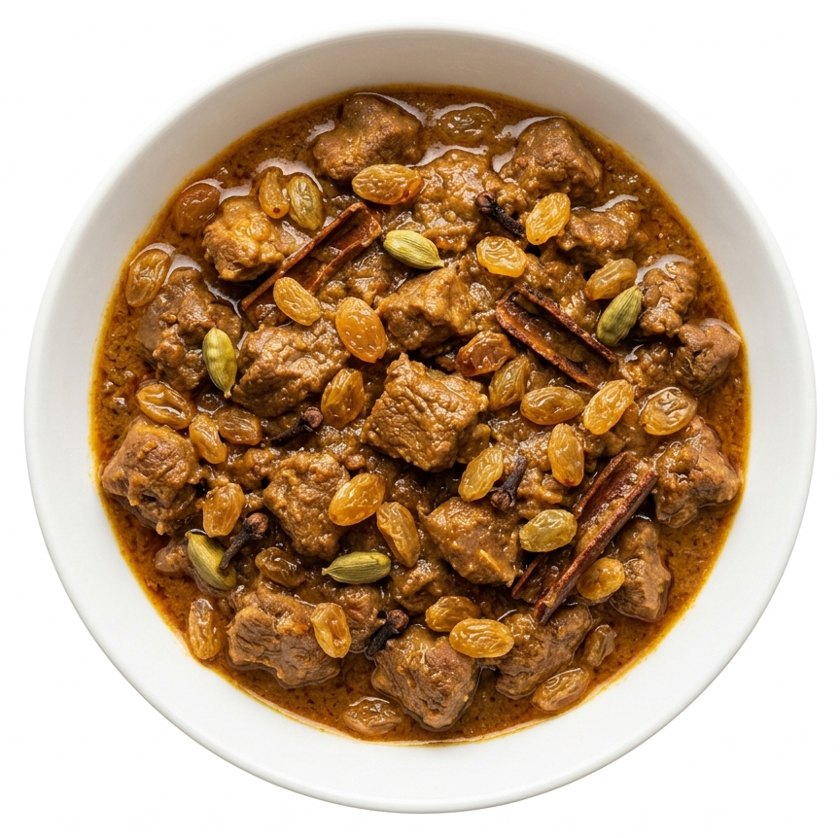
Kashmiri Qorma
A fragrant, slow-cooked lamb curry enriched with whole sweet spices, tamarind, and sugar, finished with saffron milk and plump fried raisins.
Whole spices
10 gFried with the lamb and ghee (step 3)Saffron
0.3 gInfused in warm milk (step 2) and added at the finish (step 5)Everything else

Method
- Submerge 750 g lamb in a pot of cold water, bring to a rolling boil, and boil for 1 minute. Drain the meat completely and set aside.
- Place the saffron in a small bowl, pour in 1 tbsp warm milk, and leave to infuse.
- Melt 125 g ghee in a shallow pan over medium heat. Add the blanched lamb and the whole spices, then fry for 2 to 3 minutes.
- Pour in 250 ml water and season with salt to taste, bringing the pan to a boil. Stir in 3 tbsp garlic water, 12.6 g granulated sugar, and 10.4 g tamarind extract. Simmer gently for 1 to 1½ hours, until the lamb is fully tender and the cooking liquid has completely evaporated.
- Add the infused saffron mixture and 145 g fried raisins, stirring well over low heat until warmed through.
Don't have something?




 Ground turmeric
Use 15% of the saffron's weight. Replicates the bright yellow colour well, but lacks the floral, earthy depth; use sparingly to avoid bitterness.
 Screwpine water or rosewater
Use a few drops combined with a tiny pinch of ground turmeric to mimic both the regal floral aroma and the golden hue.



 Whole milk
Use equal weight; provides the standard rich dairy fat and body expected in creamy Indian bases.
 Single cream
Dilute 3 parts cream with 1 part water to match the weight; yields a richer, glossier gravy that resists curdling.
 Plain yogurt
Whisk thoroughly and use equal weight; adds extra body and a mild pleasant acidity, best added off the heat.


 Unsalted butter
Use 120% of the weight; melt gently over low heat to avoid burning the milk solids, which will yield a softer, creamier richness rather than a nutty aroma.
 Vegetable oil
Use 85% of the weight; holds high cooking temperatures without smoking, but the final dish will lack traditional dairy depth.
 Mustard oil
Use equal weight; heat to smoking point and cool slightly before cooking, bearing in mind it introduces an assertive, pungent edge.


 Green cardamom seed
Use 35 to 40% of the total pod weight; lightly bruise the seeds before frying in oil to release their essential oils.
 Ground green cardamom
Use 20 to 25% of the pod weight (about 1 generous pinch per pod); stir in toward the end of cooking so the delicate floral notes do not dissipate.
 White cardamom pod
Use 1:1 by pod count or weight; crack gently before using, though it is slightly less intensely floral.


 Ceylon cinnamon
True cinnamon: thinner, papery quills, milder and sweeter. Use about 1.5 times the weight, and taste.
 Ground cinnamon (cassia)
Use about a third of the weight (0.5 g ground for a 2.5 cm piece), stirred in with the ground spices rather than fried whole, since the powder burns quickly.
 Cassia buds
Use 60-70% of the weight; stronger and more peppery, so taste before adding more.


 Ground cloves
Use 1 g ground for 4 g whole (or 1 small pinch per 2 to 3 whole cloves). Add with spice powders; disperses intense warmth quickly, so use with restraint.
 Allspice berries
Use 100% of the weight whole in tempering. Imparts a warm, clove-like aromatic profile combined with hints of nutmeg and cinnamon.
 Black cardamom pod
Use 1 pod for 3 to 4 cloves in whole tempering. Shares a camphor-like warmth and medicinal depth, though it introduces a distinct smoky undertone.


 Water
For 100 g garlic water, steep 5 g crushed garlic in 100 g water for 10 minutes and strain; use the same weight.
 Garlic paste
Thin 5 g garlic paste with 95 g water for 100 g garlic water; strain if the recipe needs a clear liquid.


 Jaggery
Use equal weight; grate or shave finely so it dissolves rapidly, giving a warm, caramel-like sweetness and slightly darker sauce.


 Tamarind
Use 180% of the weight of compressed tamarind; soak in three times its weight of boiling water for 15 minutes, knead, and strain out the thick pulp.
 Dried mango powder
Use 35% of the weight dissolved in two tablespoons of warm water. Provides sharp tang, though the resulting sauce will be lighter in colour.
 Lemon juice
Use equal weight, added right at the end of cooking. Adds sharp acidity without the deep brown hue or pulpy thickness.


 Dried plum
Use equal weight, pitted and finely chopped. Lends a deeper, slightly more tart sweetness to curries and rice dishes.
 Cashew nut
Use equal weight. Fry lightly in ghee until golden; substitutes the burst of sweetness with a rich, buttery crunch.
- Jaggery
Use 30% of the weight, finely grated. Dissolve straight into the sauce to match the intended sweetness, though without the fruity chew.


Similar dishes

- Same: Aab Gosht also braises lamb in ghee with green cardamom, cinnamon, and cloves.
- Different: Rather than using tamarind, sugar, raisins, and saffron, Aab Gosht simmers the meat in over a liter of milk with boiled onion paste, garlic, ginger, fennel seed, and black peppercorns.
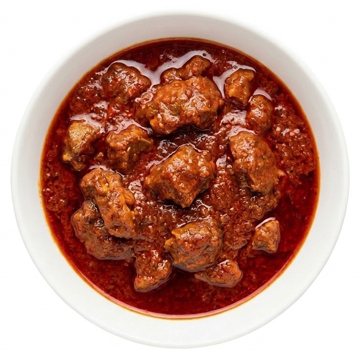
- Same: Roghanjosh also slow-cooks lamb in ghee with saffron, cinnamon, and cloves.
- Different: Roghanjosh braises the meat in a yogurt base spiced with fresh and ground ginger, asafoetida, chilli powder, and garam masala, omitting this dish's raisins, cardamom, and tamarind.

- Same: Both dishes are slow-cooked lamb curries prepared in ghee with whole green cardamom, cinnamon, and cloves.
- Different: Meat Beliram builds its sauce on a large base of onions, yogurt, ginger, garlic, coriander seeds, and chili powder, omitting this dish's saffron, tamarind, sugar, and raisins.

- Same: Mutanjan Pulao shares lamb, saffron, green cardamom, clove, cinnamon, ghee, and sugar with this dish.
- Different: It is a layered basmati rice dish with 2069 g milk, blanched almonds, sultanas, onion, ginger, cumin, black peppercorn, ground coriander, and a dough seal, and it lacks this dish’s tamarind extract and garlic water.