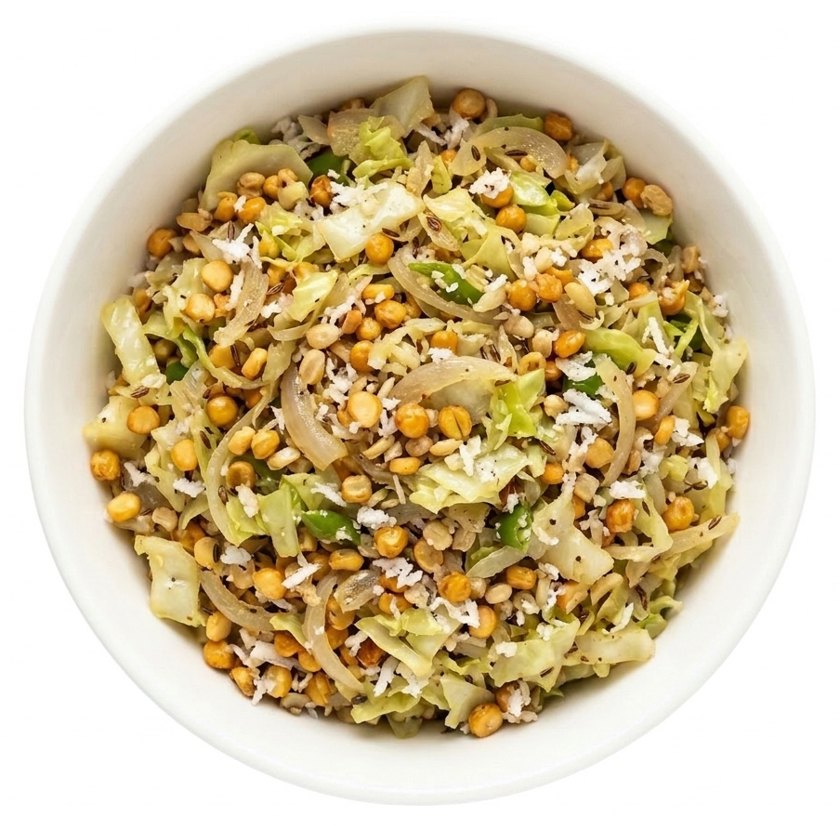
Kosu Podi
A lightly spiced South Indian cabbage stir-fry infused with crisp fried lentils, fresh chillies, and sweet grated coconut.
Tempering spice
1.1 gFried with the lentils (step 2)Garlic seasoning
5 gStir-fried with the onions (step 3)Everything else

Method
- Place 225 g cabbage into a heavy pan with 125 ml water and a pinch of salt. Cover with a lid and simmer over low heat for 10 minutes until tender, then remove from the heat and set aside.
- Warm 27 g vegetable oil in a wide frying pan over medium heat. Tip in 12.6 g chana dal, 2.1 g urad dal, and the tempering spice, then stir-fry for roughly 1 minute until the lentils take on a deep brown colour.
- Add 150 g onion and the garlic seasoning, sautéing for about 5 minutes until the onion turns golden brown.
- Transfer the cooked cabbage into the pan and stir-fry for a few minutes until all residual moisture has evaporated.
- Toss in 100 g coriander leaf, 36–48 g green chilli, and salt to taste. Stir well to combine, then take the pan off the heat.
- Scatter 18 g fresh coconut over the cabbage, mix thoroughly, and serve.
Don't have something?


 Sweetheart cabbage
Use 100% of the weight. Finely shred; cooks slightly faster than firm white cabbage and gives a sweeter, tender crunch in thorans and sabzis.
- Savoy cabbage
Use 100% of the weight. Shred finely; holds its shape well when stir-fried and carries spiced oil effectively.
 Brussels sprouts
Use 90% of the weight. Finely shred or halve; offers an identical brassica crunch and slight peppery bite.


 Peanut oil
Use 1:1 by weight. Handles high-heat frying identically and introduces a very subtle, pleasant nuttiness.
 Ghee
Use 1:1 by weight. Yields a much richer, authentic aroma and a glossy, heavier mouthfeel.
 Mustard oil
Use 1:1 by weight. Heat until smoking, then cool slightly before cooking to temper its intensely pungent, sharp mustard kick.


 Yellow split peas
Use 100% of the weight. Soak for at least 1 hour; takes about 10 minutes longer to cook through and has a marginally earthier flavour.
 Pigeon peas
Use 100% of the weight. Reduces cooking time by about 10 minutes and breaks down softer, giving a smoother consistency rather than distinct grains.
 Black gram
For tempering or tadka only: use 70% of the weight. Browns faster in hot oil, providing a nutty, crunchy bite.


 Whole black gram
Use equal weight. Needs longer soaking and cooking; the dark skins impart an earthy flavour and greyish-black hue unless thoroughly rubbed off.
- Chana dal
Use equal weight when tempering (tadka). Provides a comparable nutty, crunchy texture in hot oil, though grains are slightly larger.
 Split mung beans
Use equal weight for batters or dals. Ferments and cooks faster, producing a lighter, less sticky, and less viscous consistency.


 Ground cumin
Use 70% of the weight; add with ground spices or sauce bases rather than hot oil tempering, where it scorches quickly and turns bitter.
 Black cumin seeds
Use equal weight for oil tempering. Delivers an earthy profile with an additional musky, smoky, and slightly bitter edge.
 Fennel seed
Use 60% of the weight for tempering; offers comparable warm aroma, but leans sweet and liquorice-like rather than savoury and earthy.






 Garlic powder
Use equal weight (1:1). Behaves virtually identically, dissolving seamlessly into dry rubs or wet gravies.
 Garlic paste
Use 300% to 400% of the weight (e.g. 3–4 g paste for 1 g ground). Sauté in oil to cook off the raw moisture; imparts a fresher, sharper punch.
 Garlic
Finely mince or grate fresh cloves; use 300% to 400% of the weight. Fry gently in oil early in the cooking process to mellow the pungency.


 Chilli powder
Use 10 to 15% of the weight (about 1/4 teaspoon per chilli); imparts dry pungent heat and reddens the dish without the grassy crunch.
 Dried red chilli
Use 1 dried pod per fresh green chilli; snap in half and temper in hot oil for a deeper, toastier heat.



 Desiccated coconut
Use 50% to 60% of the weight, soaked in equal parts warm water for 15 minutes before grinding. Works well for chutneys, though texture is slightly finer and sweeter.
 Coconut milk
Use 1.2 times the weight in curries. Adds creamy richness and authentic flavour, but makes gravies smoother and eliminates the grated, chewy mouthfeel.


Similar dishes

- Same: Kaikari Masala Vada also uses cabbage, onion, green chillies, and coriander, alongside chana dal and urad dal cooked in vegetable oil.
- Different: Instead of being a cabbage stir-fry, it is a deep-fried lentil patty based heavily on soaked dals, adding ginger and curry leaves while omitting this dish's cumin seeds, garlic, and fresh coconut.

- Same: Muttokos Thoran is also a South Indian cabbage stir-fry cooked with urad dal, cumin seeds, fresh coconut, and green chillies.
- Different: Muttokos Thoran tempers mustard seeds, curry leaves, dried red chilli, and shallots with a coconut paste, omitting the chana dal, garlic, regular onion, and fresh coriander leaf used in this dish.

- Same: Karam Kalle ka Raita also features cabbage seasoned with cumin seeds, green chillies, and fresh coriander.
- Different: It mixes the cabbage uncooked into plain yoghurt with sugar and chilli powder, omitting this dish's vegetable oil, fried chana and urad dal, onion, garlic, and coconut.

- Same: Like this dish, Muttakose Kilangu is a South Indian stir-fry tempered with chana dal, urad dal, green chillies, and fresh grated coconut in vegetable oil.
- Different: Muttakose Kilangu uses mustard seeds and curry leaves in more oil, but omits the cumin seeds, onion, garlic, and fresh coriander leaves found in this dish.