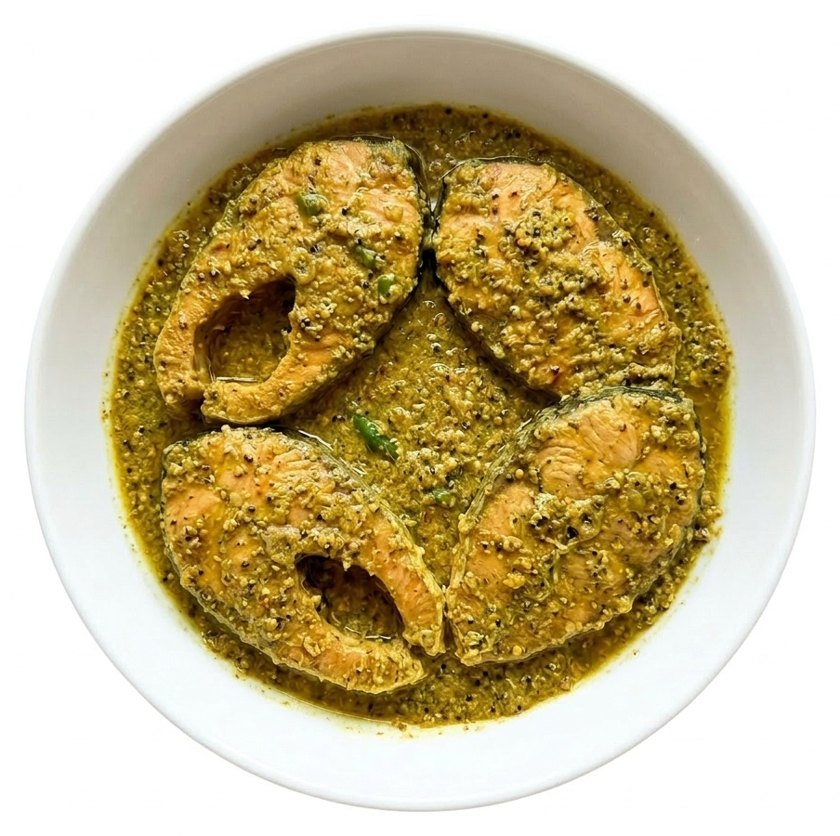
Bengali Bhapa Maach
Bengali bhapa maach is fish steak coated in a pungent mustard and green chilli paste, then steamed in paper. It tastes sharp, hot and lightly sweet from the coconut and sugar.
Marinade turmeric
1.5 gRubbed into the fish marinade (step 2)Mustard paste spices
34 gSoaked and then blended into the paste (steps 1 and 3)Everything else

Method
- Soak 9.9 g yellow mustard seed and 19.2 g black/brown mustard seed in 79.5 g water for 30 minutes.
- Rub 800 g fish steak with 25 g lemon juice, 1.5 g ground turmeric (the marinade turmeric) and salt; leave for 15–20 minutes.
- Blend 4 g green bird’s eye chilli, 24 g drained coconut, 0.3 g sugar, salt, the mustard paste spices (the soaked mustard seeds plus 1.2 g kashmiri chilli powder and 1.5 g ground turmeric) and half the soaking water to a thick smooth paste; add more soaking water only if needed. Coat the fish with the paste.
- Set up a steamer with water below the trivet and bring the water to a boil.
- Wrap each fish piece in greaseproof paper, put it in the steamer, cover and steam for 18–20 minutes, until the fish is cooked through.
Don't have something?


 Firm white fish fillet
Use the same weight; cook 2–3 minutes less than a bone-in steak because fillets are thinner and cook faster.
 Salmon steak
Use the same weight; richer and oilier, with similar cooking time, but the flavour is stronger.
 Firm fish fillet
Use the same weight and reduce cooking time slightly; it lacks the bone and may break up more in curries.


 Lime
Use the same weight or juice amount; sharper, so taste before adding all the juice.
 Lemon juice
Use about 45–50 ml for 1 lemon; add off the heat to keep the freshness.
 Dried mango powder
Use 1 tsp for the juice of 1 lemon; add early. Sourness is flatter and less fresh.


 Ground ginger
Use 50% of the weight. Mimics turmeric's warm, earthy, rhizome background, but provides none of the golden-yellow colour.
 Saffron
Steep a tiny pinch (0.1 g per 2 g turmeric) in 2 tbsp warm water; use to match the rich golden hue. Contributes an aristocratic, honeyed floral flavour rather than earthy bitterness.


 Mustard seed
Use the same weight for tempering. It is the closest match; watch the heat because it can pop faster than yellow mustard seed.
 Black mustard seed
Use the same weight, or 75% if you want less heat. It is sharper and more pungent; temper in hot oil as usual.
 Mustard powder
Use about half the weight of whole seed, mix with a little water and add near the end. It will not give the same whole-seed crunch in a tempering.


- Mustard seeds
Use equal weight. Pop in hot fat until they crackle and turn greyish; yields an almost identical nutty, pungent finish.
- Yellow mustard seeds
Use equal weight. Fry over medium heat; delivers a milder, sweeter pop and turns bitter quickly if the oil is excessively hot.


 Stock
Use the same weight in savoury dishes; it adds body, so adjust salt.
 Milk
Use the same weight only in doughs or creamy dishes; it makes the result richer.
 Coconut water
Use the same weight in curries or rice; it adds sweetness and a faint coconut taste.


- Bird's eye green chilli
Use the same weight; heat and flavour are very close.
 Green chilli
Use 1.5 to 2 times the weight; deseed for less heat. Larger chillies are more watery.
 Fresh green chilli
Use 1.5 to 2 times the weight; chop finely and adjust heat by tasting.


 Fresh coconut
Use the same weight and grate finely. This is the direct fresh substitute; keep the same cooking time.
 Grated desiccated coconut
Use the same weight, then soak in warm water for 10 minutes and squeeze dry. Drier and less sweet; add a splash of water if the dish looks dry.
 Desiccated coconut
Use the same weight, soak in warm water for 10–15 minutes, then squeeze. Coarser and drier than fresh; good for curries and chutneys.


 Jaggery
Use equal weight; grate or shave finely so it dissolves rapidly, giving a warm, caramel-like sweetness and slightly darker sauce.


 Kashmiri chilli powder
Use the same weight; this is the first half of the book's option and gives the best red colour with mild heat.
 Mild paprika
Use the same weight; add a pinch of cayenne pepper for warmth. Slightly less colour.
- Paprika
Use the same weight and add cayenne pepper to taste; works but is less aromatic.


Similar dishes

- Same: Paturi Maachh shares with this dish a fish coated in a pungent paste of yellow mustard seed, black mustard seed and green chilli, with turmeric, sugar and salt.
- Different: Paturi Maachh is wrapped in banana leaf and griddled, uses mustard oil but no lemon, coconut, water or Kashmiri chilli powder, and has more green chilli and mustard oil per gram of fish.

- Same: Both are Bengali fish dishes that use turmeric, mustard seed and green chilli.
- Different: Doi Maachh uses yogurt as its sauce base and mustard oil, and it sears then simmers the fish; this dish has no yogurt or mustard oil and is steamed in paper with lemon, coconut, sugar, black mustard seed and Kashmiri chilli powder.

- Same: Kothmiratil Machhi shares fish, turmeric, green chilli, salt and a souring agent with this dish.
- Different: Kothmiratil Machhi uses rice flour, vegetable oil, coriander, ginger and garlic and is fried, while this dish uses mustard seeds, coconut and steaming in paper.

- Same: Lal Machhali and this dish both use fish, ground turmeric, desiccated coconut, chilli and a small amount of sugar, and both are sour.
- Different: Lal Machhali uses firm white fish fillet simmered in a gravy with vegetable oil, garlic, dried red chilli, lime juice and malt vinegar, while this dish uses fish steak coated with yellow and black mustard seeds, green bird’s eye chilli and lemon and is steamed in paper.