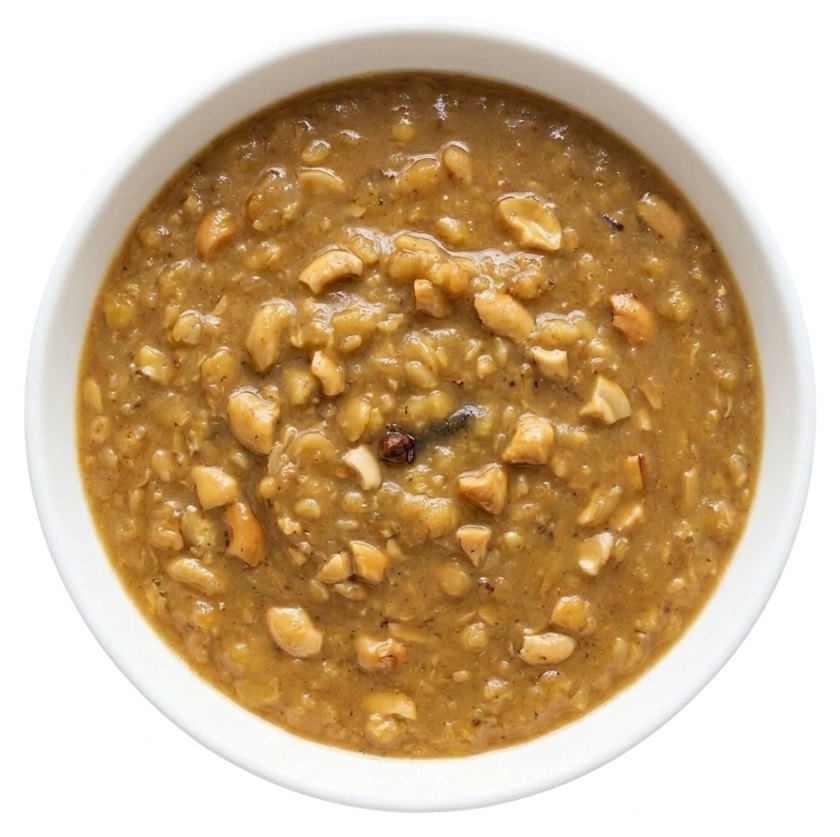
Paruppu Payasam
A South Indian sweet pudding made from moong dal simmered with jaggery, cardamom and coconut milk, with cashews for texture. It is creamy, gently sweet and lightly spiced.
Whole spices for the oil
0.4 gAdded to the hot ghee and oil at the start (step 2)Ground cardamom for finishing
1.4 gStirred in with the jaggery water and cashews (step 10)Everything else
Method
- Heat 28.2 g butter or ghee and 13.5 g vegetable oil in a saucepan over low heat.
- Add the whole spices for the oil (0.4 g clove) and fry for a few seconds.
- Add 200 g moong dal and fry, stirring, for 8–9 minutes, until it turns a deeper golden colour.
- Pour in 495 g of the 795 g warm water slowly so it does not spit.
- Raise the heat slightly and bring to the boil, then cover and simmer over low heat for 50 minutes, stirring a few times.
- While the dal cooks, dissolve 200 g jaggery in the remaining 300 g warm water in a separate saucepan.
- Simmer the jaggery water gently for 10–15 minutes, then set aside to cool slightly.
- Uncover the dal and mash it lightly to thicken the mixture, then cook for 5 minutes more, stirring so it does not catch.
- Stir the jaggery water into the dal.
- Add the ground cardamom for finishing (1.4 g) and 9 g cashew nut, stir well, and simmer uncovered for 10 minutes.
- Add 152 g coconut milk and simmer for 2–3 minutes more.
- Turn off the heat and serve warm or cold; the payasam thickens as it cools.
Don't have something?


 Ghee
Use the same weight. Gives a richer aroma and nuttier taste; if the dish already uses butter for finishing, ghee can make it slightly heavier.
 Butter
Use the same weight. Lower smoke point than ghee, so keep the heat moderate; if unsalted, add a small pinch of salt.
 Vegetable oil or ghee
Use about 90% of the weight. Less rich flavour; good when you want a lighter result.


 Peanut oil
Use 1:1 by weight. Handles high-heat frying identically and introduces a very subtle, pleasant nuttiness.
- Ghee
Use 1:1 by weight. Yields a much richer, authentic aroma and a glossy, heavier mouthfeel.
 Mustard oil
Use 1:1 by weight. Heat until smoking, then cool slightly before cooking to temper its intensely pungent, sharp mustard kick.


 Ground cloves
Use 1 g ground for 4 g whole (or 1 small pinch per 2 to 3 whole cloves). Add with spice powders; disperses intense warmth quickly, so use with restraint.
 Allspice berries
Use 100% of the weight whole in tempering. Imparts a warm, clove-like aromatic profile combined with hints of nutmeg and cinnamon.
 Black cardamom pod
Use 1 pod for 3 to 4 cloves in whole tempering. Shares a camphor-like warmth and medicinal depth, though it introduces a distinct smoky undertone.



 Red lentils
Use equal weight. It cooks in about the same time and breaks down to a similar soft, creamy consistency, though the colour will be slightly pinkish-orange.
 Pigeon peas
Use equal weight. Requires longer soaking and cooking time, and produces a slightly earthier, denser dal.


 Stock
Use the same weight in savoury dishes; it adds body, so adjust salt.
 Milk
Use the same weight only in doughs or creamy dishes; it makes the result richer.
 Coconut water
Use the same weight in curries or rice; it adds sweetness and a faint coconut taste.


 Granulated sugar
Use 80% of the weight. Granulated sugar is sweeter by weight, but gives a cleaner, one-dimensional sweetness that lacks jaggery's caramel, molasses depth.
 Raisin
Soak and blend into a paste; use 100% to 120% of the weight. Adds rich, natural, fruity sweetness with complex, dark molasses notes that thicken the gravy.


 Green cardamom seed
Use 35 to 40% of the total pod weight; lightly bruise the seeds before frying in oil to release their essential oils.
 Ground green cardamom
Use 20 to 25% of the pod weight (about 1 generous pinch per pod); stir in toward the end of cooking so the delicate floral notes do not dissipate.
 White cardamom pod
Use 1:1 by pod count or weight; crack gently before using, though it is slightly less intensely floral.


 Almond
Use 100% of the weight. Soak in boiling water and slip off skins before frying or grinding; gives a lighter, slightly less sweet richness to curries.
 Poppy seed
Use 60% of the weight for gravies. Soak in warm water and grind into a fine paste to thicken royal kormas without adding heavy oiliness.
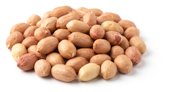 Shelled peanut
Use 100% of the weight. Roast, skin, and grind; creates a thicker, earthier texture typical of Maharashtrian and western Indian curries.


 Single cream
Use equal weight; simmer gently over low heat to prevent curdling. Imparts a comparable rich texture, though it adds dairy richness without any coconut fragrance.
 Cashew paste
Whisk 1 part cashew paste with 2 parts water to match the consistency, then use equal weight. Provides a thick, velvety body without coconut flavour.
 Whole milk
Use equal weight, but reduce other cooking liquids by 20% to compensate for the lower viscosity. The curry will be lighter and lack sweetness.

Similar dishes

- Same: Parippu Payasam shares with this dish moong dal, jaggery, cardamom, coconut milk and cashews.
- Different: Parippu Payasam uses split green moong dal and much more coconut milk, jaggery and ghee, adds raisins, and lists no clove or added water, while this dish has butter or oil, clove and water.

- Same: Kadalaparippu Payasam shares with this dish a South Indian payasam base of dal simmered with jaggery, coconut milk, cardamom, and cashews.
- Different: Kadalaparippu Payasam uses chana dal instead of this dish’s moong dal and adds coconut cream, fresh coconut, raisins, and lime juice, with more ghee and jaggery and no clove or vegetable oil.

- Same: Chandrakanthalu shares moong dal, cardamom, cashew and coconut with this dish, and both are sweet.
- Different: Chandrakanthalu uses fresh coconut, granulated sugar, saffron and edible camphor in a deep-fried dough, while this dish is a simmered pudding with jaggery, coconut milk, clove and ghee or butter.

- Same: Bengali Cholar Dal shares a dal base and the use of green cardamom and clove with this dish, and both include coconut.
- Different: Bengali Cholar Dal uses chana dal with turmeric, cumin, bay leaf, dried chilli, raisin and a coconut tempering, while this dish uses moong dal, jaggery and coconut milk and has no turmeric or chilli.