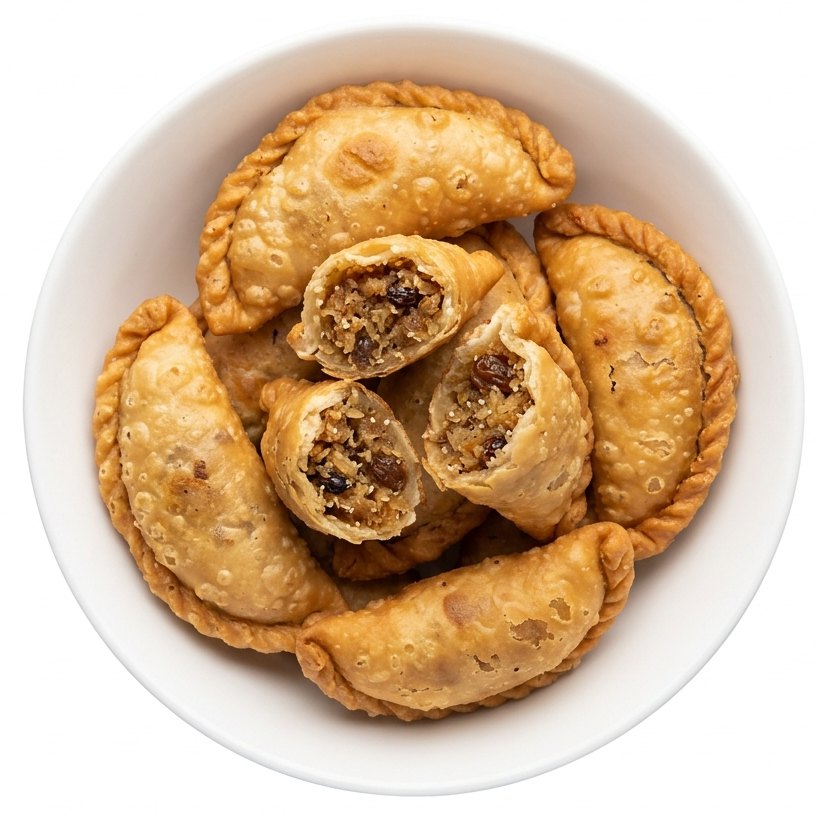
Coconut Gujiya
Coconut gujiya are crescent-shaped deep-fried pastries filled with coconut, jaggery, cardamom, raisins and poppy seeds. They are crisp outside and sweet, aromatic and slightly chewy inside.
Cardamom for the stuffing
0.5 gAdded with the coconut and jaggery at the start of frying (step 2)Poppy seeds for the stuffing
2.8 gStirred in with the raisins after the first frying (step 3)Everything else

Method
- For the stuffing, warm a medium frying pan over low heat.
- Add 120 g grated coconut, 80 g jaggery and the cardamom for the stuffing; fry for 8 minutes, stirring.
- Stir in 3 g raisins and the poppy seeds for the stuffing; fry for 2 minutes more.
- Take the pan off the heat and let the stuffing cool a little.
- In a large bowl, combine 170 g plain flour, 28.2 g melted butter or ghee and 0.3 g salt.
- Pour in 89.5 g water a little at a time, mixing until a smooth dough forms.
- Dust with a little extra flour and knead for 1 minute.
- Cover the dough and rest for 10 minutes.
- Divide the dough into 14 equal pieces; flatten each and roll on a lightly floured surface into a 4 cm disc.
- Put 1 tablespoon of the cooled stuffing in the centre of one disc.
- Brush the edge with 10.2 g milk, fold the disc into a half-moon, press the edge to seal and crimp with a fork.
- Set the gujiyas on a plate under a damp cloth while you fill and seal the rest.
- Pour vegetable oil into a saucepan or wok to about one-third depth and heat over medium heat.
- When the oil is hot, fry 2 gujiyas at a time, turning, until they are an even golden colour and crisp; they will swell a little.
- Drain on kitchen paper and keep warm while you fry the remaining gujiyas.
Don't have something?

 Whole wheat flour
Use the same weight, add 10–15% more water and rest the dough for 20 minutes; the result is heavier and nuttier.
 Rice flour
Use the same weight for crisp coatings; for doughs use no more than half rice flour with wheat flour, or it will be crumbly.
 Cornflour
For thickening use half the weight, mixed with cold water; it is not suitable for bread or chapati dough.


 Ghee
Use the same weight. Gives a richer aroma and nuttier taste; if the dish already uses butter for finishing, ghee can make it slightly heavier.
 Butter
Use the same weight. Lower smoke point than ghee, so keep the heat moderate; if unsalted, add a small pinch of salt.
 Vegetable oil or ghee
Use about 90% of the weight. Less rich flavour; good when you want a lighter result.


 Stock
Use the same weight in savoury dishes; it adds body, so adjust salt.
 Milk
Use the same weight only in doughs or creamy dishes; it makes the result richer.
 Coconut water
Use the same weight in curries or rice; it adds sweetness and a faint coconut taste.


 Whole milk
Use equal weight; provides the standard rich dairy fat and body expected in creamy Indian bases.
 Single cream
Dilute 3 parts cream with 1 part water to match the weight; yields a richer, glossier gravy that resists curdling.
 Plain yogurt
Whisk thoroughly and use equal weight; adds extra body and a mild pleasant acidity, best added off the heat.

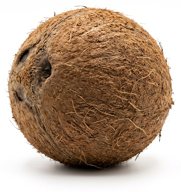
 Fresh coconut
Use equal weight freshly grated or diced. Delivers the identical sweet, milky taste and juicy texture.
 Desiccated coconut
Use 60% of the weight and soak in hot water or milk for 15 minutes before using. The finished dish will be slightly sweeter and less fibrous.
 Dried coconut
Finely grate and use 50% of the weight, soaked in hot water for 20 minutes. Yields a firmer chew and a denser, oilier coconut aroma.


 Granulated sugar
Use 80% of the weight. Granulated sugar is sweeter by weight, but gives a cleaner, one-dimensional sweetness that lacks jaggery's caramel, molasses depth.
 Raisin
Soak and blend into a paste; use 100% to 120% of the weight. Adds rich, natural, fruity sweetness with complex, dark molasses notes that thicken the gravy.


 Cardamom seed
Grind the same weight; remove the pods first for a cleaner, stronger powder.
 Green cardamom pod seed
Grind the same weight of the seeds from green pods; discard the husks for the best flavour.
 Ground green cardamom
Use the same weight; it is the same spice and works directly.


 Dried plum
Use equal weight, pitted and finely chopped. Lends a deeper, slightly more tart sweetness to curries and rice dishes.
 Cashew nut
Use equal weight. Fry lightly in ghee until golden; substitutes the burst of sweetness with a rich, buttery crunch.
- Jaggery
Use 30% of the weight, finely grated. Dissolve straight into the sauce to match the intended sweetness, though without the fruity chew.


 Poppy seed
Use the same weight; grey seeds make a darker paste but taste close.
 White sesame seed
Use the same weight, lightly toasted; the paste is nuttier and less thickening.
 Cashew nut paste
For 10 g poppy seeds use about 15 g cashew nut paste; it thickens more, so reduce other thickeners.


 Peanut oil
Use 1:1 by weight. Handles high-heat frying identically and introduces a very subtle, pleasant nuttiness.
- Ghee
Use 1:1 by weight. Yields a much richer, authentic aroma and a glossy, heavier mouthfeel.
 Mustard oil
Use 1:1 by weight. Heat until smoking, then cool slightly before cooking to temper its intensely pungent, sharp mustard kick.


Similar dishes

- Same: Kadalaparippu Payasam shares jaggery, coconut, cardamom, raisins, and a ghee-or-butter fat with this dish.
- Different: Kadalaparippu Payasam is a simmered chana dal pudding with coconut milk, coconut cream, lime juice, cashews, and ghee, while this dish is a deep-fried flour pastry filled with coconut, jaggery, cardamom, raisins, and poppy seeds.

- Same: Kobari Pachadi shares coconut as its main ingredient and uses vegetable oil, like this dish.
- Different: It is a yogurt-based chutney with a tadka of urad dal, mustard seed, and dried red chilli, and it lacks this dish's plain flour, butter or ghee, jaggery, raisins, poppy seeds, and ground cardamom; it is mixed and seasoned rather than made into a deep-fried pastry.

- Same: Nariyal ki Chutney shares coconut as a main ingredient with this dish.
- Different: Nariyal ki Chutney is a fresh ground chutney with green chilli, coriander, cumin, asafoetida, and lime, while this dish is a deep-fried flour pastry filled with coconut, jaggery, cardamom, raisins, and poppy seeds.

- Same: Puttu and this dish both use coconut as a main ingredient.
- Different: Puttu uses rice flour, coconut and salt and is steamed, while this dish uses plain flour, butter or ghee, coconut, jaggery, cardamom, raisins and poppy seeds and is deep-fried in vegetable oil.