Indian cooking
Indian cooking / Dishes / Missi Roti
Missi Roti (Lentil Bread)

Missi Roti

Lentil Bread
Vegetarian●●●Origin PunjabPrep 50 minutes, plus soaking and standing timeCook 4–6 minutesMakes 10

A nutritious Indian flatbread made from a blend of boiled lentils, flour, fresh herbs, and spices. It has a hearty, tender texture with a warm and savoury kick from ginger and chillies.

Dough spices

4.1 gMixed into the flour and dal mixture (step 2)
01
1.5 g½ teaspoon
spice
02
2.6 g1 teaspoon
spice
Stir together to combine.

Everything else

01
Chana dalrinsed and drained
100 g
legume
02
100 g
legume
03
Wholemeal flour · Attaplus extra for dusting
22 g3 tablespoons
flour
04
16 g2 tablespoons
flour
05
50 g5 tablespoons
vegetable
06
Green chilli · Hari Mirchde-seeded and chopped
18 g3 chillies
vegetable
07
6 g1 tablespoon
aromatic
08
1 g3 teaspoons
herb
09
~0.3 gpinch
salt
10
Ghee or butter · Gheemelted, plus extra for greasing
41 g3 tablespoons
oil/fat

Method

  1. Cover 100 g chana dal and 100 g moong dal with water in a bowl and leave to soak for 30 minutes, then drain thoroughly. Transfer the lentils to a saucepan, add enough water to submerge them, and boil for 15 minutes until thick. Let them cool slightly, then blitz in a blender or food processor to a smooth paste.
  2. In a large mixing bowl, combine 3 tablespoon flour and 2 tablespoon flour. Add the lentil paste, 5 tablespoon onion, 18 g green chilli, 6 g fresh ginger, 1 g coriander leaf, 0.3 g salt, and the masala, withholding the 3 tablespoon melted ghee (use none of the ghee at this stage). Gradually incorporate enough water to bring the ingredients together into a soft, pliable dough.
  3. Turn the dough out onto a lightly floured worktop and knead for 5 minutes. Place into a lightly oiled bowl, drape with a damp kitchen towel, and rest in a warm spot for 30 minutes. If baking in an oven, preheat it to 200°C (400°F).
  4. Divide the dough into 10 equal portions and roll each into a ball. Dust the balls with extra flour, cover with the damp towel, and let them rest for 5 minutes. Flatten each portion into a thin round between the palms of your hands.
  5. Bake the rotis using a tandoor or an oven. For a tandoor, place the dough on a cushion pad, apply to the inside of a moderately hot tandoor, bake for about 4 minutes, and retrieve with tongs. For an oven, place the rounds onto a greased baking sheet and bake for about 6 minutes. Brush the cooked rotis with the melted ghee before serving.

Don't have something?

Chana dal
  • Yellow split peas

    Use 100% of the weight. Soak for at least 1 hour; takes about 10 minutes longer to cook through and has a marginally earthier flavour.

  • Pigeon peas

    Use 100% of the weight. Reduces cooking time by about 10 minutes and breaks down softer, giving a smoother consistency rather than distinct grains.

  • Black gram

    For tempering or tadka only: use 70% of the weight. Browns faster in hot oil, providing a nutty, crunchy bite.

Moong dal
  • Red lentils

    Use equal weight. It cooks in about the same time and breaks down to a similar soft, creamy consistency, though the colour will be slightly pinkish-orange.

  • Pigeon peas

    Use equal weight. Requires longer soaking and cooking time, and produces a slightly earthier, denser dal.

Wholemeal flour
  • Whole wheat flour

    Use the same weight; it is almost the same, though slightly finer, so add water gradually.

  • Plain flour

    Use the same weight but reduce water by about 10%; the result is lighter and less nutty.

  • Flour

    Use the same weight as plain flour; reduce water slightly and expect less bran and colour.

Plain flour
  • Whole wheat flour

    Use the same weight, add 10–15% more water and rest the dough for 20 minutes; the result is heavier and nuttier.

  • Rice flour

    Use the same weight for crisp coatings; for doughs use no more than half rice flour with wheat flour, or it will be crumbly.

  • Cornflour

    For thickening use half the weight, mixed with cold water; it is not suitable for bread or chapati dough.

Onion
  • Shallot

    Use equal weight, finely sliced. Shallots soften and brown faster, giving a slightly sweeter and more delicate base to curries.

  • Cabbage

    Use 80% of the weight, finely shredded and browned slowly with a pinch of asafoetida. Replicates the bulk and natural sweetness in gravies without allium.

Green chilli
  • Chilli powder

    Use 10 to 15% of the weight (about 1/4 teaspoon per chilli); imparts dry pungent heat and reddens the dish without the grassy crunch.

  • Dried red chilli

    Use 1 dried pod per fresh green chilli; snap in half and temper in hot oil for a deeper, toastier heat.

Fresh ginger
  • Ginger paste

    Use equal weight. Sauté in hot fat until the raw allium smell disappears; slightly wetter, but provides identical warmth and pungency.

  • Ground ginger

    Use 20% to 25% of the weight (1 g for every 4 to 5 g fresh). Stir into the gravy; adds peppery heat and warmth, though it misses the crisp, zesty kick of raw root.

Coriander leaf
  • Coriander

    Use equal weight finely chopped; this is the exact same fresh herb.

  • Mint

    Use half the weight finely chopped; provides vibrant green freshness, though the flavour profile becomes noticeably cooler and sharper.

Ground turmeric
  • Ground ginger

    Use 50% of the weight. Mimics turmeric's warm, earthy, rhizome background, but provides none of the golden-yellow colour.

  • Saffron

    Steep a tiny pinch (0.1 g per 2 g turmeric) in 2 tbsp warm water; use to match the rich golden hue. Contributes an aristocratic, honeyed floral flavour rather than earthy bitterness.


Chilli powder
  • Red chilli powder

    Use 100% of the weight. Provides direct, sharp heat and red colour in equal measure.

  • Kashmiri chilli powder

    Use 150% to 200% of the weight if matching colour, but add a pinch of black pepper or hot chilli if you need equivalent fiery heat.

  • Cayenne pepper

    Use 75% to 100% of the weight. Offers a sharp, clean heat with slightly less earthy depth and less crimson colour.

Ghee or butter
  • Ghee

    Use the same weight. Gives a richer aroma and nuttier taste; if the dish already uses butter for finishing, ghee can make it slightly heavier.

  • Butter

    Use the same weight. Lower smoke point than ghee, so keep the heat moderate; if unsalted, add a small pinch of salt.

  • Vegetable oil or ghee

    Use about 90% of the weight. Less rich flavour; good when you want a lighter result.

Similar dishes

Dal Paratha
Moong Dal Paratha
Dal Paratha tastes richer and more buttery, but it has less chilli heat and lacks the sharp kick of fresh ginger found in this dish.
  • Same: Dal Paratha is also a lentil-based flatbread seasoned with onion, green chilli, chilli powder, ground turmeric, and coriander leaf.
  • Different: It uses solely moong dal instead of a moong and chana dal mix, omits the fresh ginger, adds far more coriander leaf, and is pan-fried in a generous amount of butter.
Bervin Poori
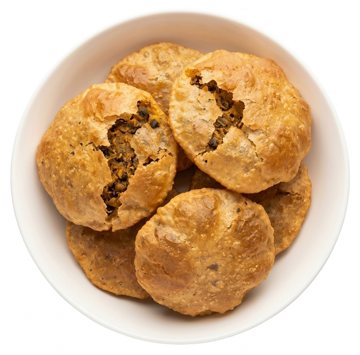
Poori Filled with Black Lentils
Bervin Poori is crisper, flakier, and richer from deep-frying with warm spice notes, while this dish is softer and packs a sharper, fresher bite from raw onions and green chillies.
  • Same: Both breads incorporate spiced lentils into the dough base alongside ginger and chilli powder.
  • Different: Bervin Poori is stuffed with urad dal and deep-fried in vegetable oil using Valsadi Masala and coriander seeds, whereas this dish kneads boiled chana and moong dal into a flatbread with onion, turmeric, fresh coriander, and green chillies.
Puran Poli
Shallow-fried Bread with Sweet Filling
Puran Poli is sweet and fragrant with nutmeg and cardamom rather than savoury, pungent, and spicy from chillies, ginger, and turmeric.
  • Same: Puran Poli is also a griddle-cooked Indian flatbread made with chana dal.
  • Different: Puran Poli is shallow-fried in vegetable oil and uses chana dal as a stuffed sweet filling with cardamom and nutmeg, omitting the moong dal, onion, fresh ginger, and green chillies mixed into this dish's dough.
Bervin Roti
Plain Stuffed Bread
Bervin Roti tastes richer and distinctly buttery with a mild peppery note, lacking the sharp, pungent heat of fresh ginger, green chillies, and chilli powder.
  • Same: Bervin Roti is also an Indian flatbread centered around cooked chana dal.
  • Different: Bervin Roti stuffs the chana dal inside the dough alongside 125 g of ghee and black pepper, rather than kneading it with moong dal, onions, ginger, green chillies, turmeric, and coriander leaf.