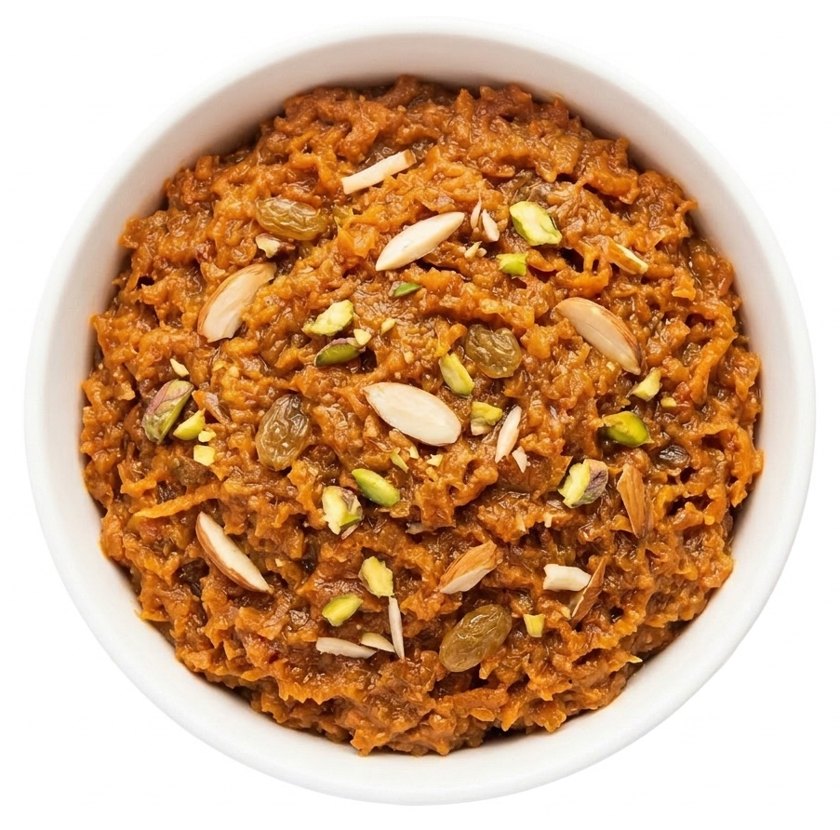
Gajar ka Halwa
A rich North Indian pudding of grated carrots slow-cooked in sweetened milk and fried in ghee with aromatic cardamom. It has a soft, melt-in-the-mouth texture with a deeply milky, caramelized sweetness.
Finishing spice
2 gStirred in after frying the halwa (step 4)Everything else
Method
- Bring 1034 g milk to a boil in a wide, heavy-bottomed pan.
- Add 1000 g carrots and cook over medium heat for approximately 25 minutes, stirring continuously, until softened and most of the liquid cooks off.
- Stir in 200 g granulated sugar and continue cooking for 20 to 25 minutes, stirring regularly, until the sugar completely dissolves and all liquid is absorbed.
- Add 60 g ghee and fry the carrot mixture steadily for 5 minutes.
- Mix in the finishing spice, combine thoroughly, and remove the pan from the heat.
- Spread the halwa onto a serving platter and garnish with 60 g khoya, 10 g blanched slivered almonds, 10 g blanched crushed pistachios, and 20 g raisins. Serve warm or at room temperature.
Don't have something?

 Whole milk
Use equal weight; provides the standard rich dairy fat and body expected in creamy Indian bases.
 Single cream
Dilute 3 parts cream with 1 part water to match the weight; yields a richer, glossier gravy that resists curdling.
 Plain yogurt
Whisk thoroughly and use equal weight; adds extra body and a mild pleasant acidity, best added off the heat.


 Turnip
Use the same weight; peel and cut as for carrot. It is less sweet and slightly peppery, so add a pinch of sugar and expect a softer, more earthy result.
 Potato
Use the same weight; cut into similar pieces and add 5–10 minutes' extra cooking. It gives bulk but no carrot sweetness or colour.
 Courgette
Use the same weight; cut a little larger and add near the end. It releases water, so reduce other liquid slightly and expect a softer texture.


 Jaggery
Use equal weight; grate or shave finely so it dissolves rapidly, giving a warm, caramel-like sweetness and slightly darker sauce.


 Unsalted butter
Use 120% of the weight; melt gently over low heat to avoid burning the milk solids, which will yield a softer, creamier richness rather than a nutty aroma.
 Vegetable oil
Use 85% of the weight; holds high cooking temperatures without smoking, but the final dish will lack traditional dairy depth.
 Mustard oil
Use equal weight; heat to smoking point and cool slightly before cooking, bearing in mind it introduces an assertive, pungent edge.


 Green cardamom seed
Grind freshly extracted inner black seeds finely; use equal weight (1:1). Greatly superior aroma with potent eucalyptus and citrus notes.
 Green cardamom pod
Lightly crack whole pods and simmer them in the gravy; use 150% of the weight of ground cardamom. Fish out the pods before serving.
 Ground nutmeg
Use 50% of the weight. Delivers warm, sweet aroma, but lacks cardamom's cooling, citrusy top notes.


- Whole milk
Use 4 times the weight of milk; simmer and stir continuously in a wide heavy pan until reduced to a dense, fudgy paste.
 Paneer
Use equal weight of finely crumbled or grated paneer mixed with 15% single cream; gives similar body but a less caramelised, milk-solid flavour.
- Single cream
Simmer gently until heavily reduced, or stir in directly at 70% weight; produces rich gravies without the granular bite of khoya.


 Cashew nut
Use equal weight. Soak in warm water and grind to a paste or fry identically; yields a slightly creamier and sweeter sauce.
 Shelled peanut
Use equal weight. Lightly roast, skin, and grind; introduces a heavier body and a pronounced roasted-nut aroma.


 Pistachio
Use the same weight; blanch and peel for a bright paste. This is the closest match.
- Almond
Use the same weight; blanch and peel. It is firmer, so grind a little longer and add a drop of milk if needed.
- Cashew nut
Use the same weight; soak in hot water for 15 minutes. It is softer and sweeter, so reduce sugar slightly.


 Dried plum
Use equal weight, pitted and finely chopped. Lends a deeper, slightly more tart sweetness to curries and rice dishes.
- Cashew nut
Use equal weight. Fry lightly in ghee until golden; substitutes the burst of sweetness with a rich, buttery crunch.
- Jaggery
Use 30% of the weight, finely grated. Dissolve straight into the sauce to match the intended sweetness, though without the fruity chew.

Similar dishes

- Same: Gajar Burfi shares the 1000 g carrots, 200 g sugar, green cardamom and khoya with this dish.
- Different: It uses 125 g ghee, 90 g dried khoya, 40 g icing sugar and 0.1 g kewra water, while this dish uses 60 g ghee, 60 g khoya, milk, almonds, pistachios and raisins and is slow-cooked rather than set dense.

- Same: Gajar Ki Barfi shares with this dish a grated-carrot base, slow cooking, cardamom, raisins, almonds, pistachios, and a sweet milky profile.
- Different: Gajar Ki Barfi uses 149 g double cream, 260 g condensed milk, and 180 g full-fat milk powder instead of this dish's 1034 g milk, 200 g sugar, 60 g ghee, and 60 g khoya; it lacks ghee and khoya and is a dense fudge rather than a pudding.

- Same: Masala Milkshake shares a base of dairy milk sweetened with granulated sugar and flavored with ground green cardamom.
- Different: It is a cold beverage seasoned with saffron and rosewater, whereas this dish is a hot pudding made by slow-cooking grated carrots with ghee, khoya, and almonds.

- Same: Gil e Behisht is also a slow-cooked dessert enriched with milk, khoya, ghee, and ground green cardamom.
- Different: Instead of grated carrots and almonds, Gil e Behisht is thickened with rice flour and incorporates yoghurt and saffron with far less liquid milk.