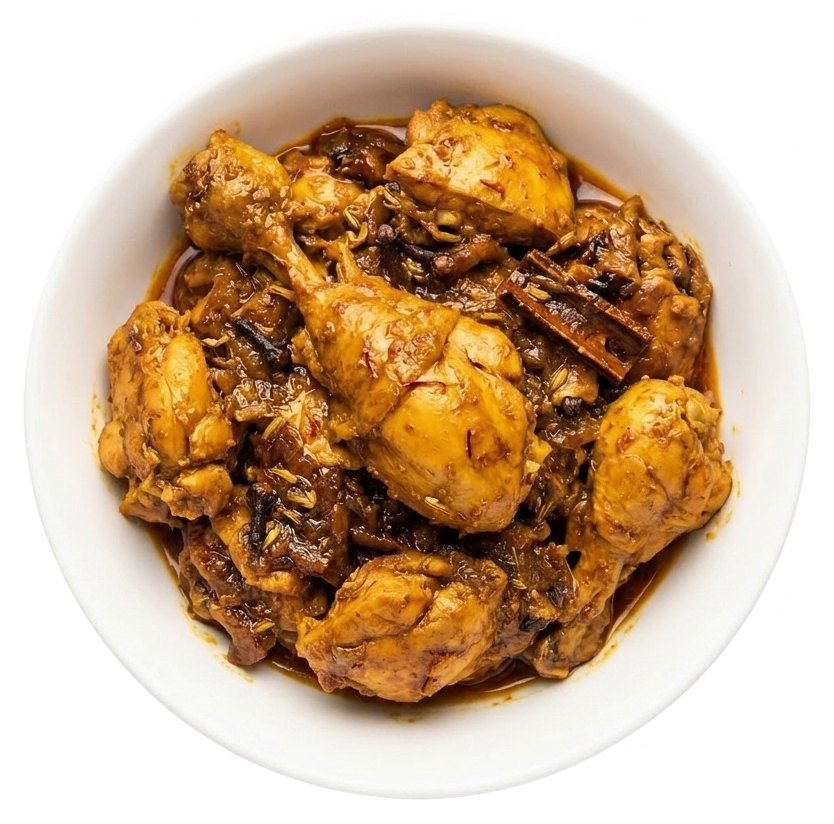
Trami Kokur
A fragrant Kashmiri chicken dish braised with warm spices and saffron, simmered until the liquid evaporates entirely into a rich, clinging glaze.
Simmering spices
16 gAdded to the pan with the stock and browned chicken (step 2)Saffron
0.3 gSteeped in water and stirred into the simmering curry (step 4)Everything else

Method
- Warm 39.6 g ghee in a deep frying pan set over medium heat. Fry 1000 g chicken for roughly 5 minutes until lightly browned on all sides, then remove the meat and set aside.
- Place 2 tablespoons of the cooking ghee into a large, heavy-based pot. Pour in 1000 g stock and add the browned chicken pieces, 4 tablespoon onion paste, 5 teaspoon garlic paste, the simmering spices, and salt to taste.
- Bring the liquid to a boil, then turn the heat down to maintain a gentle simmer.
- Place the saffron in a small dish with 1 teaspoon of water, leaving it to steep until deeply infused, then grind or crush it into a paste.
- Stir the saffron paste into the pot and simmer for approximately 35 minutes, until the liquid cooks away completely and the chicken is tender and cooked through.
Don't have something?


 Unsalted butter
Use 120% of the weight; melt gently over low heat to avoid burning the milk solids, which will yield a softer, creamier richness rather than a nutty aroma.
 Vegetable oil
Use 85% of the weight; holds high cooking temperatures without smoking, but the final dish will lack traditional dairy depth.
 Mustard oil
Use equal weight; heat to smoking point and cool slightly before cooking, bearing in mind it introduces an assertive, pungent edge.


 Turkey thigh
Use 100% of the weight, cut into equivalent bone-in or boneless pieces. Simmer for an extra 5 to 10 minutes; flavour and texture are very similar.
 Lamb
Use 100% of the weight. Cut into bite-sized pieces and extend simmering time by 35 to 50 minutes, adding extra liquid to allow the meat to tenderise.


 Vegetable stock
Use the same weight. Lighter and less gelatinous; add a pinch of turmeric or extra bay leaf for colour and savouriness.
 Stock
Use the same weight; check whether it is meat or vegetable. Adjust salt as brands vary.
 Water
Use the same weight and add a bay leaf and a few black peppercorns. Much thinner; reduce salt and expect less body.


 Onion paste
Use the same weight, then simmer in a little water for 5–8 minutes and cool; raw paste is sharper and stronger.
 Fried onion paste
Use about 75% of the weight; it is sweeter, darker and stronger, so reduce salt and sugar slightly.
 Boiled onion
Use the same weight, boil until soft and blend; it is the same thing made fresh.


 Fennel seed
Grind whole seeds finely; use equal weight (1:1). Provides a fresh, sweet, aniseed aroma that is slightly stronger than pre-ground powder.
 Aniseed
Grind finely; use 75% to 80% of the weight. Has a sharper, sweeter liquorice taste with less of fennel's herbal earthiness.
 Star anise
Grind whole star anise finely; use 30% to 40% of the weight. Very potent aniseed flavour that easily overpowers a dish if not used sparingly.


 Ground cloves
Use 1 g ground for 4 g whole (or 1 small pinch per 2 to 3 whole cloves). Add with spice powders; disperses intense warmth quickly, so use with restraint.
 Allspice berries
Use 100% of the weight whole in tempering. Imparts a warm, clove-like aromatic profile combined with hints of nutmeg and cinnamon.
 Black cardamom pod
Use 1 pod for 3 to 4 cloves in whole tempering. Shares a camphor-like warmth and medicinal depth, though it introduces a distinct smoky undertone.


 Red chilli powder
Use 100% of the weight. Provides direct, sharp heat and red colour in equal measure.
 Kashmiri chilli powder
Use 150% to 200% of the weight if matching colour, but add a pinch of black pepper or hot chilli if you need equivalent fiery heat.
 Cayenne pepper
Use 75% to 100% of the weight. Offers a sharp, clean heat with slightly less earthy depth and less crimson colour.


 Ceylon cinnamon
True cinnamon: thinner, papery quills, milder and sweeter. Use about 1.5 times the weight, and taste.
 Ground cinnamon (cassia)
Use about a third of the weight (0.5 g ground for a 2.5 cm piece), stirred in with the ground spices rather than fried whole, since the powder burns quickly.
 Cassia buds
Use 60-70% of the weight; stronger and more peppery, so taste before adding more.


- Ground fennel seed
Use the same weight; fennel is the closest everyday match, slightly sweeter and milder.
- Aniseed
Grind the same weight freshly; the aroma is stronger, so add it near the end.
 Ground star anise
Use about 50% of the weight; it is much more powerful and slightly liquorice-heavy.


 Ground turmeric
Use 15% of the saffron's weight. Replicates the bright yellow colour well, but lacks the floral, earthy depth; use sparingly to avoid bitterness.
 Screwpine water or rosewater
Use a few drops combined with a tiny pinch of ground turmeric to mimic both the regal floral aroma and the golden hue.


Similar dishes

- Same: Trami Kokur Safed also braises one kilogram of chicken in ghee with cinnamon sticks, cloves, and ground fennel seed until the liquid reduces into a coating.
- Different: Trami Kokur Safed simmers the meat in over a kilogram of milk with ground ginger, omitting the boiled onion paste, chilli powder, and saffron found in this dish.

- Same: Sookhe Masale ka Murg and this dish are both chicken dishes that use ground aniseed, chilli powder, salt and ghee and finish with little liquid.
- Different: Sookhe Masale ka Murg has garlic, green chilli, coriander, turmeric and black pepper but lacks this dish's saffron, fennel, clove, cinnamon, onion paste and chicken stock, and it uses 200 g ghee to this dish's 39.6 g.

- Same: Both cook a kilogram of chicken in ghee with onions, cinnamon, and cloves until the cooking liquid reduces down to a clinging coating.
- Different: Thanda Qorma adds ginger, garlic, green chillies, cardamom, and black peppercorns, but omits the saffron, fennel, and red chilli powder, and it is chilled before serving.

- Same: Chicken Masala shares chicken, ghee, chilli powder, aniseed and salt with this dish, and both cook the chicken until dry.
- Different: It uses much more ghee, adds green chilli, garlic, black peppercorn, coriander and turmeric, and lacks this dish's stock, onion paste, saffron, fennel, clove and cinnamon; it is poached in a spice paste then fried crisp, not braised in stock to a glaze, and neither lists a souring agent.