Indian cooking
Indian cooking / Dishes / Jalebi Paratha
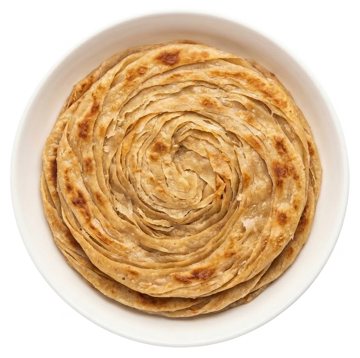
Jalebi Paratha (Spiral Paratha)

Jalebi Paratha

Spiral Paratha
VegetarianOrigin DelhiPrep 1 hour, plus standing and chilling timeCook 1 hourMakes 12

Flaky, multi-layered flatbreads shaped into spiral rounds and perfumed with crushed fennel seeds. Cooked slowly in ghee, they develop crisp, golden edges with tender, laminated layers inside.

Coarsely crushed fennel

6 gKneaded into the enriched dough (step 2)
01
6 g3 teaspoons
spice
Pound coarsely in a mortar and pestle or pulse briefly in a spice grinder.

Everything else

01
Plain flour · Maidaplus extra for dusting
500 g
flour
02
259 g250 ml
dairy
03
180 g
oil/fat
04
to taste
salt

Method

  1. Sift 500 g flour and salt to taste into a large mixing bowl. Create a well in the middle, pour in 259 g milk and 125 g water, and bring together into a dough. Knead for 5 minutes until smooth, then cover with a damp cloth and leave to rest for 10 minutes.
  2. Gradually work 120 g of the ghee (two-thirds of the total 180 g) into the dough until soft and pliable. Work in the coarsely crushed fennel, cover, and let rest for 10 minutes.
  3. Split the dough into 12 equal pieces and shape them into smooth balls. Dust lightly with extra flour, cover, and rest for 10 minutes.
  4. Working on a floured surface, roll each ball out into a thin round. Smear roughly a teaspoon of the remaining ghee across the surface and dust lightly with flour. Make a single cut from the centre point straight to the outer edge, then roll the dough tightly around itself from the slit to create a cone.
  5. Grasp each cone upright about 1 cm from the base and press straight down in a twisting, spiral motion to form a thick disc. Lay the discs on greaseproof paper and refrigerate for 4 hours.
  6. Roll the chilled discs out on a floured surface into flat rounds. Separate the rounds with sheets of greaseproof paper and return them to the refrigerator for 30 minutes.
  7. Set a tawa or heavy frying pan over low heat. Melt a small spoonful of the remaining ghee, add a paratha, and cook for 2 to 3 minutes on each side until crisp and pale golden brown. Repeat with the remaining parathas.

Don't have something?

Fennel seed
  • Aniseed

    Use 75% of the weight. Fry in hot oil or ghee; has a sharper, more pronounced liquorice flavour, so use a lighter hand.

  • Ground fennel seed

    Use 60% of the weight. Stir into the sauce with ground masalas; provides identical sweet aniseed flavour without whole seed crunch.

  • Star anise

    Use one point (single carpel) per 1 g of fennel seeds. Simmer in gravies and remove before serving; gives a deeper, woodier liquorice aroma.

Plain flour
  • Whole wheat flour

    Use the same weight, add 10–15% more water and rest the dough for 20 minutes; the result is heavier and nuttier.

  • Rice flour

    Use the same weight for crisp coatings; for doughs use no more than half rice flour with wheat flour, or it will be crumbly.

  • Cornflour

    For thickening use half the weight, mixed with cold water; it is not suitable for bread or chapati dough.

Milk
  • Whole milk

    Use equal weight; provides the standard rich dairy fat and body expected in creamy Indian bases.

  • Single cream

    Dilute 3 parts cream with 1 part water to match the weight; yields a richer, glossier gravy that resists curdling.

  • Plain yogurt

    Whisk thoroughly and use equal weight; adds extra body and a mild pleasant acidity, best added off the heat.

Ghee
  • Unsalted butter

    Use 120% of the weight; melt gently over low heat to avoid burning the milk solids, which will yield a softer, creamier richness rather than a nutty aroma.


  • Vegetable oil

    Use 85% of the weight; holds high cooking temperatures without smoking, but the final dish will lack traditional dairy depth.

  • Mustard oil

    Use equal weight; heat to smoking point and cool slightly before cooking, bearing in mind it introduces an assertive, pungent edge.

Similar dishes

Warqi Paratha
Layered Paratha
Warqi Paratha tastes plainly of wheat and ghee with crisp, delicate layers, while this dish has fennel perfume and a milk-enriched, ghee-cooked richness.
  • Same: Warqi Paratha shares with this dish a plain-flour, ghee-enriched, flaky multi-layered paratha made by a spiral rolling or lamination technique.
  • Different: Warqi Paratha lacks this dish’s crushed fennel seeds and milk, and its weighed list uses only plain flour, salt, and ghee, with far less flour and ghee than this dish.
Ulte Tawe ka Paratha
Paratha Cooked on the Griddle
Ulte Tawe ka Paratha tastes delicately sweet and aromatic from khus and cashew, while this dish is savory with crushed fennel and crisp ghee-fried edges.
  • Same: Ulte Tawe ka Paratha shares plain flour, milk, ghee, and a layered paratha style with this dish.
  • Different: Ulte Tawe ka Paratha adds baking powder, cashew paste, sugar, and khus essence, uses much more milk, has no fennel, and is cooked on an inverted griddle rather than shaped into spirals and cooked slowly in ghee.
Tandoori Roti
Bread Baked in a Clay Oven
Tandoori Roti tastes smoky and plain rather than rich, buttery, and fragrant with fennel.
  • Same: Both are crisp, layered Indian flatbreads made with salt and finished with ghee.
  • Different: Tandoori Roti is baked at high heat in a clay oven using minimal fat, omitting the fennel seeds and milk used to knead and fry this dish.
Roomali Roti
Handkerchief Bread
Roomali Roti is soft, supple, and delicately charred, whereas this dish is crisp and golden at the edges with tender laminated layers and a fennel perfume.
  • Same: Roomali Roti and this dish are both Indian flatbreads made from flour and salt and cooked on a hot pan.
  • Different: Roomali Roti uses wholemeal flour and plain flour with no ghee, milk, or fennel, and it is stretched paper-thin and quickly blistered on an inverted pan, while this dish uses plain flour, milk, ghee, and crushed fennel and is layered into a spiral and cooked slowly.