
Phulkas
Phulkas are soft, thin wholemeal flatbreads cooked quickly on a hot griddle until they puff. They taste wheaty and mild, with a little richness from the ghee.
Ingredients

Method
- Put 250 g chapatti flour, 26.4 g ghee and 0.3 g salt in a mixing bowl and rub them together with your fingertips until evenly combined.
- Add 159–169 g water a little at a time, stirring with a spoon or your fingers, until a rough dough forms.
- Knead the dough until smooth, then cover the bowl and leave it to rest for 20 minutes.
- Divide the rested dough into 12 equal balls.
- Flatten one ball and dust it with extra chapatti flour.
- Roll the dusted ball into a thin round about 12.5 cm (5 in) across, then repeat with the remaining balls.
- Heat a griddle or frying pan over a medium heat until hot.
- Cook one rolled phulka for 30 seconds, then turn it over and cook for 1 minute.
- When it begins to puff, turn it back to the first side and cook for another 30 seconds, pressing lightly with a spatula.
- Take the phulka off the heat, spread a little extra ghee over it and cover it with a clean tea towel or paper towel.
- Keep the cooked phulkas warm while you roll and cook the rest.
Don't have something?


 Wholemeal flour
Use the same weight; it is very close, but add water slowly as it can be coarser and absorb more.
 Plain flour
Use the same weight but reduce water by about 10%; the dough is softer and the flavour less nutty.
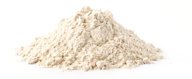 Flour
Use the same weight as a plain-flour swap; reduce water slightly and expect a lighter, less wheaty result.


 Unsalted butter
Use 120% of the weight; melt gently over low heat to avoid burning the milk solids, which will yield a softer, creamier richness rather than a nutty aroma.
 Vegetable oil
Use 85% of the weight; holds high cooking temperatures without smoking, but the final dish will lack traditional dairy depth.
 Mustard oil
Use equal weight; heat to smoking point and cool slightly before cooking, bearing in mind it introduces an assertive, pungent edge.


 Stock
Use the same weight in savoury dishes; it adds body, so adjust salt.
 Milk
Use the same weight only in doughs or creamy dishes; it makes the result richer.
 Coconut water
Use the same weight in curries or rice; it adds sweetness and a faint coconut taste.


Similar dishes
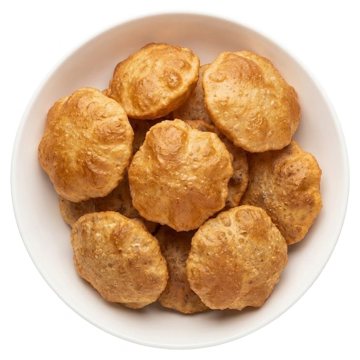
- Same: Puris are wheat breads made from chapatti flour like this dish, and both puff during cooking.
- Different: Puris are deep-fried in vegetable oil, while this dish is cooked on a hot griddle with ghee and water; Puris list no ghee or water.
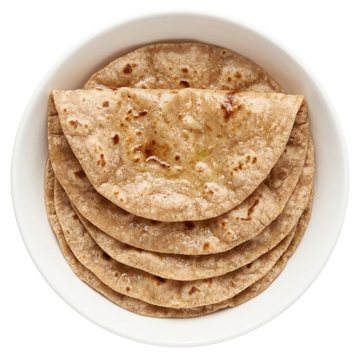
- Same: Chapattis shares chapatti flour, salt and dry-griddle cooking with this dish.
- Different: It uses vegetable oil in the dough and melted butter to finish instead of ghee, and its weighed list has no water.
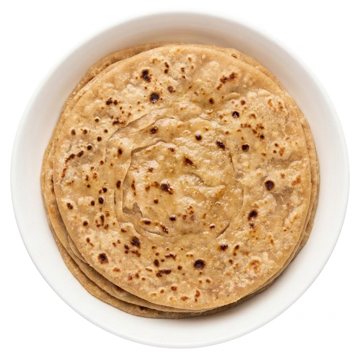
- Same: Plain Buttery Parathas shares with this dish the same 250 g chapatti flour, 0.3 g salt, and the fact that both are Indian flatbreads made from a simple dough.
- Different: Plain Buttery Parathas uses 40.5 g vegetable oil and 70 g butter instead of this dish’s 26.4 g ghee, lists no water, and is layered with butter and pan-fried until golden rather than cooked quickly on a hot griddle until it puffs.
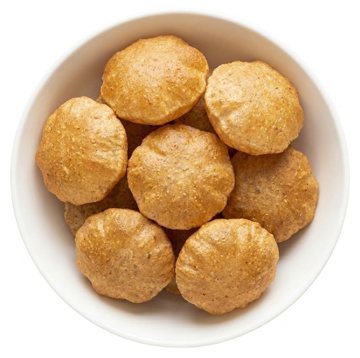
- Same: Puris shares wholemeal or chapatti flour, salt, and water with this dish.
- Different: Puris adds vegetable oil to the dough and is deep-fried, while this dish uses ghee and cooks on a hot griddle.