The following article is based on a presentation by Stéphane Ribes from June 2019. It's based on research with the so-called Hog puck preparation tool. In fact, this study evaluates how the Hog tool impacts extraction dynamics, flow profiles, temperature and concentration gradients, and taste across different extraction profiles.
What is the Hog?
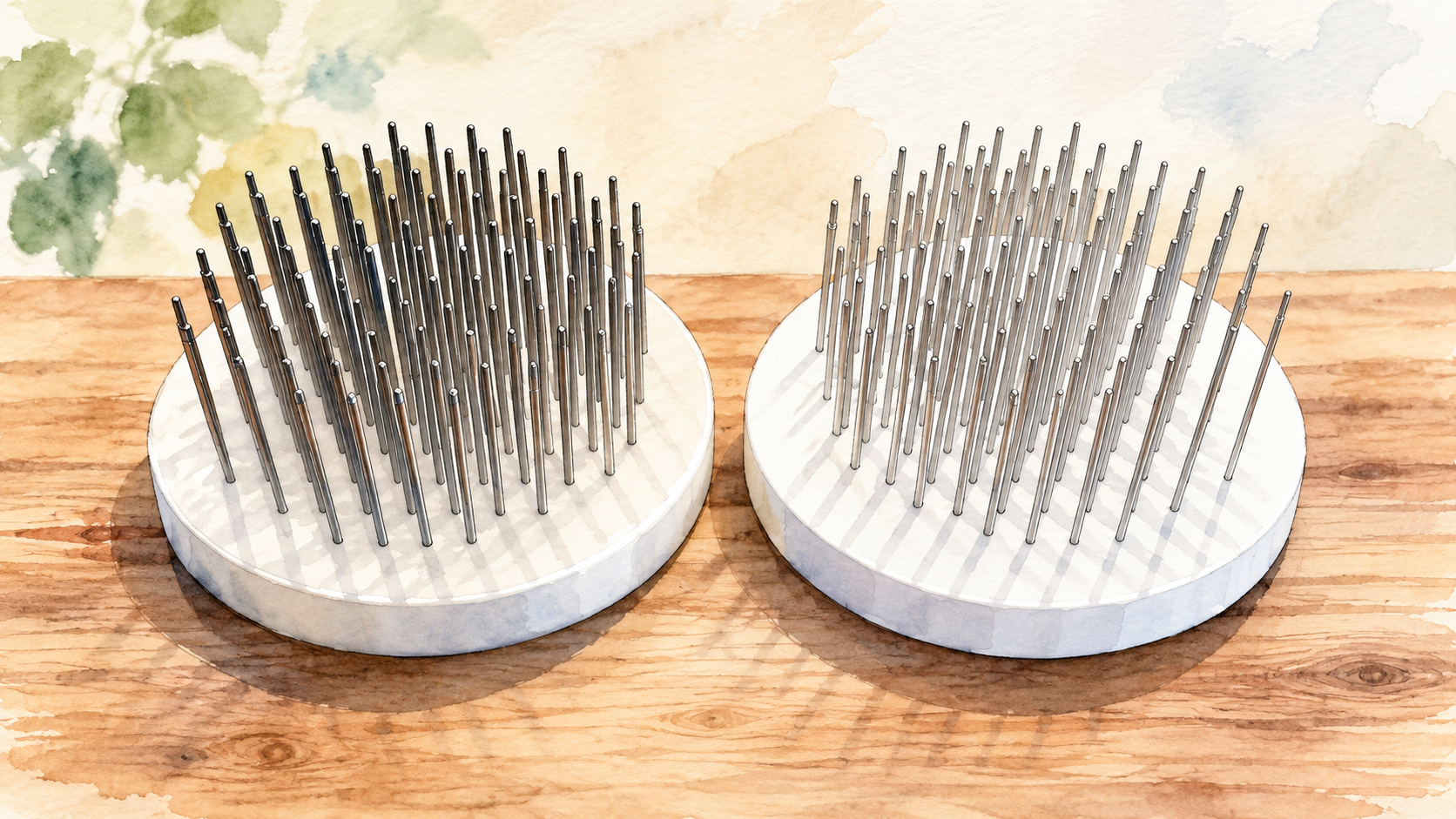
Introduced conceptually by Matt Perger of Barista Hustle in 2017, "The Hog" is a specialized puck preparation tool designed to introduce "controlled channeling" by poking vertical canals into the compressed coffee puck prior to tamping. So it's not a WDT distributor tool like we know it today. Rather, it's actively used to poke holes into the coffee puck and, thus, control the channeling.
The 2 hog tools tested were inspired by this work; they were designed and manufactured by Joachim Morceau (and his wife), French barista – formerly head Barista at Terres de Café and now owner of the Substance café specialty coffee place in Paris.
95 steel spikes stuck and glued in a 3D printed base
* Designed for VST 20g+ baskets
2 versions: 0.8 mm diameter spikes ("thin" Hog) and 1.1 mm diameter spikes
A similar, now available tool, is the PorcuPress by Sworksdesign.
Benefits
Reduced edge channeling
Quicker wetting of the coffee puck -> More even preinfusion & extraction
reduced temperature gap between top and bottom grinds
lower concentration gradient of the extracting fluid between top and bottom grinds
reduced negative impacts of slow preinfusions
less puck compression with high preinfusion flow rates
More stable pressure (flow profile with constant flow)
Smoother evolution of the extraction yield -> better control of the extraction in the typical range of brew ratio, when reaching the highest possible extraction is not the most desirable objective
Additional information
Requires a finer grind
Represents an additional step in the puck preparation (does not replace grinds distribution)
Questions asked
1. How does creating vertical canals in the puck ("controlled channeling") affect espresso pressure stability, flow dynamics, and puck wetting?
2. How does the Hog tool alter extraction yield (EY) progression throughout a shot compared to standard prep?
3. What are the physical differences between thin-spike and thick-spike Hog designs?
4. How do different extraction profiles (flow priority vs. straight 9 bar vs. advanced preinfusion) interact with the Hog?
5. Does the use of the Hog tool measurably improve the in-cup taste profile?
Tools used
Espresso machine: Decent Espresso DE1PRO v1.1 fitted with an IMS SI 200 IM shower screen.
Grinder: Mahlkönig EK43 S.
Puck preparation tools:
The Hog: 95 steel spikes embedded in a 3D-printed base for 20g+ VST baskets, designed and manufactured by Joachim Morceau. Tested in two variants:
Thin Hog (0.8 mm diameter spikes) and
Thick Hog (1.1 mm diameter spikes).
Hog stand: Used during pressure tests to ensure precise, straight vertical insertion and withdrawal.
Other prep: Mini whisk (for WDT in cup and basket), 58.6 mm manual tamper, 22g VST basket.
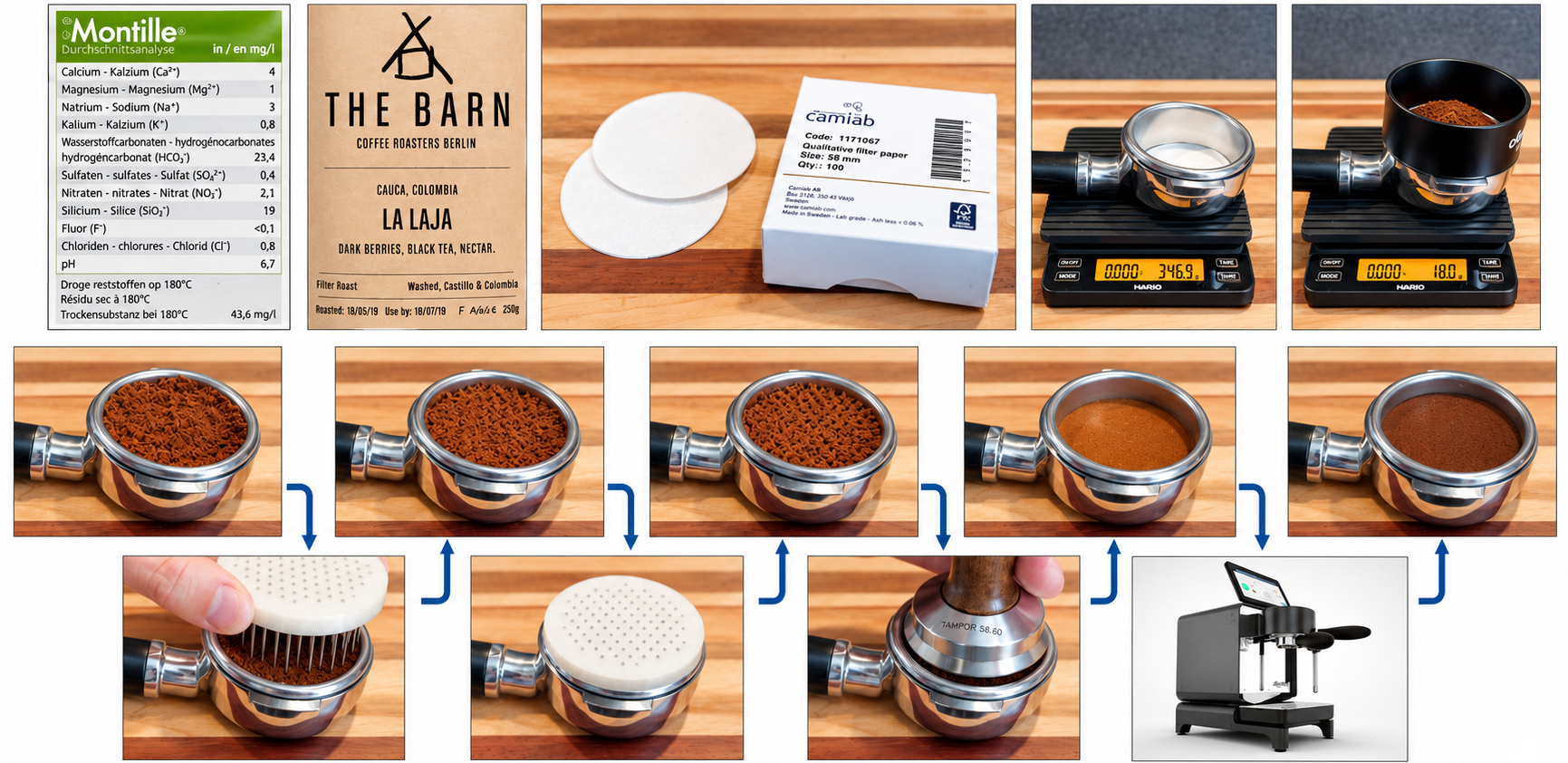
Filter paper (flow tests): 55 mm Camlab paper filters placed at the bottom of the basket (omitted during 9 bar pressure tests).
Measurement & water:
Atago PAL refractometer for TDS/EY measurements.
Montille water (low mineral), re-mineralized to SCAA standards with sodium carbonate and Epsom salts for pressure-priority testing.
Method / proceeding
1. Grind & dose prep:
Single-origin beans (The Barn La Laja for flow tests; Friedhats Kochere Boji & Las Margaritas for pressure tests) were vacuumed, frozen, and ground frozen in a double-wall stainless steel cup.
Dose: 19g (flow tests) or 18.5g targeting 42g out (pressure tests) into a 22g VST basket.
2. Distribution & Hog application:
WDT performed in the cup and basket using a mini whisk.
The Hog tool was pressed straight down into the un-tamped bed and pulled directly back out.
Gentle surface raking (no tapping) followed by manual tamping with a 58.6 mm tamper.
3. Extraction testing frameworks:
Flow priority profiles: 2.5 mL/s constant flow rate with bottom paper filter. Sliced extractions were performed where the output was split into 10 distinct portions (every 4 seconds post-first-drop) to track gradual extraction yield evolution.
Straight 9 bar pressure ("E61 Classic"): Performed without bottom paper filter.
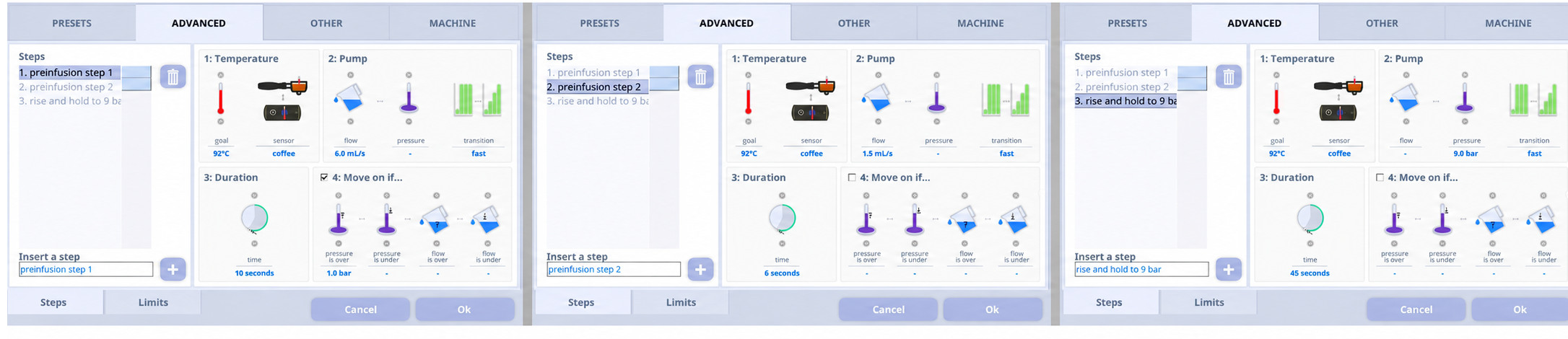
Advanced preinfusion + 9 bar pressure: Performed without bottom paper filter.
4. Data collection:
Pressure/flow curve logging via the Decent DE1PRO interface.
Refractometer measurements (TDS/EY averaged over 3–6 readings per sample at room temperature).
Sensory/taste ratings on a subjective scale comparing acidity, sweetness, and astringency.
Observed impact of the Hog on extraction
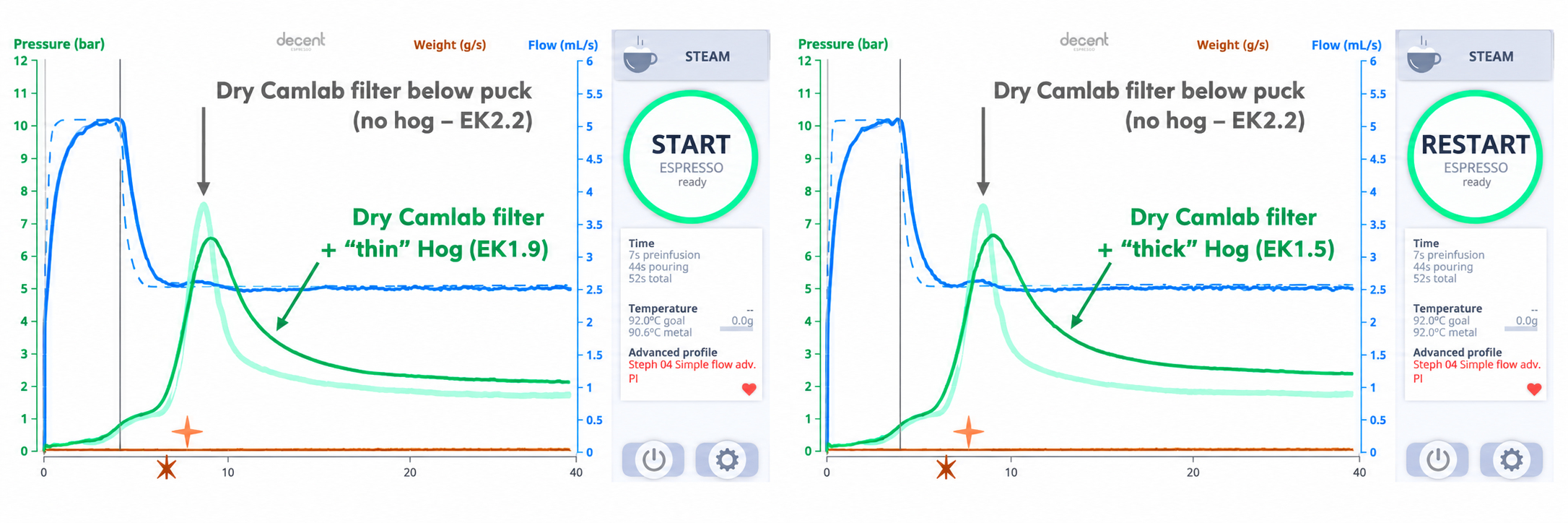
Effects of the hog tool on pressure evolution during espresso extraction (flow profile)
Grind setting was adapted to reach a comparable pressure peak during extraction
Much finer grind is needed with the "thick Hog" (EK1.5, from EK2.2 with no hog)
Quicker wetting of the coffee puck with hogs, earlier first drop in cup
First drop in cup with hogs: 12 s
Without hog: 14 s
Slower rates of pressure rise and decrease with hogs – more stable overall extraction pressure
Intermediate intensity of all recorded effects with the thinner spines
Effects of the hog tools on extraction evolution
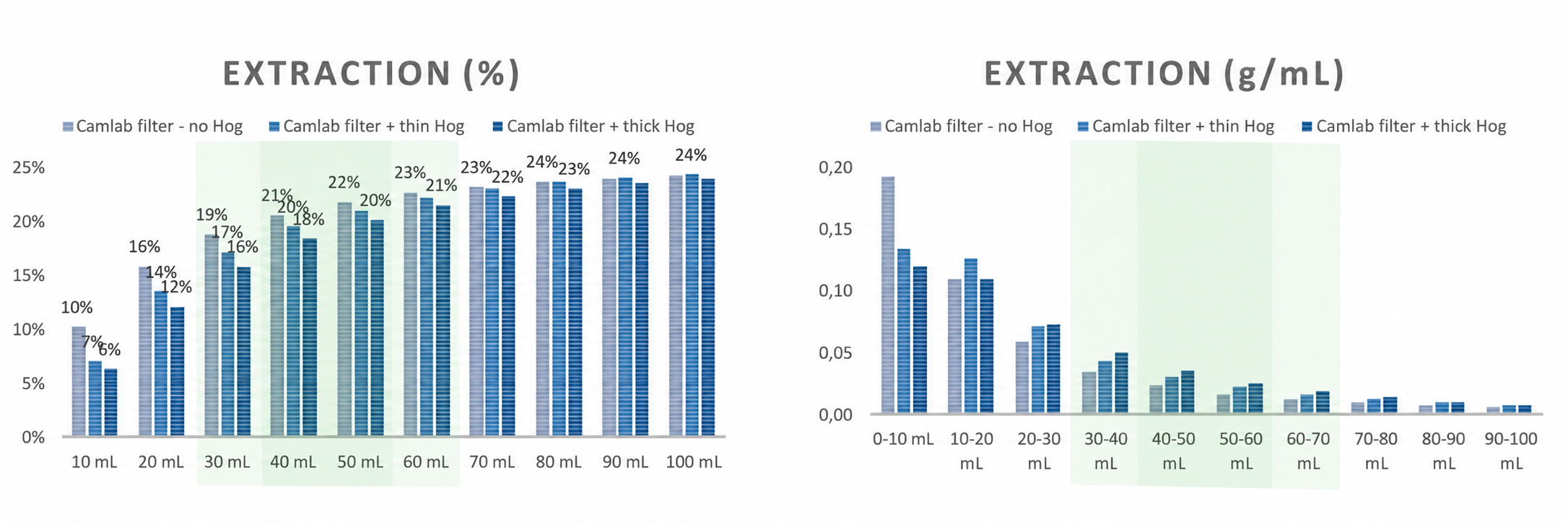
Flow profile, 19 gram dose
For each shot, the output was split into 10 portions (every 4 s after first drop)
Thanks to the flow priority extraction (2.5 mL/s), all samples had comparable volumes
Coffee extraction is performed more gradually with the hogs
Typical brew ratio zone: (2.1 – 2.6)
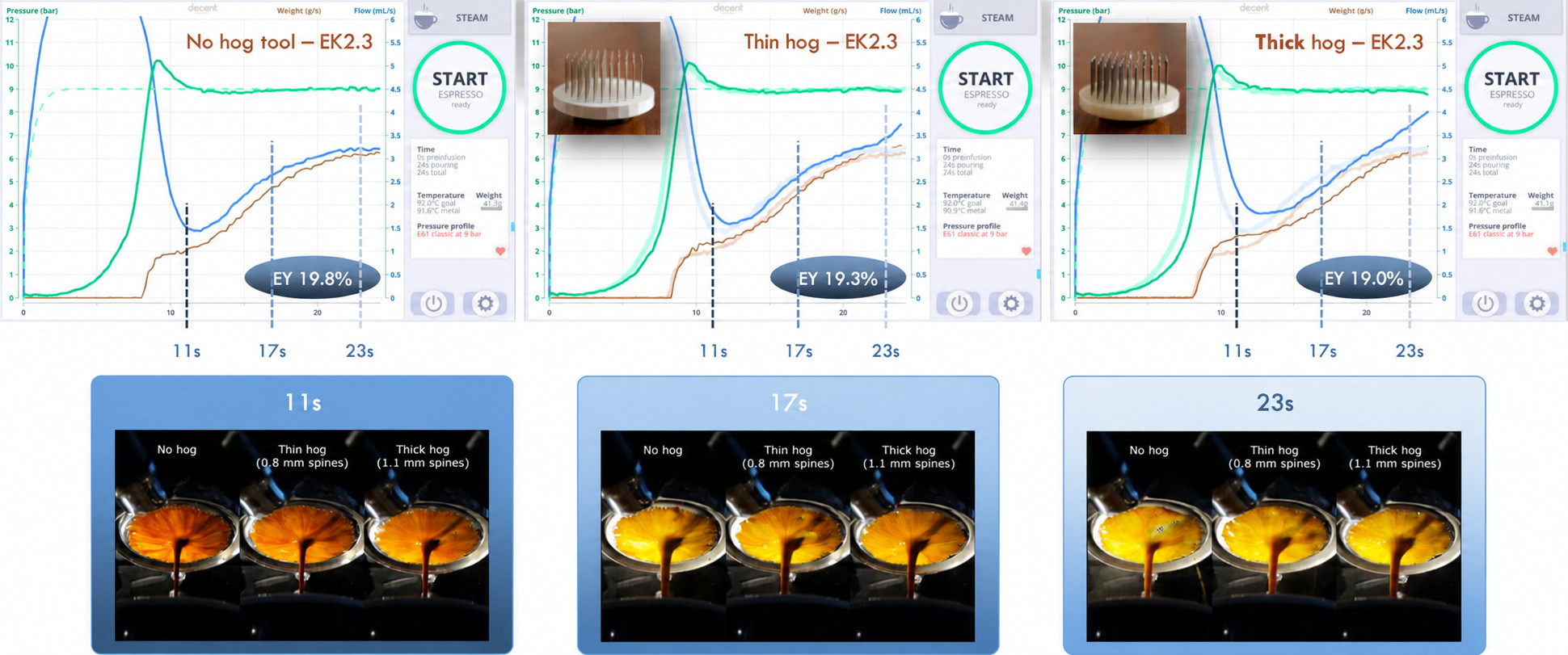
The Hog: Straight 9 bar extraction experiment without paper filter
Tested configurations
No hog tool – EK2.3: EY 19.8%
Thin hog – EK2.3: EY 19.3%
Thick hog – EK2.3: EY 19.0%
Observation and measurement results
Slightly delayed pressure rise but no visible impact on the extraction time
Altered flow evolution in the cup: higher flow rate first, then lower flow
Less turbulences and sprays at the exit of the basket
Lower extraction yield
All these effects are more intense with the "thick" hog (1.1 mm spines)
Taste Results
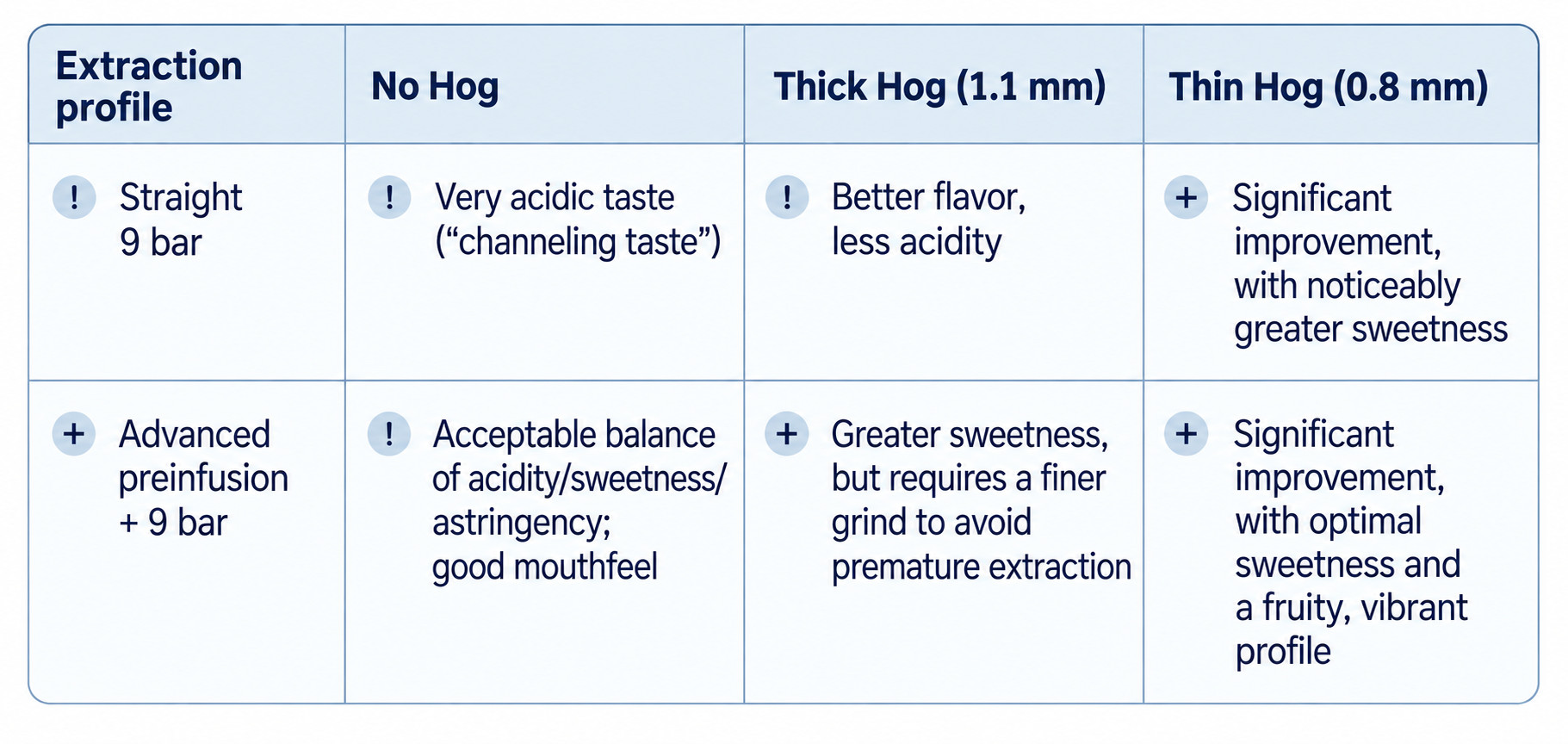
Very sour taste with no hog ("channeling taste")
Better taste with the thick hog (less sour)
Significantly improved taste with the thin hog (much more sweetness)
Longer extraction time with no hog (not tested) may have led to better taste results (less sour)
The Hog: Advanced preinfusion and 9 bar extraction experiment without paper filter
Tested configurations
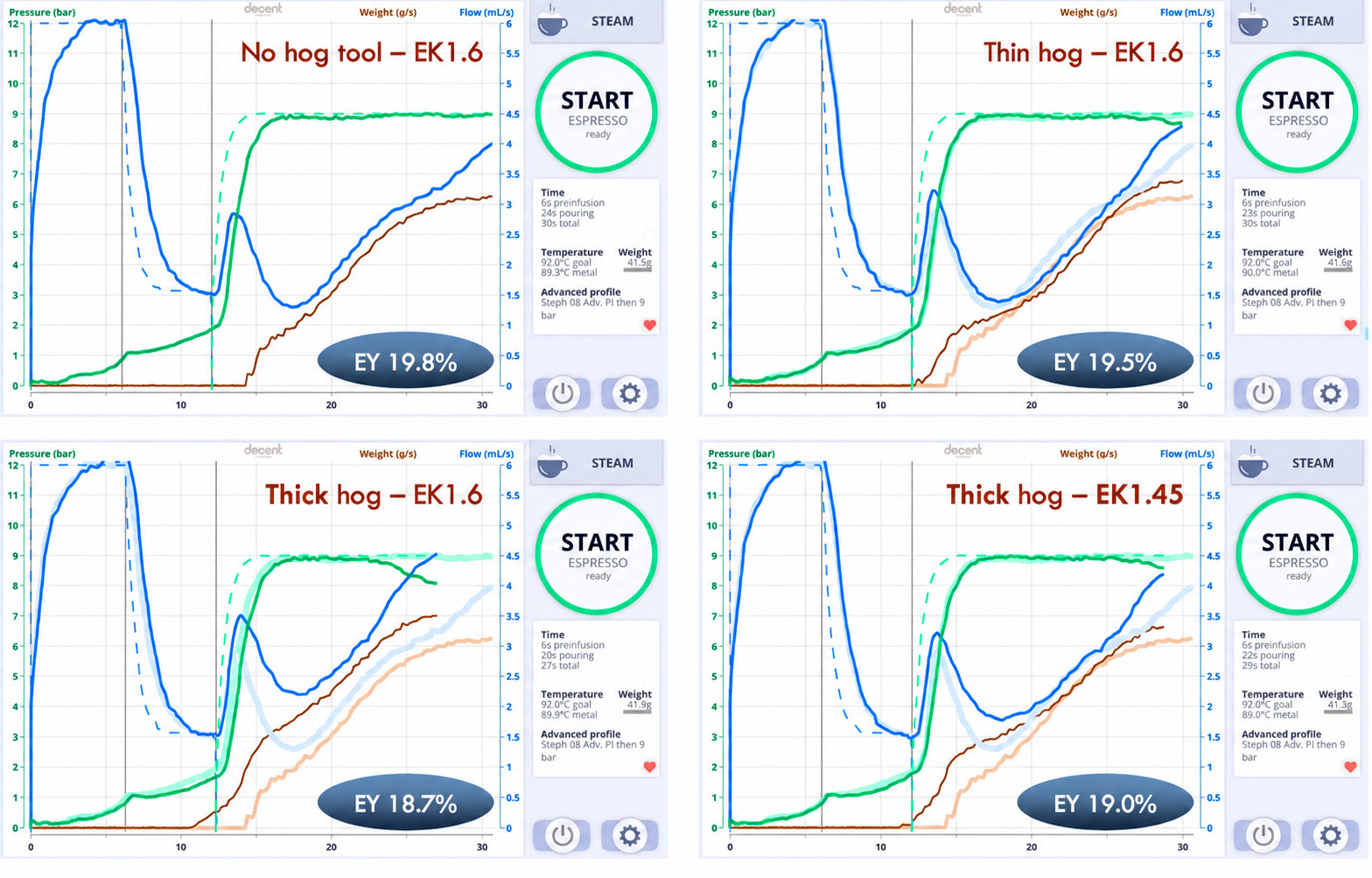
No hog tool – EK1.6: EY 19.8%
Thin hog – EK1.6: EY 19.5%
Thick hog – EK1.6: EY 18.7%
Thick hog – EK1.45: EY 19.0%
Observations
1. Earlier first drop in the cup
2. Quicker extraction, especially with the thick hog (finer grind needed to compensate)
Also...
Lower extraction yield
All these effects are more intense with the "thick" hog (1.1 mm spines)
Taste results
No hog: acceptable balance of acidity, sweetness and astringency – very nice mouthfeel
Thick hog (finer grind): Better results with the thick pins hog (more sweetness) only after adjustment of the grind setting
Thin hog: Significantly improved taste with the thin pins hog (much more sweetness and fruity taste)
Summary table comparing taste
Conclusion
Creating vertical canals in the coffee bed via the Hog preparation tool acts as a mechanism of "controlled channeling" that fundamentally changes how water interacts with the coffee puck. Based on the findings of the experiments, the questions elaborated above can be answered as follows:
1. How do vertical canals affect pressure stability, flow dynamics, and puck wetting? Creating vertical canals leads to significantly quicker, more uniform puck wetting, moving the time to first drop from 14 seconds to 12 seconds. The canals reduce edge channeling, lower the temperature and concentration gradients between top and bottom grinds, and minimize puck compression during high preinfusion flow rates. Under flow priority profiles, this reduces the rates of pressure rise and decrease, resulting in a smoother, more stable extraction pressure overall.
2. What is the impact of the Hog tool on Extraction Yield (EY) progression? Instead of a rapid initial spike in extraction, the Hog alters the EY progression to extract coffee more gradually throughout the shot. While overall final extraction yields are slightly lower compared to non-Hog prep at the same grind size, this smoother progression offers better control over extraction in standard brew ratio ranges (e.g., 2.1-2.6), preventing sharp over- or under-extraction spikes early in the shot.
3. What are the key differences between the thin-spike and thick-spike Hog designs? Both designs feature 95 steel spikes set in a 3D-printed base for 20g+ VST baskets, but differ in spike diameter: the "thin" version uses 0.8 mm spikes, while the "thick" version uses 1.1 mm spikes. The thick-spike tool exerts a much stronger effect on puck resistance, requiring a significantly finer grind setting (e.g., EK1.5 vs. EK2.2) to match peak extraction pressure. The thin-spike design offers a more moderate, balanced modulation of pressure and flow without requiring extreme grind adjustments.
4. How does the Hog tool interact with different extraction profiles?
Flow priority: Provides a stabilized pressure curve and a controlled, gradual extraction curve when paired with a bottom paper filter.
Straight 9 bar: Delays initial pressure rise slightly and alters flow rate evolution (higher initial flow, lower late flow), reducing basket exit spray and turbulence.
Advanced preinfusion: Results in earlier first drops and faster overall shot times. A finer grind setting is required to restore target shot timing and yield, particularly when using the thick-spike design.
5. How does vertical canal preparation influence the in-cup taste profile? The Hog measurably improves in-cup flavor profiles by reducing harsh channeling sourness. Across both straight 9-bar and advanced preinfusion profiles, the thin-spike Hog (0.8 mm) consistently produces the best sensory results, significantly enhancing sweetness, clarity, and fruity acidity compared to standard preparation.
#research #Ribes #coffee #channeling #documentation


