1. Introduction
Stéphane Ribes's March 2020 presentation, Radial Uniformity of Espresso Extractions, investigates whether coffee is extracted evenly across the radius of an espresso puck. Instead of treating the extraction yield of the finished beverage as a complete description of the shot, the presentation separates the spent puck into concentric regions and measures the extraction yield of its centre, middle and outer portions.
This distinction matters because a satisfactory average extraction yield can conceal substantial internal variation. A highly extracted centre can compensate numerically for a severely underextracted perimeter. The presentation therefore focuses on both:
Overall espresso extraction yield, measured from the beverage.
Local puck extraction yield, measured separately in concentric regions of the coffee bed.
Two practical interventions are compared: placing a V60 paper filter below the puck and changing the tamper from a flat base to a convex “US curve” base. The presentation then proposes a basket-design explanation for the remaining edge deficit.
The central finding is that, under the tested conditions, the perimeter of a conventional espresso puck is much less extracted than its centre. A paper filter below the puck substantially reduces this radial difference, whereas a convex tamper base makes it worse.
2. Questions asked
Stéphane attempted to investigate and answer the following questions:
In a standard espresso shot without a paper filter below the puck, how uniform is extraction yield from the centre to the edge?
Does placing a V60 paper filter below the puck improve radial extraction uniformity and increase the average extraction yield?
How does a convex “US curve” tamper base affect radial extraction compared with a flat tamper base?
Could the limited perforated area of an espresso basket explain peripheral underextraction, and would enlarging that area be a promising solution?
3. Method
Experimental principle
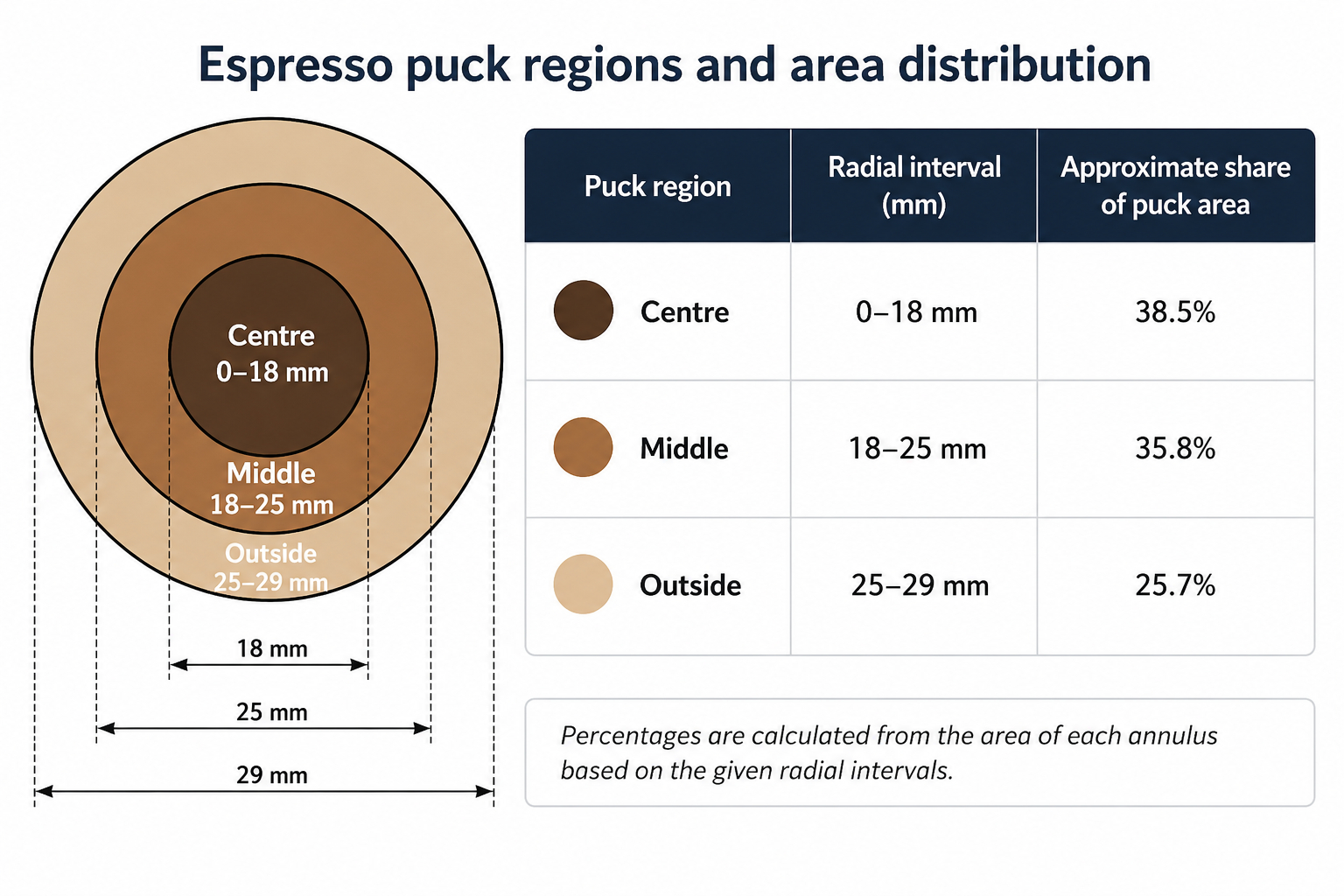
The test protocol proceeds along two analytical paths. First, the espresso beverage is collected and its overall extraction yield is determined. Second, the puck is divided into three concentric portions: outside, middle and centre. The EY of the three puck fractions is then also determined.
The radial graphs identify the boundaries of the three regions as follows:
Equipment and controlled conditions
Equipment & tools: Decent Espresso Machine DE1PRO v1.1 (with a red Cafelat 8.0 mm silicone gasket and an IMS SI 200 IM screen without spacer), Mahlkönig EK43 S grinder fitted with SSP "High Uniformity" burrs, and a 15g VST ridgeless filter basket.
Water & coffee preparation: Montille water adjusted to 50 ppm CaCO₃ alkalinity and 125 ppm CaCO₃ total hardness using sodium carbonate and Epsom salts. Single doses of frozen coffee beans (12g per shot) were ground into a double-walled stainless steel cup.
Puck prep & tamping: The basket and shower screen were dried with a clean tissue before every shot. Distribution was performed using a Londinium WDT tool with a Decent funnel (no vertical tapping), followed by gentle raking with a hog tool to smooth the surface. Tamping was completed using The Force Tamper (58.5 mm smooth flat or US curved base) applied twice sequentially.
Measurements: Samples were extracted, divided into radial zones (center, middle, outside), and evaluated along with the final espresso shot. Total Dissolved Solids (TDS) and Extraction Yield (EY) were measured at room temperature using an unfiltered Atago PAL refractometer (zeroed with the test water) after vigorous stirring. Each recorded data point represents the average of 3 to 5 measurements.
For the filter and tamper comparisons, the dose, basket, grind setting and 1:2.5 ratio were held constant. This makes the comparisons meaningful at one common grind resistance, although it does not show how each configuration would perform if individually re-dialed to its own optimum.
Extraction profile
The presentation supplies a hybrid “lever-blooming” profile described as a combination of Londinium and blooming profiles. Its principal extraction flow is 2.5 mL/s. Here's the profile steps:
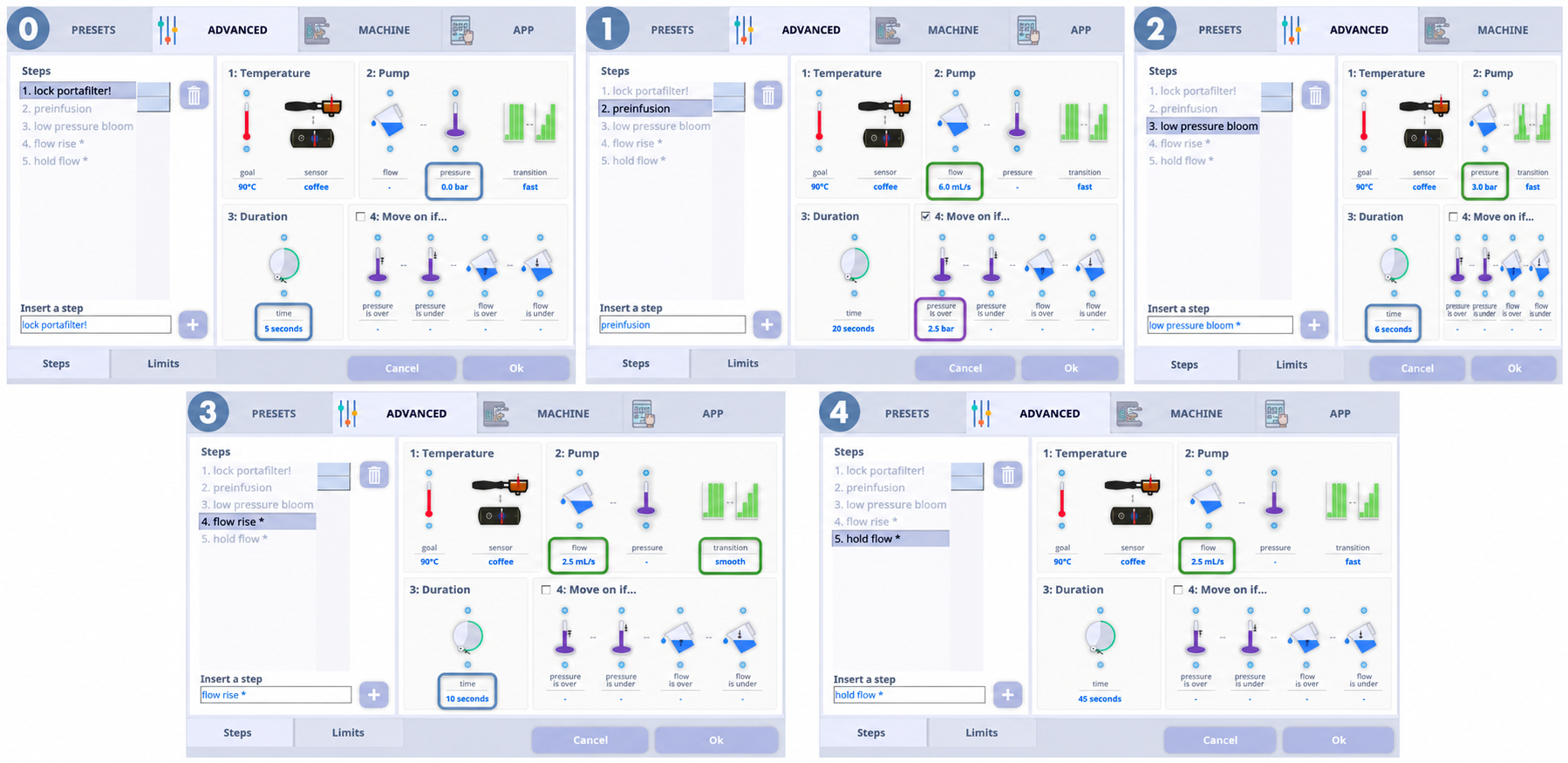
The initial “lock portafilter” step is optional. Its purpose is to keep the puck from being exposed to the hot machine environment while the brew water completes its final warm-up.
4. Results
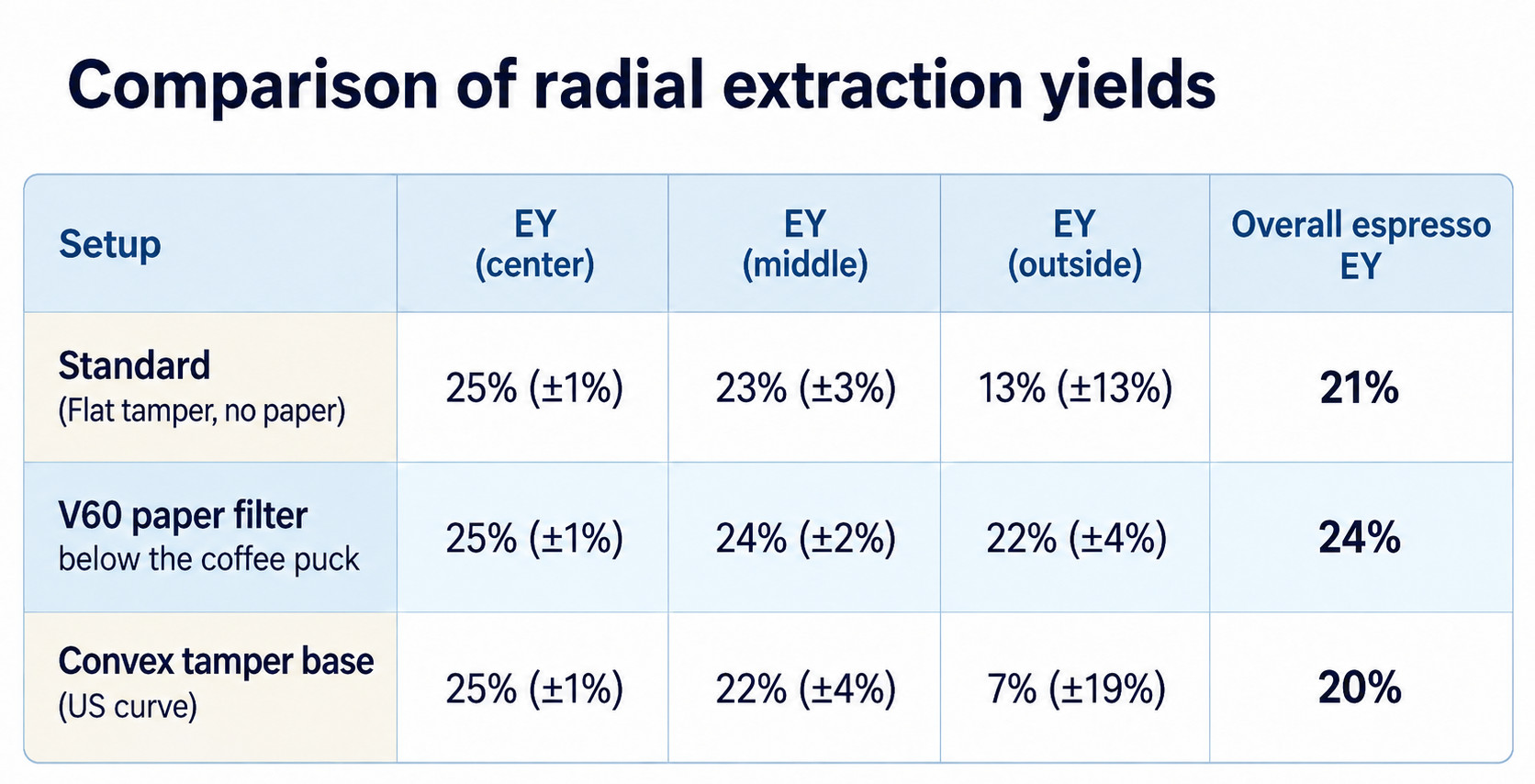
Thanks to his experiments, Stéphane found the following EY:
To sum it all up, Stéphane found the following:
1. Baseline extraction deficit: In a standard espresso shot, the outer edges of the coffee puck (outer 1/4 of total dose weight) achieve only half the extraction yield of the center grinds.
2. Impact of paper filters: Placing a V60 paper filter below the puck significantly improves radial uniformity and increases average Extraction Yield from 21% to 24%.
3. Impact of tamper shape: A convex tamper base (US curve) increases flow toward the center, worsening radial unevenness and dropping average EY to 20% compared to a flat tamper base (21%).
4. Impact of the filter basket perforated surface area: The Reneka Micro-Sieve basket (40 mm perforated diameter) has a surface area 33% smaller than standard 49 mm baskets (Decent, VST, IMS), causing a typical loss of 3 EY percentage points.
Expanding the perforated surface area on precision baskets from 49 mm to 53 mm increases active hole coverage by +17%, which is hypothesized to significantly improve radial extraction uniformity.
5. Conclusion
The presentation's evidence points to a specific structural weakness in conventional espresso extraction: the outer part of the puck receives substantially less effective extraction than the centre. This is not a minor border effect, because the affected outside annulus represents approximately one quarter of the dose.
The V60 paper filter below the puck is the most successful tested intervention. It leaves the centre essentially unchanged while raising the outer-region extraction from 13% to 22%, reducing the radial spread by three quarters and increasing overall extraction from 21% to 24%. In contrast, the convex tamper intensifies central preference and reduces outer extraction to only 7%.
The basket-perforation analysis provides a coherent engineering explanation, but it remains a proposal requiring a direct experiment.
1: In a standard espresso shot without a paper filter below the puck, how uniform is extraction yield from the centre to the edge?
It is highly nonuniform under the tested conditions. The centre reaches 25% EY, the middle 23% and the outside only 13%. The outer quarter of the dose is therefore extracted at only about 52% of the centre's level. The reported 21% beverage average conceals a 12-percentage-point radial range.
2: Does placing a V60 paper filter below the puck improve radial extraction uniformity and increase the average extraction yield?
Yes, substantially in this experiment. The outside rises from 13% to 22%, while the middle rises from 23% to 24% and the centre remains at 25%. The centre-to-edge range contracts from 12 to 3 points, and the overall extraction yield increases from 21% to 24%. The improvement is driven mainly by recovery of peripheral extraction rather than by further extraction of the centre.
3: How does a convex “US curve” tamper base affect radial extraction compared with a flat tamper base?
It worsens radial uniformity. The centre remains at 25%, but the middle falls to 22% and the outside falls to 7%. The centre-to-edge difference grows from 12 to 18 points, and the reported overall extraction declines from 21% to 20%. The data are consistent with flow being concentrated more strongly toward the centre at the expense of the puck perimeter.
4: Could the limited perforated area of an espresso basket explain peripheral underextraction, and would enlarging that area be a promising solution?
It is a plausible and geometrically well-supported hypothesis, but it is not proven by the presentation. A standard 49 mm perforated field ends almost exactly where the underextracted outer region begins, and the 40 mm Reneka field is considerably smaller. Increasing the perforated diameter from 49 to 53 mm would add approximately 17% active area and extend the holes into the measured outer annulus. A controlled basket experiment would still be necessary to separate the effect of perforated diameter from hole density, hole shape, basket geometry and other design differences.
#research #Ribes #coffee #EY #extraction #documentation
