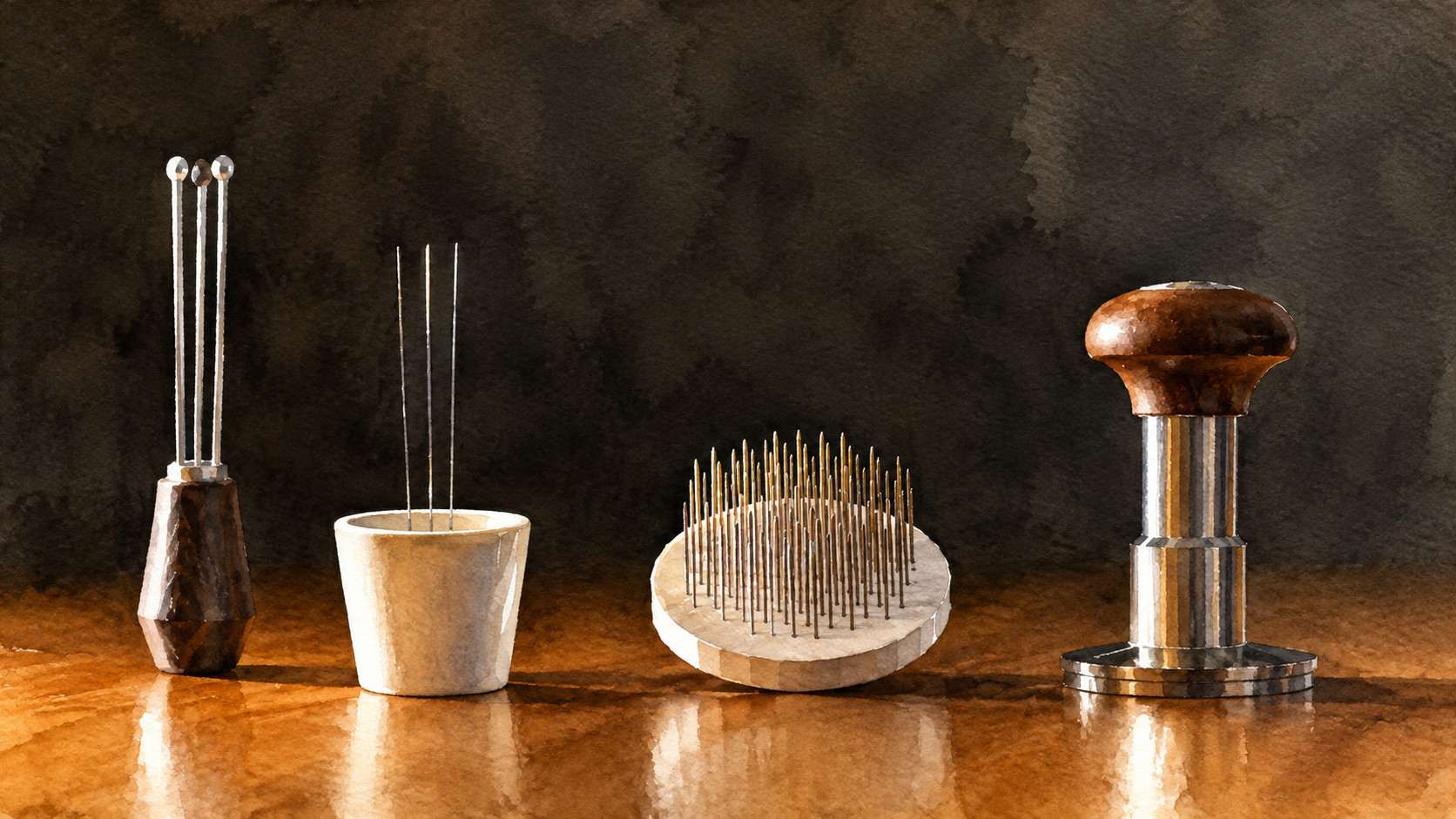
This article is based on an investigation into espresso puck preparation techniques conducted by Stéphane Ribes in June 2020 (v1.1). For reference, here's Stéphane's original PDF. Using a Decent Espresso machine (DE1PRO v1.1) and a blooming shot profile, the experiment evaluates the impact of various distribution methods, tapping, and deep-needle alignment tools (such as the Hog tool) on extraction dynamics, yield, and shot clarity/taste.
Questions
The following questions were investigated across the tests:
1. What combination of puck preparation techniques yields the most consistent and highest quality espresso?
2. How does the Weiss Distribution Technique (WDT) compare when using different needle diameters (e.g., 0.4 mm vs. 0.7 mm Londinium tool)?
3. What is the impact of using a Hog tool (95 spikes of 0.8 mm diameter) following WDT and tapping?
4. How do vertical taps before tamping affect extraction pressure and speed?
5. Does visual uniformity during extraction directly correlate with extraction yield (EY) or taste scores?
6. How does dose adjustment (e.g., 18.0 g vs. 18.5 g vs. 19.0 g) influence extraction dynamics across different preparation methods?
Method
The tests were performed following a strict standard protocol to ensure test reliability:
Machine & basket: Decent Espresso DE1PRO v1.1, Cafelat 8.0 mm silicone gasket, IMS SI 200 IM shower screen, VST 22g ridgeless filter basket.
Grinder & beans: Mahlkönig EK43 S with SSP "High Uniformity" (Silver Knight coating) burrs, single-dosed and ground frozen (setting EK1.7).
Water & thermal control: Montille water re-mineralized to 40 ppm CaCO3 alkalinity and 90 ppm CaCO3 hardness; portafilter pre-heated to 80°C in a kettle; basket and screen wiped dry before every shot.
Dose & ratio: Standard dose of 18.5 g (unless specified otherwise) targeting a brew ratio of 1:2.2.
Tamping: The Force Tamper (58.5 mm smooth flat base) at 24 lbs spring pressure.
Brew profile: 20-second blooming profile with a slow ramp (15 sec) followed by 2.2 mL/s flow rate extraction.
Measurement: TDS measured with an unfiltered Atago PAL refractometer at room temperature after vigorous stirring (each data point represents an average of 3 to 5 measurements).
Proceeding The experimental runs were conducted over two main test dates:
June 13, 2020 Tests: Compared varied distribution methods including no distribution (nothing, portafilter circular motion, surface raking, full WDT with 0.7 mm needles (Londinium tool), full WDT with 0.4 mm home-made needles, WDT + gentle vertical taps, and WDT + vertical taps + Hog tool.
June 23, 2020 Tests: Evaluated consistency across fixed dose variations (18.5 g vs 19.0 g) comparing no distribution, WDT (0.4 mm) + taps, and WDT (0.4 mm) + taps + Hog tool.
Results
The main findings and detailed metric comparisons from the tests are detailed below:
Main Findings:
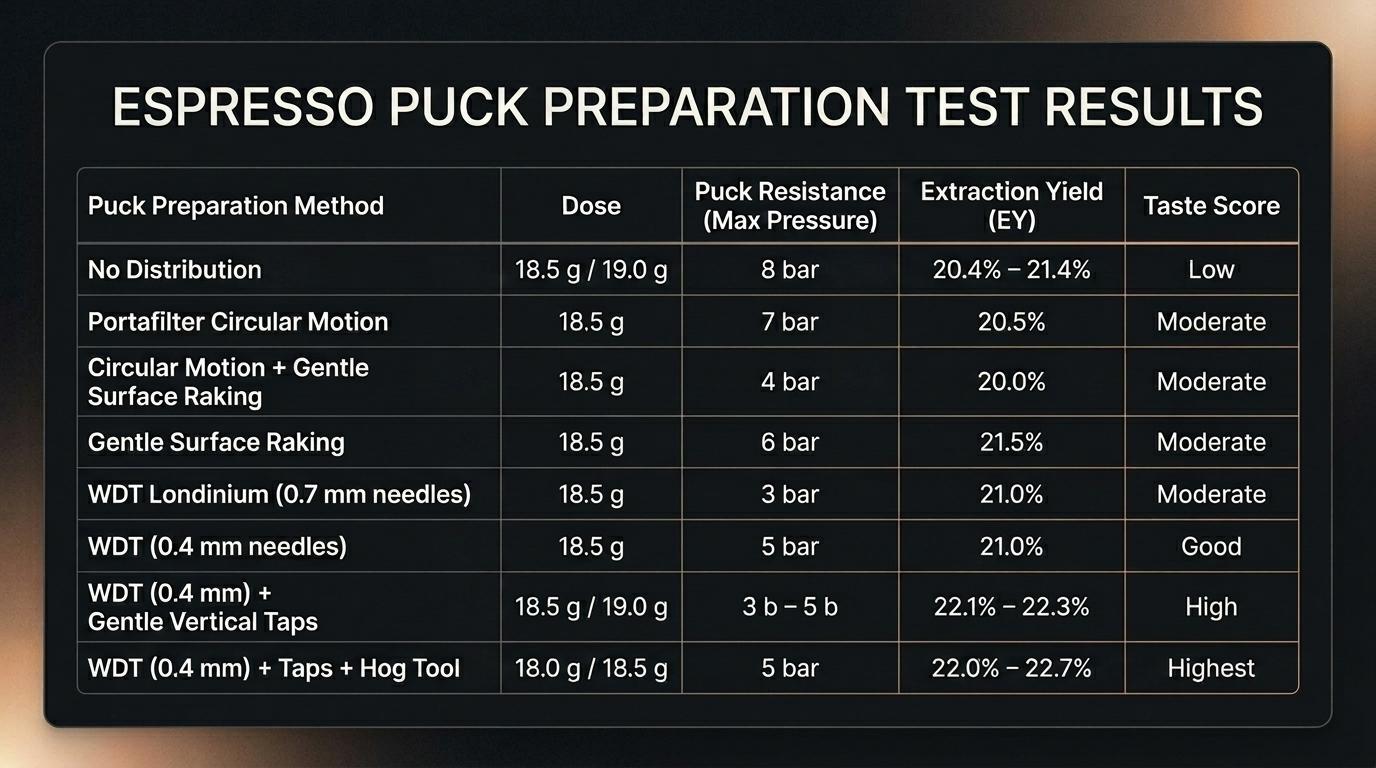
Combining WDT through the full height of the puck using 0.4 mm needles with gentle vertical taps before tamping produced the best and most consistent results.
The Hog tool (95 spikes of 0.8 mm) applied after WDT + vertical taps yielded faster puck wetting, higher extraction resistance, and improved taste profiles (increased sweetness and fruity acidity).
Skipping distribution entirely occasionally produced high EY or tasty shots, but lacked consistency compared to WDT methods.
Visual extraction uniformity did not reliably correlate with higher EY values or superior taste scores.
Higher extraction yields consistently correlated with the highest-rated shots in taste tests.
Here's a table summarizing the tests and results:
Conclusion
Based on the findings, we can answer our questions as follows:
1. What combination of puck preparation techniques yields the most consistent and highest quality espresso?
Combining deep WDT throughout the entire height of the coffee bed using thin 0.4 mm needles with gentle vertical taps prior to tamping produces the highest consistency and overall shot quality.
2. How does WDT compare when using different needle diameters (0.4 mm vs. 0.7 mm)?
Thinner needles (0.4 mm) perform better than thicker needles (0.7 mm Londinium tool), providing smoother distribution without creating macro-channels or excessive disruption in the bed.
3. What is the impact of using a Hog tool after WDT and tapping?
The Hog tool significantly increases extraction resistance and speeds up initial puck wetting, leading to enhanced sweetness and fruity acidity alongside top-tier extraction yields (up to 22.7%).
4. How do vertical taps before tamping affect extraction?
Gentle vertical taps collapse deep air pockets and level the coffee bed, facilitating cleaner, more uniform flow dynamics and preventing premature channeling.
5. Does visual uniformity during extraction directly correlate with extraction yield or taste scores?
No, visual uniformity during extraction does not always correlate directly with higher EY or superior taste scores.
6. How does dose adjustment influence extraction dynamics across these preparation methods?
Lowering the dose slightly (e.g., from 18.5 g to 18.0 g) under fine grind settings speeds up initial flow ("first drop in cup") while preserving or enhancing peak pressure and total extraction yield.
#research #Ribes #coffee #puckprep #documentation
