Stéphane Ribes explored the impact of freezing coffee beans on espresso extraction consistency, water flow resistance, and optimal resting time post-roast. This article is based on his presentation from July 2019.
Main questions asked
1. Consistency: Does grinding frozen coffee beans lead to more consistent extractions across multiple days using identical parameters?
2. Resistance: How does grinding frozen beans affect water flow resistance during extraction compared to grinding non-frozen beans?
3. Resting time: What is the impact of resting coffee beans for additional days prior to freezing on extraction pressure, extraction yield (EY), and overall taste quality?
Method used & proceeding
Stéphane conducted controlled experiments measuring extraction yield (EY), extraction pressure profiles, and flavor characteristics across different coffee roasts and resting timelines.
Equipment & preparation details
Espresso machine: Decent Espresso DE1PRO v1.1 equipped with an IMS SI 200 IM shower screen.
Grinder: Mahlkönig EK43 S grinder.
Water: Montille water adjusted to SCAA standards using sodium carbonate and Epsom salts.
Puck Preparation: Beans ground directly into a double-wall stainless steel cup; Weiss Distribution Technique (WDT) applied in cup with a mini whisk; un-wetted 55 mm Camlab paper filter placed at the bottom of the basket; basket WDT with a mini whisk; surface raking with a Hog tool (0.8 mm diameter spikes) using a vertical hog stand; manual tamp with a 58.6 mm tamper.
TDS & EY measurement: Measured with an Atago PAL refractometer zeroed with SCAA water; samples measured at room temperature following thorough agitation, averaging 3 to 4 measurements per data point.
Testing procedure
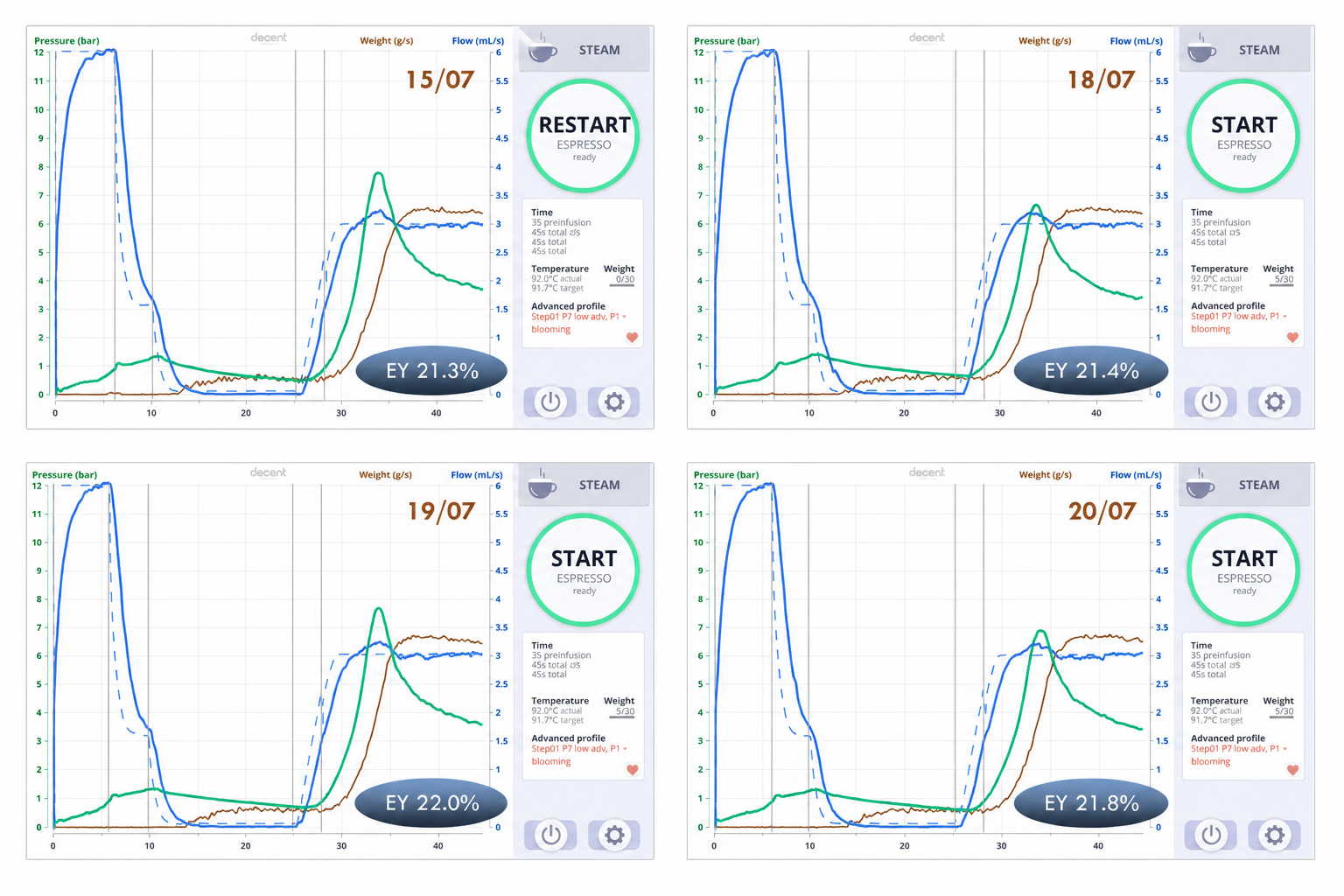
Consistency test: Pulled single shots daily across several days (July 15, 18, 19, and 20) using a natural Ethiopian Yirgacheffe (Friedhats Coffee Roasters, filter roast called Kochere Boji) frozen 6 days post-roast, holding grind setting, dose (18.5g in a 22g VST basket), and workflow identical.
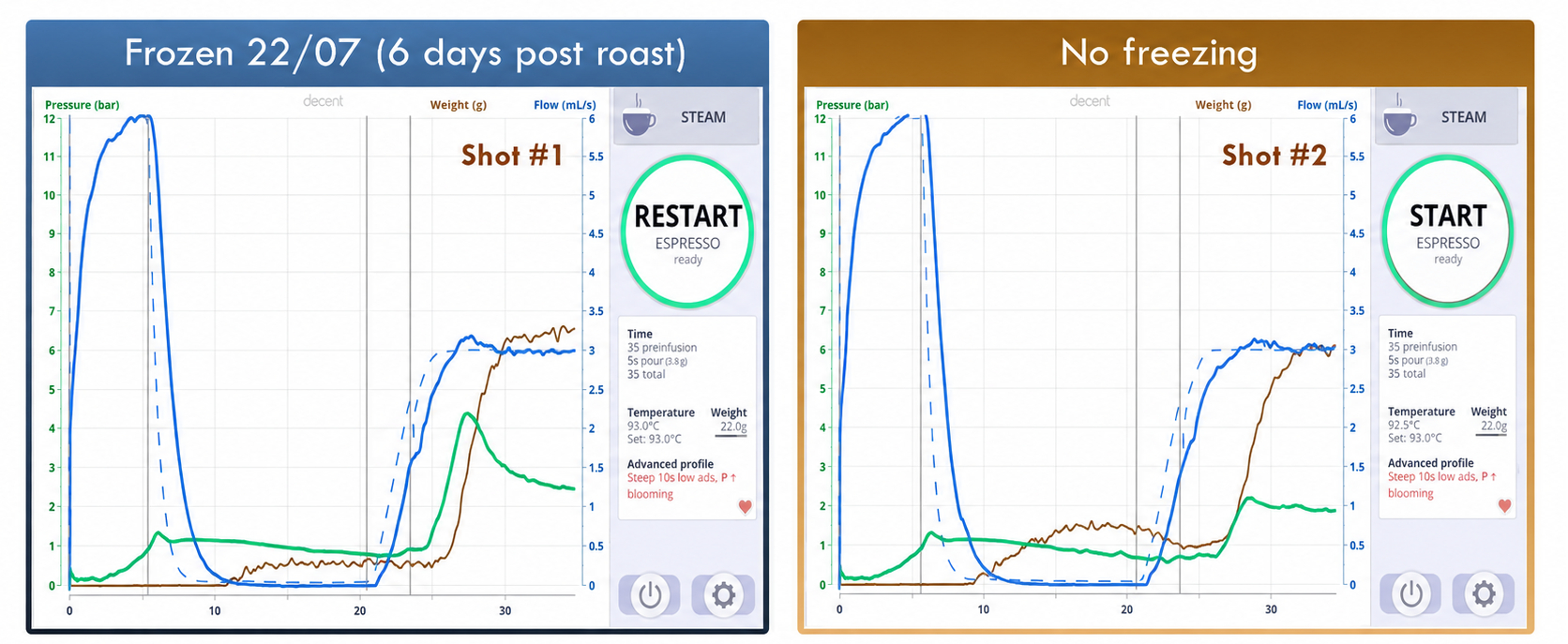
Resistance test: Compared back-to-back shots on the same day using non-frozen vs. frozen natural Kenyan coffee (Terres de Café - Chania Estate) at identical grind settings.
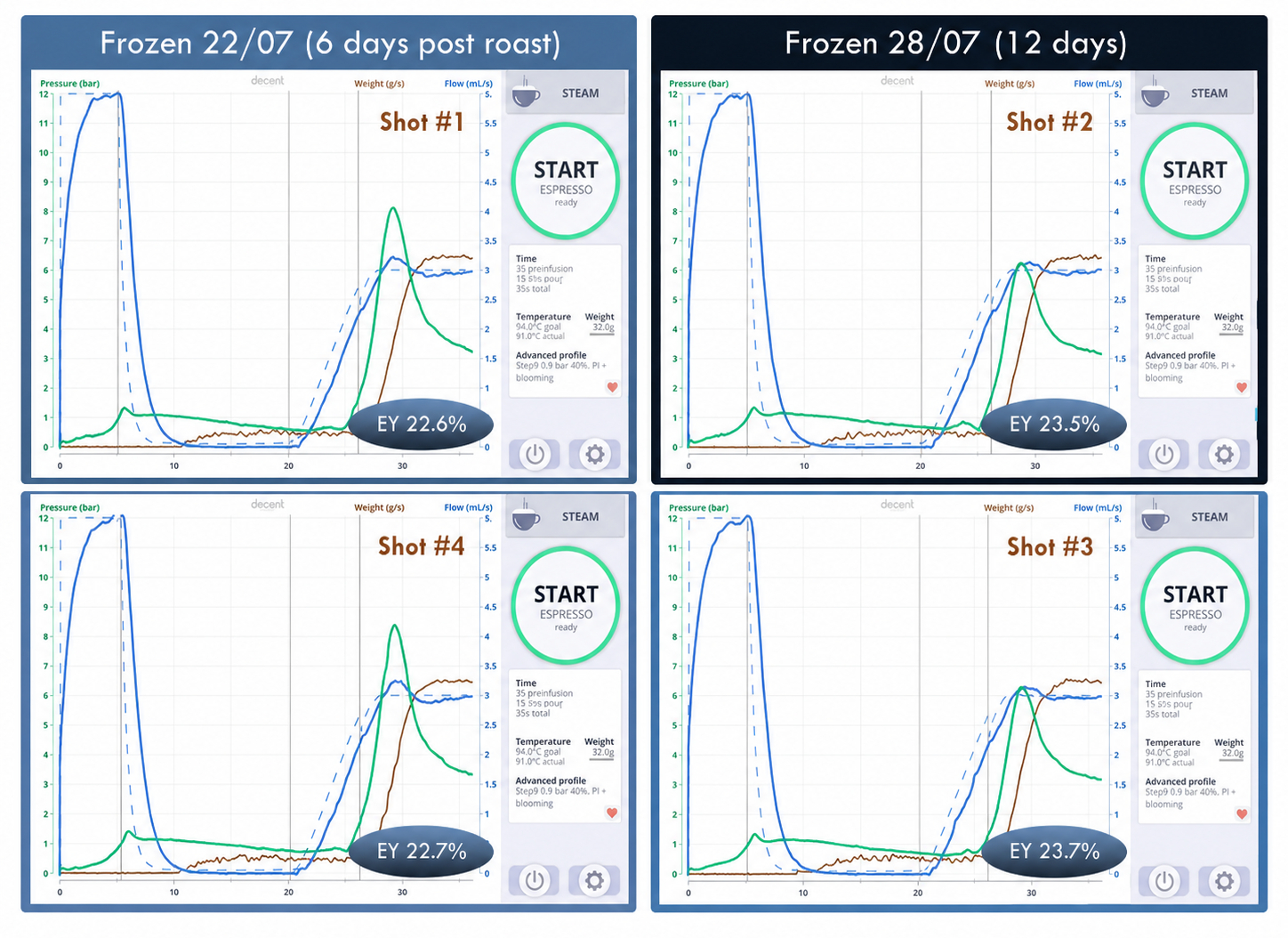
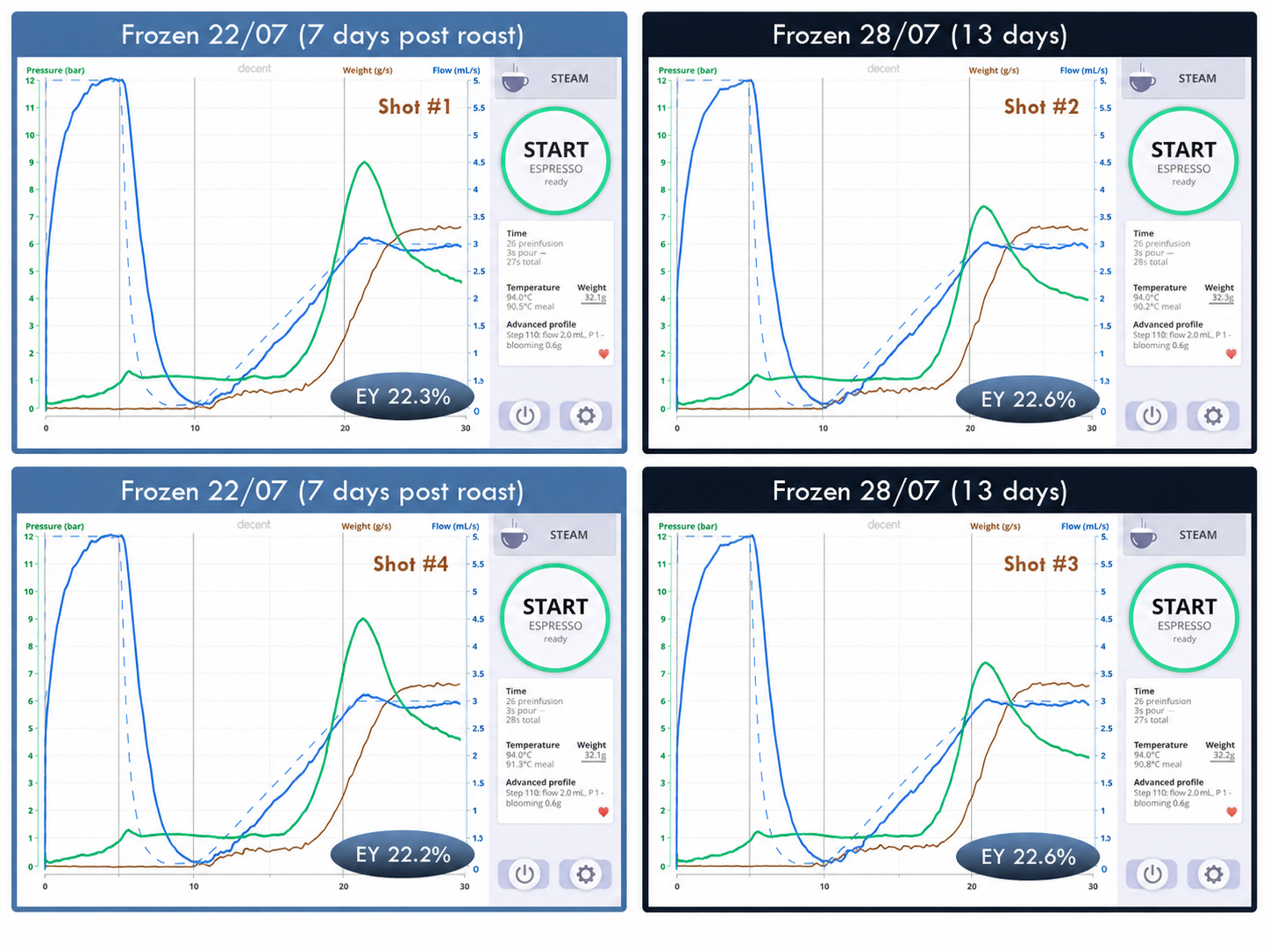
Resting time test: Compared consecutive shots of beans frozen at 6, respectively7 days post-roast versus beans frozen after an additional 6 days of resting (12, respectively 13 days post-roast) using natural Kenyan and natural Ethiopian roasts.
Results
Consistent extractions: Freezing beans resulted in minimal variance in extraction pressure and Extraction Yield across four separate days (EY values: 21.3%, 21.4%, 21.8%, and 22.0%).
Increased resistance to flow: Grinding frozen beans created significantly higher resistance to water flow compared to non-frozen beans, allowing the barista to use a coarser grind setting to achieve the target extraction pressure.
Impact of resting time: Allowing beans to rest an additional 6 days before freezing lowered the peak extraction pressure, slightly increased the Extraction Yield, and yielded sweeter, more pleasant acidity and overall better-tasting espresso.
Conclusion
The following conclusions can be drawn from the experiments, answering the questions:
1: Does grinding frozen coffee beans lead to more consistent extractions?
Yes. Grinding frozen beans produces highly repeatable extraction pressures and steady Extraction Yields across days without changing grinder settings. This significantly reduces the need to constantly dial in coffee once an optimal recipe is set.
2.: How does freezing affect water flow resistance during grinding and brewing?
Frozen coffee beans offer greater resistance to water flow when ground. Because frozen beans yield higher puck resistance, a coarser grind setting can be used to reach a target extraction pressure, helping bypass grinder performance limitations associated with ultra-fine grind settings.
3.: Does resting coffee beans longer before freezing improve taste and extraction?
Yes. Allowing beans to rest for roughly two weeks post-roast before freezing lowers the extraction pressure peak, boosts extraction yield, and yields superior flavor profiles marked by sweeter notes and pleasant acidity.
#research #Ribes #coffee #beans #freezing #resting #documentation
