1. Introduction
This article is based on research from Stéphane Ribes from February 2020. It investigates the adaptation of a hybrid "lever-blooming" profile on a Decent Espresso DE1PRO v1.1 machine. The core focus of this study is determining whether adjustments to profile steps allow for higher final extraction flow rates while maintaining the target extraction pressure range and mitigating puck channeling.
2. Questions
The investigation focuses on answering the following key questions:
1. Can higher extraction flow rates be achieved without causing coffee puck channeling?
2. How does the rate of flow rise (transition step) during the dialing-in process impact extraction yield (EY) and shot taste?
3. How do adaptations to the "lever-blooming" profile perform at different final flow rates (1.5mL/s vs. 2.5mL/s)?
3. Method
Equipment
Decent espresso machine: DE1PRO v1.1 equipped with a red Cafelat 8.0mm silicone gasket.
Shower screen: IMS SI 200 IM screen (used without a spacer).
Grinder: Mahlkönig EK43 S equipped with SSP "High Uniformity" burrs featuring a Silver Knight coating.
Filter basket: VST 15g ridgeless filter basket.
Tamper: The Force Tamper with a 58.35mm US curved smooth base, applied twice per shot.
Water & Coffee Preparation
Water: Montille water adjusted using sodium carbonate and Epsom salts to achieve 50ppm eq. CaCO3 alkalinity and 125 ppm eq. CaCO3 total hardness.
Preparation workflow: Frozen beans were single-dosed and ground into a double-walled stainless steel cup. The filter basket and shower screen were thoroughly dried prior to each shot. Basket Weiss Distribution Technique (WDT) was performed using a Londinium tool with a Decent funnel, followed by gentle raking with a Hog tool to create a uniform surface (ensuring no vertical tapping). Puck preparation was completed using a Hog tool mounted on a stand to ensure precise vertical motion.
Measurement protocol
Refractometer: Atago PAL refractometer zeroed with the adjusted Montille water.
Sampling: Unfiltered coffee samples were measured at room temperature after vigorous stirring.
Averaging: Each reported data point represents the average of 3 to 5 separate measurements.
4. Proceeding
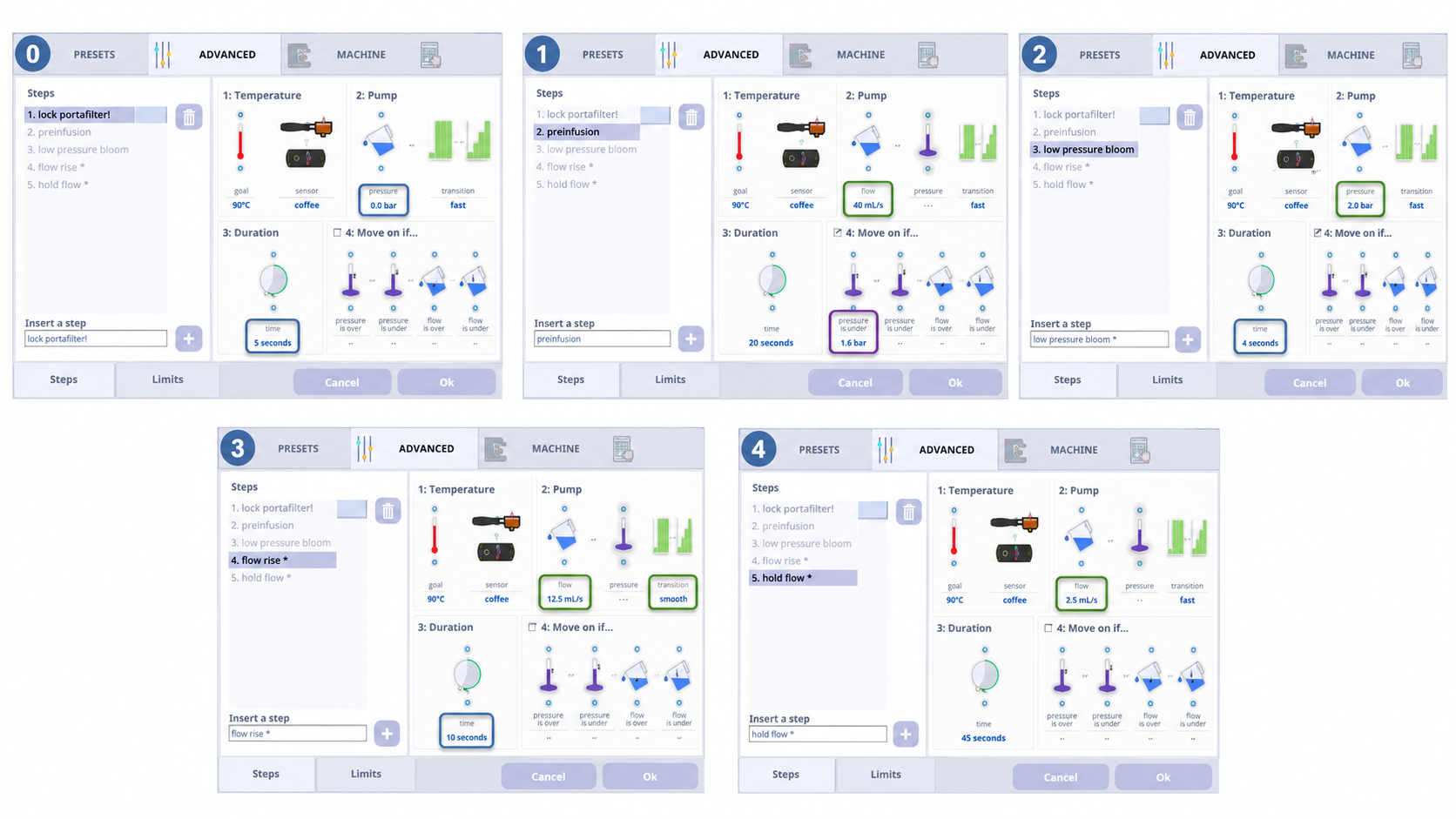
Profile Structure (Hybrid "Lever-Blooming")
Step 0 (Optional): "Lock portafilter" step designed to shield the coffee puck from hot steam during the final brew water warm-up phase.
Step 1 (Preinfusion): Water is delivered at 4mL/s, terminating once 80% of the target pressure of Step 2 is reached.
Step 2 (Pressurized bloom): Pressure priority stage. Target pressure is reduced for higher flow profiles to prevent excessive drippage when using coarser grinds.
Step 3 (Flow transition): A smooth, gentler increase in flow rate that transitions into the final extraction flow rate.
Step 4 (Extraction): Flow priority extraction stage stopped automatically by weight at a target Brew Ratio of 1:2.4.
Tested profiles
Profile A (1.5mL/s extraction flow rate):
Recipe: 14g dose in, 34g yield out (Brew Ratio 1:2.4).
Variations: Compared a shorter pressurized bloom (4 s) paired with a longer flow ramp (12 s) against a longer bloom (12 s) paired with a shorter flow ramp (4 s).
Shot duration: Total shot times ranged between 40 s and 45 s.
Profile B (2.5mL/s extraction flow rate):
Recipe: 13g dose in, 31g yield out (Brew Ratio 1:2.4).
Variations: Compared a shorter bloom (4 s) paired with a longer flow ramp (10 s) against a longer bloom (10 s) paired with a shorter flow ramp (4 s).
Shot duration: Total shot times ranged between 29 s and 35 s.
5. Results
The table below outlines the measured Extraction Yield (EY) data collected across various grind size settings on the Mahlkönig EK43 S:
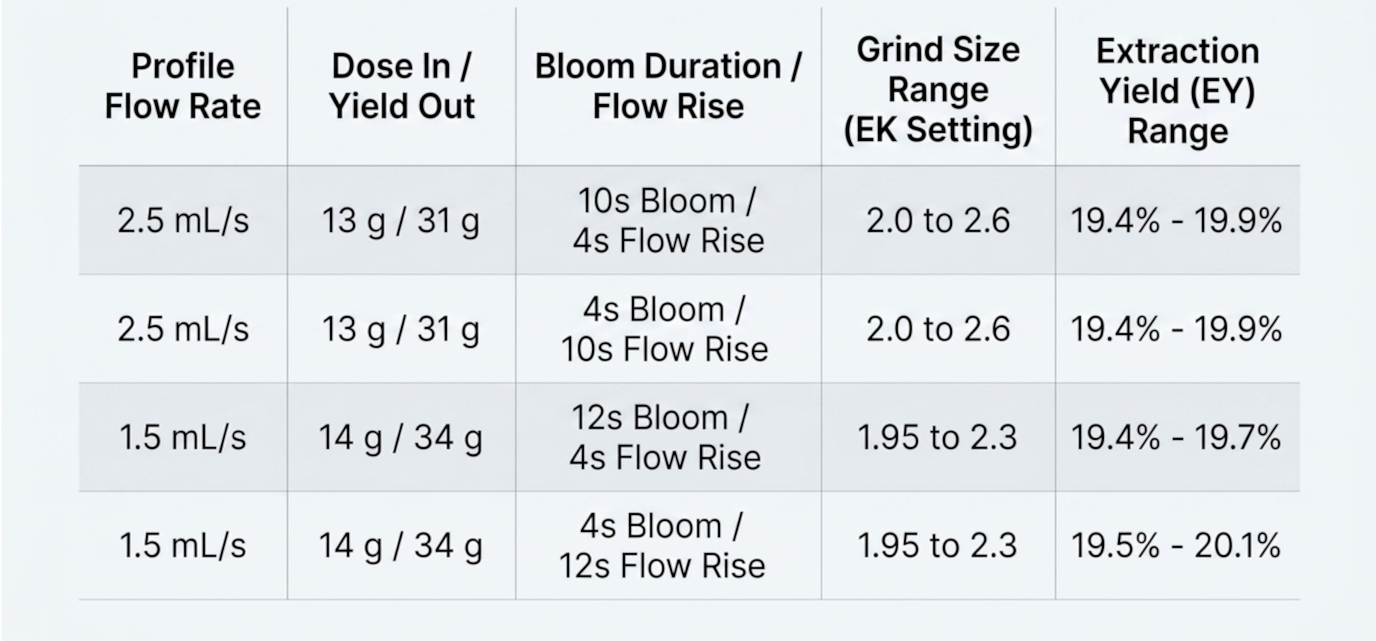
At 2.5mL/s, the experiments resulted in an identical Extraction Yield (EY) range of 19.4% – 19.9% for both bloom/flow rise variations. At 1.5mL/s, the 12s Bloom / 4s Flow Rise setup achieved an EY range of 19.4% – 19.7%, while the 4s Bloom / 12s Flow Rise setup yielded slightly higher at 19.5% – 20.1%.
6. Conclusion
The following can be concluded from the experiments:
1. Can higher extraction flow rates be achieved without causing coffee puck channeling?
Yes. Higher flow rates (2.5mL/s) are achievable without channeling by making specific profile adaptations. Coarser grind sizes are used to maintain target pressure ranges, requiring a lower pressure limit during the pressurized bloom step to prevent premature drippage.
2. How does the rate of flow rise during the dialing-in process impact extraction?
A gentler, slower increase in flow rate (Step 3 transition) helps avoid sour shots by mitigating puck channeling. Extraction Yields remain highly consistent (19.4% - 20.1%) across various grind size adjustments.
3. How do adaptations to the "lever-blooming" profile perform at different final flow rates (1.5mL/s vs. 2.5mL/s)?
At 2.5 mL/s, the profile requires coarser grind settings and a lower pressure limit during the pressurized bloom step to prevent premature drippage. Despite completing much faster (29–35 s compared to 40–45 s for the 1.5mL/s profile), the 2.5mL/s profile achieves virtually identical extraction yields (19.4%–19.9% vs. 19.4%–20.1%). Both flow rates successfully eliminate puck channeling and avoid sour shots as long as a gentle flow transition step is applied.
#research #Ribes #coffee #flowrate #channeling #documentation

