1. Introduction
This research by Stéphane Ribes (April 2020) evaluates the physical and chemical impacts of pre-infusion flow rates on espresso extraction dynamics using a light-medium espresso roast. By leveraging the Decent Espresso platform, the study examines how varying initial water flow rates during pre-infusion alter peak extraction pressure, espresso yield, total dissolved solids (TDS), and extraction yield (EY) while holding other variables like grind size and temperature constant.
2. Questions
How does altering the pre-infusion flow rate affect the peak pressure and extraction velocity when keeping the dose, grind size, and target yield constant?
How does pre-infusion flow rate impact the extraction yield (EY) of an espresso roast?
How must coffee dose weight be adapted across different pre-infusion flow rates to maintain a consistent peak extraction pressure (~6 bar)?
3. Method
Machine & setup: Decent Espresso DE1PRO v1.1 machine with a Cafelat 8.0mm silicone gasket and IMS SI 200 IM shower screen (no spacer).
Grinder & preparation: Mahlkönig EK43 S grinder with SSP "High Uniformity" burrs. Puck preparation utilized a double-walled stainless steel cup, a Londinium WDT tool with Decent funnel, a Hog puck preparation tool on a vertical stand, and The Force Tamper with a 58.5mm smooth flat base (applied twice).
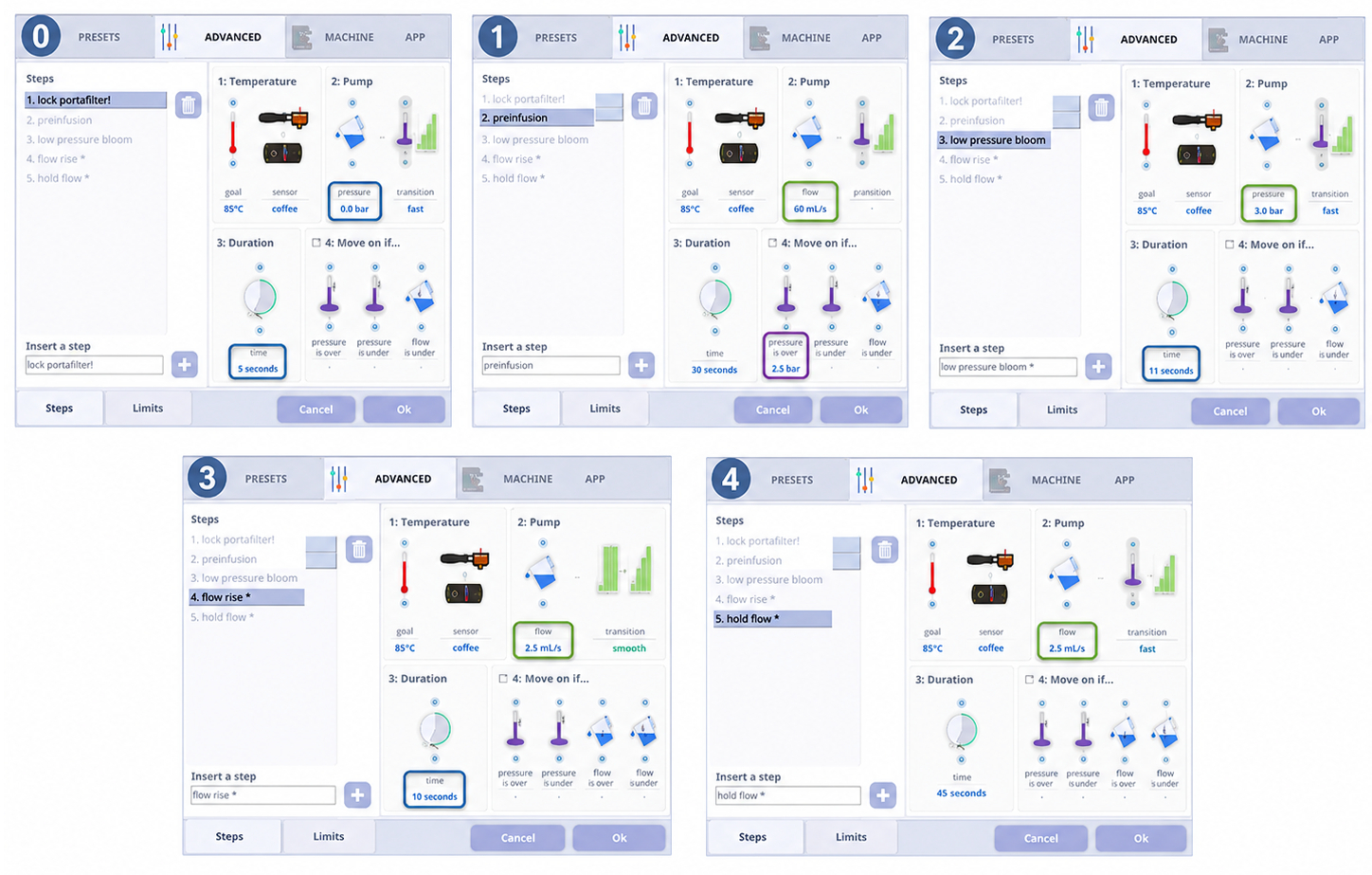
Water & thermal protocol: Portafilter pre-heated to 70°C in a kettle; basket and screen dried completely prior to each shot. Remineralized Montille water (50ppm CaCO3 alkalinity, 125ppm CaCO3 hardness). Extraction performed using a hybrid "Lever-Blooming" profile at 85°C with a target main extraction flow rate of 2.5mL/s.
Coffee & ratio: Colombia Huila Tesoro Gigante (Natural, Espresso Roast by OR Roastery). VST 15g ridgeless basket with a 13g dose aiming for a 30g output (brew ratio of 2.3) over a 33-second total shot time.
Measurement: Atago PAL refractometer zeroed with adjusted water; all samples measured at room temperature without filtering, taking the average of 3 to 5 readings per sample.
Below are the parameters used for the Hybrid "Lever" Blooming profile:
4. Proceeding
1. Fixed-dose flow rate sweep: Five pre-infusion flow rates were tested (2.4 mL/s, 3.0mL/s, 4.0mL/s, 6.0mL/s, and 8.0 mL/s) using an identical 13g coffee dose, identical grind size, and identical target output (30g in 33 seconds).
2. Pressure profile & EY analysis: Measured the corresponding peak pressure (bar) and Extraction Yield (EY %) for each pre-infusion flow rate setting.
3. Dose adjustment calibration: Conducted a second test series adjusting the dose weight (+0.3g to -0.3g) across the different pre-infusion flow rates to normalize and match a target peak pressure of approximately 6 bar.
5. Results
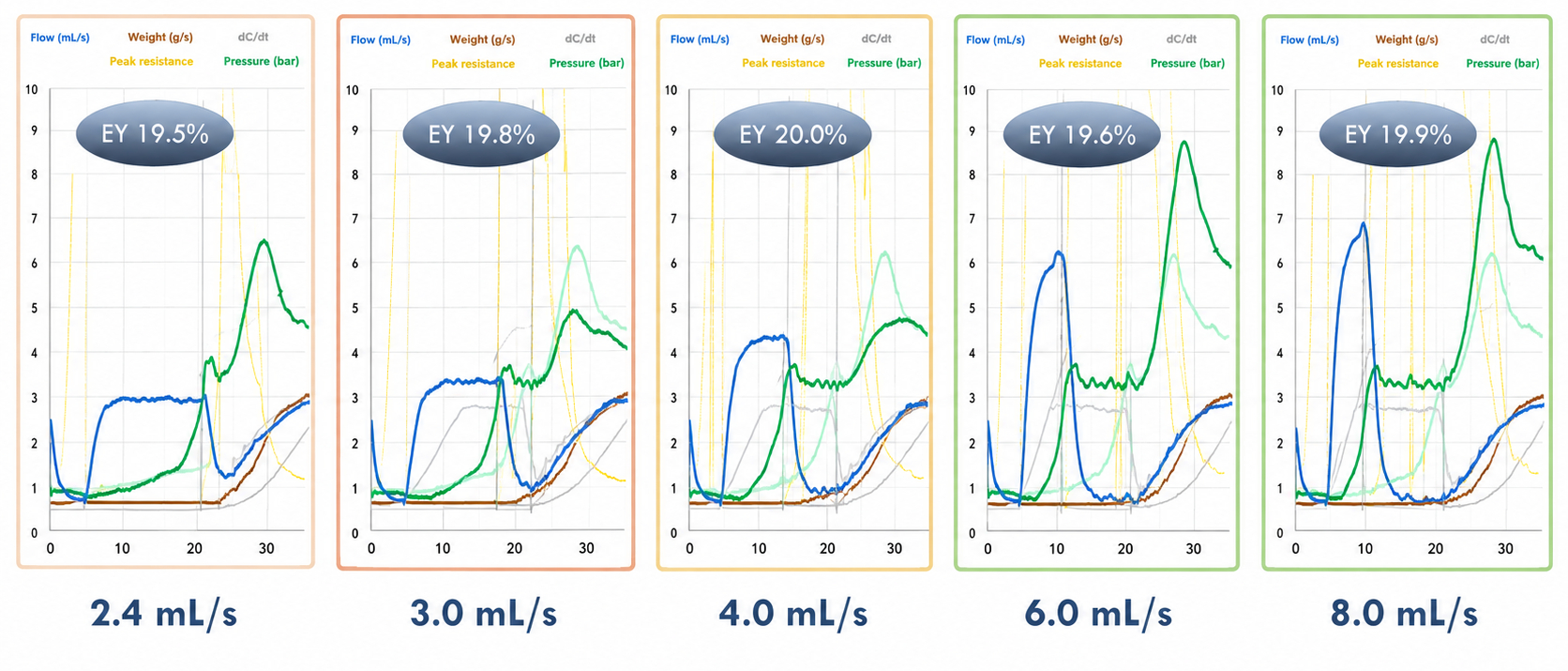
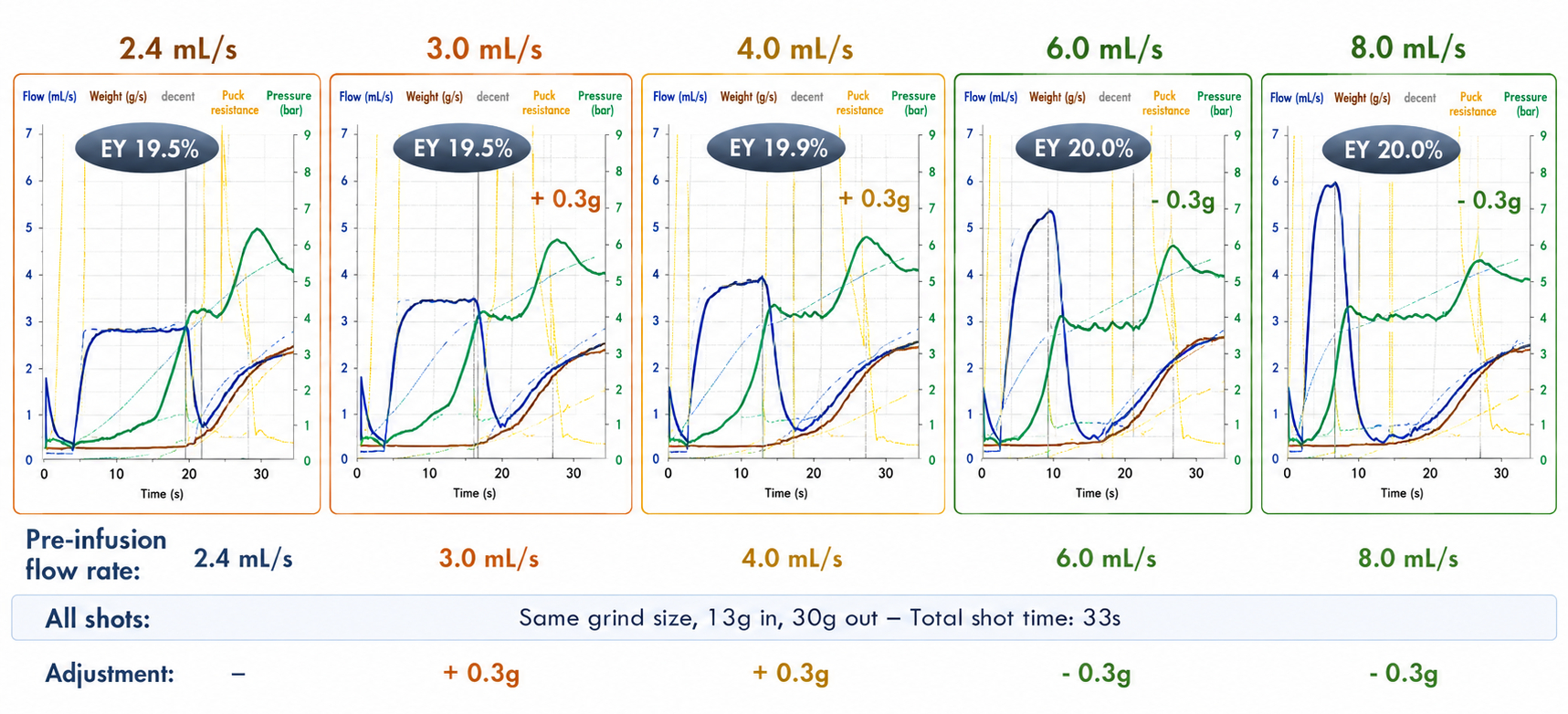
Here's the results found via the experiments, first with a constant 13g dose and then adjusting the dose upwards or downwards:
The following table shows all the results of the experiments in one view:
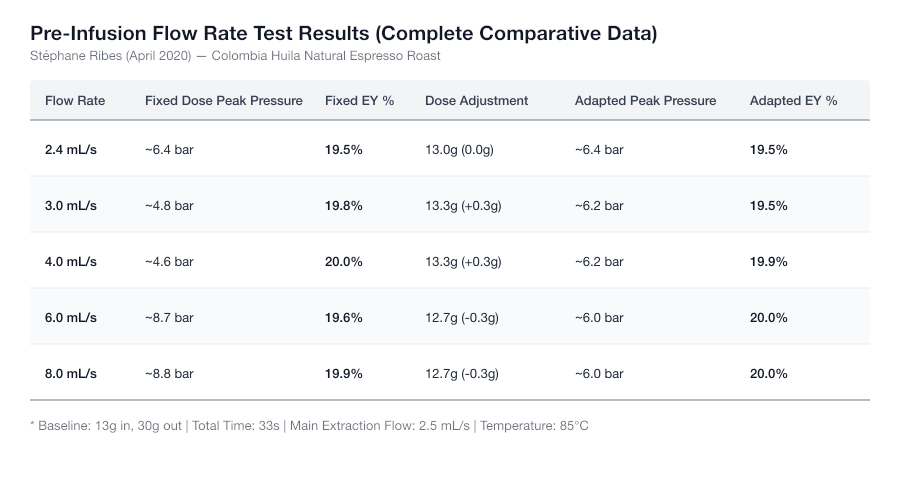
Said results reveal key insights into how pre-infusion flow rates shape extraction hydraulics and puck dynamics:
Non-linear peak pressure behavior (fixed 13.0g dose): Peak extraction pressure follows a non-linear, U-shaped relationship as pre-infusion flow rate increases. At low rates (2.4\mL/s), the pressure peaks at about 6.4 bar. Mid-range rates (3.0–4.0mL/s) drop to lower peak pressures (about 4.6–4.8 bar) due to reduced early bed compaction. High flow rates (6.0–8.0mL/s) violently fill and compact the puck early, driving peak extraction pressures sharply up to about 8.7–8.8 bar.
Inverted dose adjustment for pressure normalization (6 bar target): To maintain a uniform 6 bar peak pressure, dose weight must inversely compensate for puck compression. Mid-range flow rates (3.0–4.0mL/s) require adding coffee (+0.3g, total 13.3g) to raise bed resistance to about 6.2 bar. High flow rates (6.0–8.0mL/s) require subtracting coffee (-0.3g, total 12.7g) to reduce resistance and bring peak pressure down to about 6.0 bar.
Extraction Yield (EY) invariance: Across all profiles—whether fixed-dose or dose-adapted—Extraction Yield remains virtually static between 19.5% and 20.0%. This confirms that pre-infusion flow rate acts primarily as a physical lever for hydraulic pressure and flow dynamic control rather than a chemical solvent driver.
6. Conclusion
The experimental findings demonstrate how pre-infusion flow rates modulate coffee bed resistance and puck compression, establishing the necessary dose compensations to maintain target extraction pressures.
How does altering the pre-infusion flow rate affect peak extraction pressure when maintaining constant grind size, coffee dose (13g), and shot duration (33s)?
Mid-range pre-infusion flow rates (3.0–4.0mL/s) produce the lowest peak extraction pressures (about 4.6–4.8 bar) due to lower initial bed compression. Fast pre-infusion flow rates (6.0–8.0mL/s) forcefully fill and compress the coffee puck early, causing peak pressures to surge to about 8.7–8.8 bar.
How does pre-infusion flow rate impact the overall Extraction Yield (EY) of an espresso roast?
Pre-infusion flow rate has virtually no effect on Extraction Yield. Across all testing conditions—both unadjusted and dose-adjusted—EY remains locked within a tight band of 19.5% to 20.0%.
How must coffee dose weight be adapted across different pre-infusion flow rates to normalize the extraction to a constant peak pressure (~6 bar)?
For moderate pre-infusion flow rates (3.0–4.0\mL/s), the dose must be increased by +0.3g (13.3g) to build sufficient bed resistance. For rapid pre-infusion flow rates (6.0–8.0mL/s), the dose must be decreased by -0.3g (12.7g) to reduce resistance and prevent high peak pressures.
#research #Ribes #coffee #preinfusion #flow #documentation
