Masterclass on how to find the right recipe for your beans
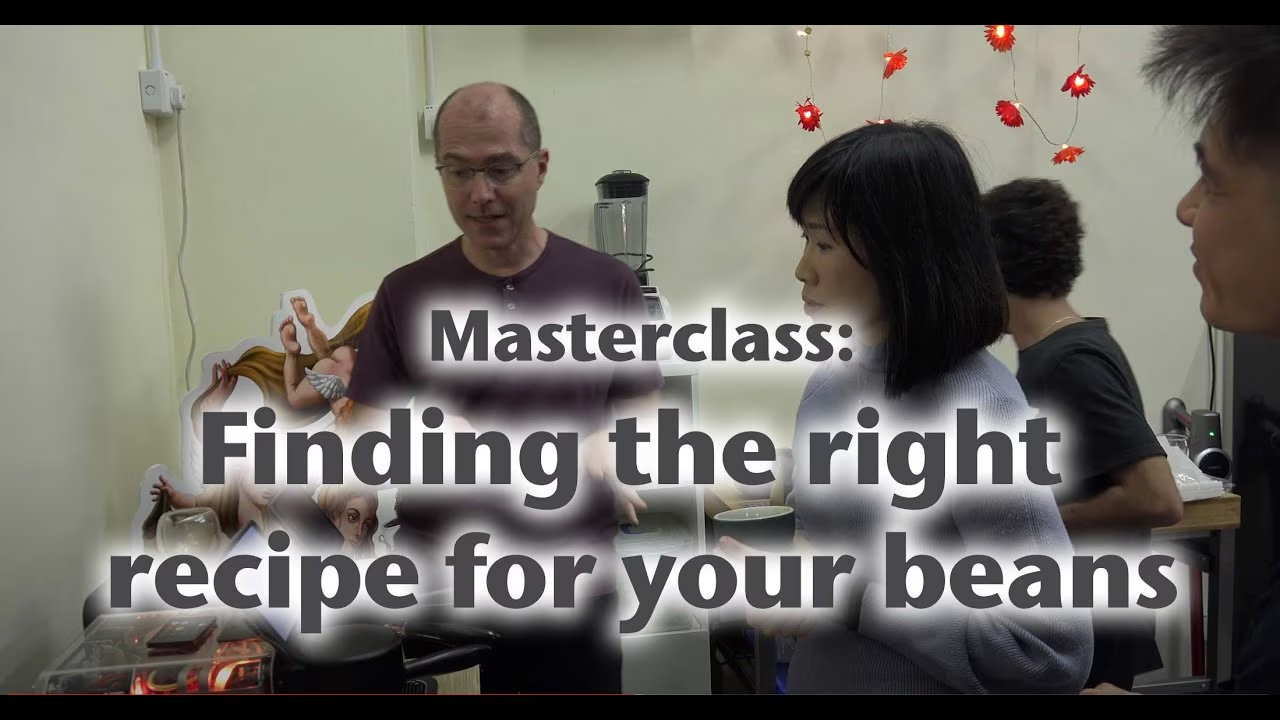

All the info below is pulled from John's masterclass on how to find the right recipe for your beans:
What are the main variables that control an espresso extraction?
John simplifies making espresso into a unified theory focused on two primary variables: the solubility of the coffee bean (how easily it gives up its material to water) and the puck integrity (how well the coffee bed resists water pressure). Balancing these variables helps a barista adjust recipes based on how the bean was roasted.
How does the roast level of a bean affect the espresso recipe?
John explains that roast level heavily dictates both solubility and puck integrity. Lightly roasted beans have low solubility and require longer water contact times or higher flow rates to yield maximum flavor, though they are prone to falling apart quickly during extraction. Darker roasts give up their materials much more easily and naturally maintain a higher puck integrity under pressure, making them significantly easier to extract traditionally.
Why does John utilize a 15-gram dose for the masterclass?
John standardized a 15-gram dose across the recipes because it is a popular, eco-friendly option that stretches more coffee out of fewer beans. He also expresses that using massive doses (like 20 to 24 grams) to pull short ristrettos can be a shortcut that fails to extract the full potential out of the coffee.
What happens when an espresso shot "falls apart"?
According to John, every espresso extraction eventually ends in tragedy when the puck integrity breaks down and the puck fails. A primary goal when executing an espresso recipe is to delay this breakdown for as long as possible so that the shot can be pulled longer to introduce more subtlety, mouthfeel, and complexity without degrading the flavor.
How does pulling a shot shorter vs. longer affect flavor?
John points out that shorter shots tend to display simpler, easier-drinking flavors with less subtlety, making them ideal for milk-based drinks where lower acidity and complexity are desired. Pulling a shot longer brings out more complexity, acidity, and mouthfeel, which is highly preferred when drinking the espresso straight or as an Americano.
What is the purpose of the default lever profile?
John explains that the machine's default profile replicates a traditional lever machine profile. It features an initial pre-infusion phase, ramps up to peak pressure (around 8.6 bars), and then slowly declines in pressure as the shot progresses. This decline stabilizes the water flow acceleration as the puck loses mass, helping to bring out chocolatey, traditional notes from medium to dark roasts.
Why does John recommend adding a touch of water or letting espresso cool for tasting?
High concentrations of total dissolved solids (TDS) in a thick, hot espresso can overwhelm the palate and mask the coffee's subtle notes. John notes that watering down a shot slightly or allowing it to cool toward 30°C (86°F) opens up the flavors, making it much easier to detect fruitiness, acidity, and complex characteristics.
Why does John introduce temperature profiling at the start of a shot?
John experiments with a slightly hotter start (e.g., 90°C dropping quickly to 88°C) to counteract the room-temperature beans chilling the incoming water. Kick-starting the temperature helps warm the puck faster during slow-flowing extractions, ensuring a more stable and equal thermal extraction environment across the entire shot.
What flaw does John find with the popular "Slayer-style" pre-infusion technique?
John argues that the Slayer technique, which involves a very slow pre-infusion that can last up to 40 seconds until the first drip appears, results in an uneven extraction. This occurs because the top of the puck receives water for a full 40 seconds while the bottom only receives it for a few seconds right before the shot starts, leading to an over-extracted top and an under-extracted bottom.
How do the Londinium and Blooming profiles fix this uneven extraction issue?
Both profiles aim to saturate the puck quickly at the start to avoid over-extracting only the top.
Why do profiles with longer pre-infusions require a much finer grind size?
Profiles with extended pre-infusions alter the structure of the puck over time. If a standard grind size is used, the water will simply gush through too rapidly after the pause phase, resulting in a fast, sour, and hollow shot. Baristas must grind much finer to compensate for the accelerated flow that occurs once the puck has sat wet for 10 to 30 seconds.
What is "gushing," and how does John distinguish it from "channeling"?
John distinguishes between the two primary ways an espresso shot can fail structurally:
What pressure thresholds does John identify as problematic for peak espresso extraction?
John states that shots peaking under 6 bars or pushing over 10 bars generally suffer in quality. Going over 10 bars subjects the coffee bed to a "secondary compression" that heavily mutes and deadens the flavor notes. Conversely, staying below 4 bars prevents the puck from compressing at all, leading to a gushing shot that tastes overly acidic and behaves more like a fast filter coffee.
Why is the Blooming profile specifically recommended for light roasts rather than milk drinks?
The Blooming profile uses a long 40-second overall pre-infusion to tackle poorly soluble, lightly roasted beans. It achieves massive extraction rates (23% to 25% on a refractometer compared to a typical cafe's 19% to 21%). Because it completely opens up the bean's soluble material and yields a thinner body with a higher water-to-coffee ratio (typically 3:1), it is designed to highlight delicate, floral filter-style notes rather than cutting through milk.
What is the "Allongé" recipe, and why is it unique?
The Allongé is an ultra-fast, high-flow profile that mimics an Americano or strong drip coffee directly out of the machine. It utilizes a coarse grind and an aggressive flow rate to pull long ratios—pushing a 15-gram dose up to an 80-gram yield in around 30 seconds.
What flavor advantages does the Allongé style offer for light roasts?
Because the shot floods the coffee bed with a continuous stream of fresh, clean water, it utilizes maximum solvent potential without letting the brewing water saturate and stall its extraction power. John notes that it strips away aggressive, unpleasant acidity from light roasts and completely avoids heavy chocolate tones, resulting in a highly expressive, sweet "fruit bomb" filled with tropical or yellow fruit notes.
mirjam created 2026/07/01.