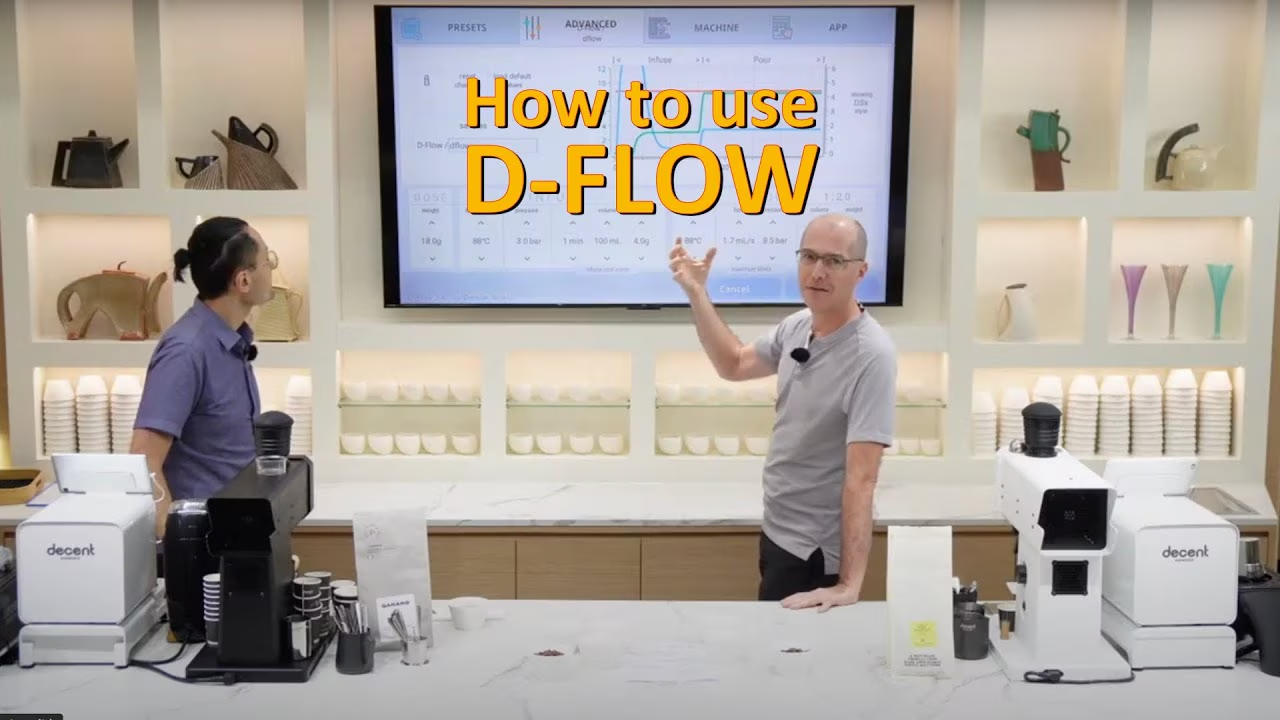
This guide explains how to dial in D-Flow
D-Flow is a de1app profile_editor for creating and editing a particular style of espresso profiling.
D-Flow comes preinstalled with your de1app, including 3 D-Flow profiles, default, La Pavoni and Q.
D-Flow profile names are saved in the form of D-Flow / profile_name so that they list within a D-Flow category in the apps Presets list.
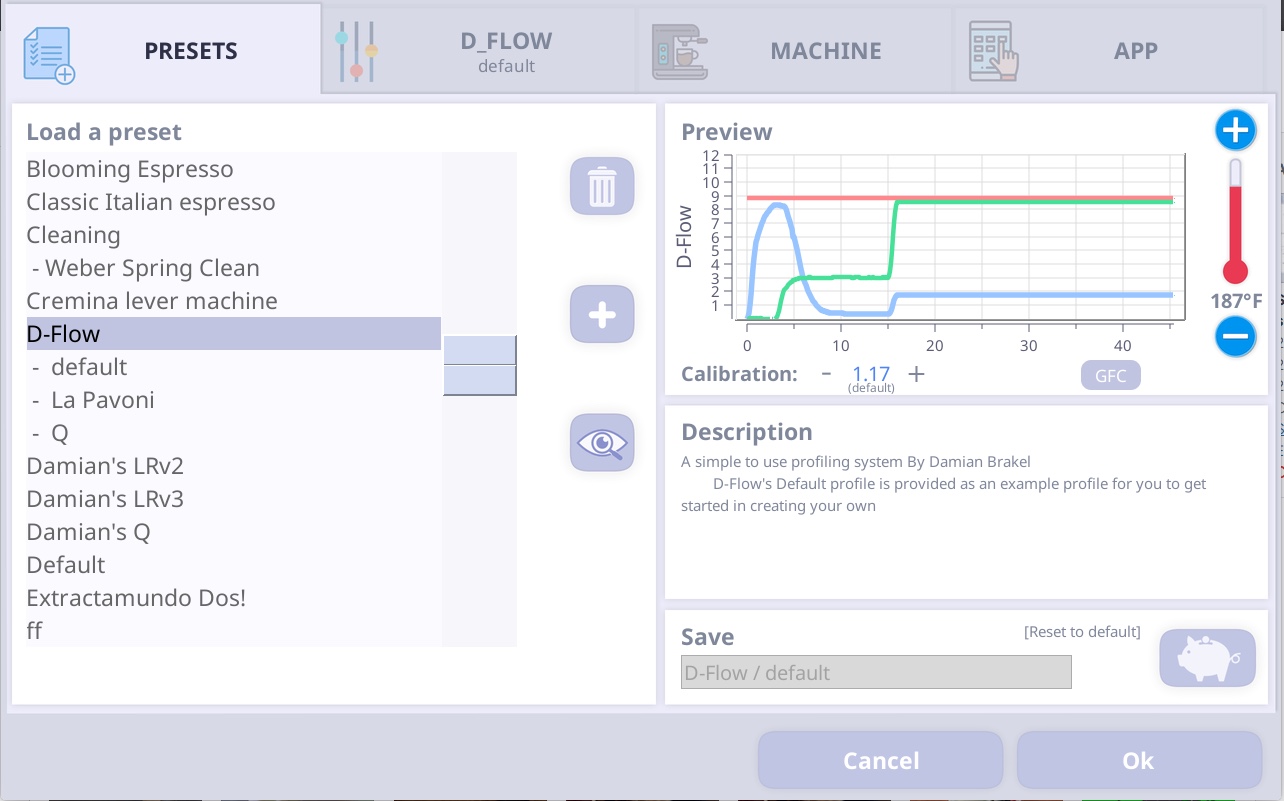
The D-Flow profile (often called the "Londinium family") is designed to simplify espresso brewing by focusing on coffee-relevant variables rather than technical programming. It is highly adaptive, meaning it automatically adjusts its behavior based on your grind size to ensure you always get a good shot.
How D-Flow works
The core philosophy of D-Flow is to use pressurized pre-infusion (infuse in the app) to "heal" the puck and ensure even extraction. Unlike traditional slow-flow pre-infusion, D-Flow fills the basket quickly and then holds it under pressure.
1.
Fast Fill: Water enters the basket quickly to fill the headspace
[00:25].
2.
Pressurized Soak: The machine maintains a specific pressure (typically between 2-4 bar, default is 3 bar). This pressure forces water into every dry pocket of the coffee puck much faster than capillary action alone
[04:49].
3.
Smart Trigger: Instead of a fixed timer, D-Flow waits until it detects a specific weight of coffee (e.g., 4 grams) dripping into the scale before moving to the extraction phase
[02:04].
4.
Hybrid Extraction: Once extraction begins, D-Flow monitors both
pressure and
flow. It will try to hit your target pressure but will automatically "cap" the flow if the puck starts to erode or if the grind is too coarse
[05:11].
Dialing in D-Flow - in 5 simple steps
1. Create your own profile
To get started with creating your own D-Flow profile, select the D-Flow / default profile from the Presets list and then tap the editor tab labelled D-Flow to edit the profile.
Then tap in the text input box, and give your profile a unique name and tap save as, to create your new profile.
You can then adjust settings to suit your goals, tapping the heading tab to save those changes.
Note: D-Flow editor has an “i” information button, which will provide tips on what effect each setting has.
2. Set your baseline variables
Open the D-Flow editor and set these standard starting points:
Dose & Temp: Set your standard dose (e.g., 18g) and temperature based on your roast [01:13].
Infuse Pressure: Set this to around 3.0 bar. This is the pressure maintained while waiting for the puck to saturate [01:28].
Infusion Trigger: Set the Infuse "Weight" trigger to 4.0g. This tells the machine: "Don't start the high-pressure pump until you see 4g of liquid in the cup" [02:08].
3. Set your extraction limits
This is where D-Flow becomes "3 profiles in 1" [06:29]:
Max Pressure: Typically 8.5 or 9.0 bar.
Max Flow Rate: Typically 1.7 to 2.2 ml/s.
4. Interpret the results (the "auto-adapt")
Pull a shot and watch how the machine reacts to your grind:
Grind is Too Fine: The machine will hit the 8.5 bar limit but won't reach the flow limit. You get a traditional 9-bar style espresso [06:37].
Grind is Perfect: The machine hits 8.5 bar, the puck begins to erode, and as the flow speeds up, the machine caps it at your set flow rate (e.g., 1.7 ml/s). This mimics a lever-style (Londinium) shot [05:46].
Grind is Too Coarse: The machine can't reach 8.5 bar because the water flows too easily. It immediately caps the flow at 1.7 ml/s, resulting in a "Sweet and Gentle" low-pressure shot [06:09].
5. Fine-tuning for flavor
If it tastes too acidic (under-extracted): Grind finer or increase the Infusion Weight (e.g., to 6g) to allow for a longer soak time [10:07].
If it tastes too bitter (over-extracted): Grind coarser or lower the Infusion Pressure [08:05].
For Light Roasts: If you find the pressure won't rise after the soak, try lowering the Infusion Pressure to 0 and increasing the Infusion Weightto create an "Adaptive" style profile that handles light beans better [07:58].
Tip: If you see "doughnut extraction" (coffee coming from the edges first), don't panic. D-Flow's pressurized soak is designed to fix this by ensuring the center is wet before the high-pressure phase kicks in [10:07].