How we designed Bengle's sculptural wings
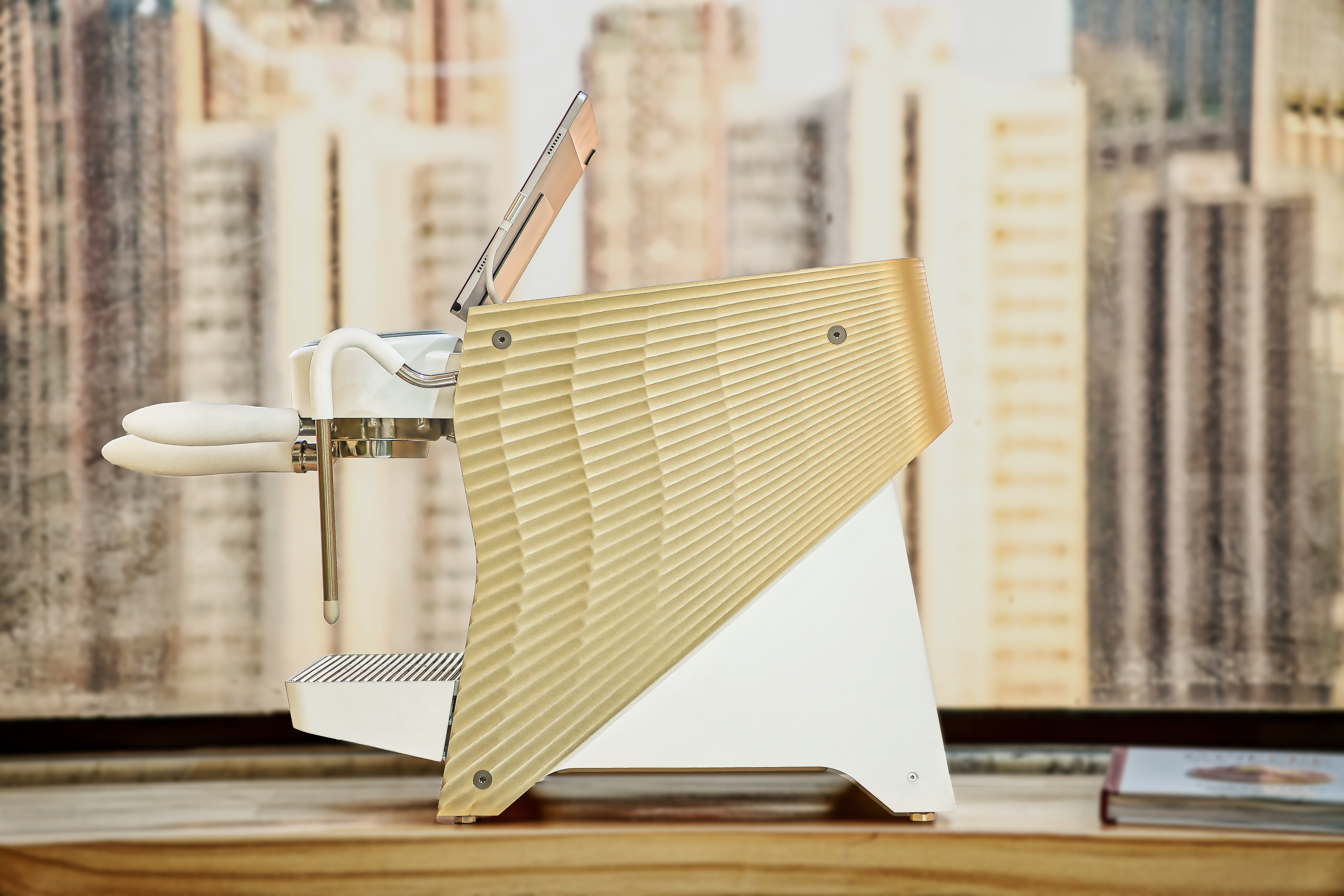
In this article I will explain how we were inspired by artists and cutting-edge industrial machine control, to create something new to espresso machine design.
Our Bengle espresso machine features a steam-shaped, curved wood back inspired by the iconic Charles and Ray Eames Chair.
Our aim was to create a shape for Bengle that would draw inspiration from the golden era of Italian espresso machine design. We wanted to create something made of metal that was both of its time and firmly rooted in its historical context. We wanted to create a design that would provoke the reaction, "I've seen this design before in a classic espresso machine. No, I haven't, but it feels like I have."Decent designer Ben Champion found inspiration in the organic, curvy lines of this high-end knife handle.

The curves have a natural quality to them, reminiscent of art deco.
Researching how this was made, Ben found articles about controlling milling machines directly instead of relying on CAD software to do so.
Clean, soft curves are usually impossible (or extremely expensive) with CNC because the CAD software converts those shapes into slow back-and forth motions using fine tools. This process is not only very slow, but it also leaves slight grooves. Also, creative possibilities are limited as the CAD software usually avoids "artistic" milling tools, and carves with the tool at 90º to the surface.
With direct control of the milling machines, however, creative possibilities greatly expand. You can use different carving tools for vastly different effects:

You can adjust the angle of your tool as it meets the metal surface. There's no reason your tool has to be perpendicular!
I wanted our design to hark back to the Art Deco sculptures I saw while drifting through museums in Paris during my time at university. This aesthetic spoke to me in particular:


The first step in creating the Wings design was to define the 2D back-and-forth path that the tool would take, as well as its travel speed and angle.

Then draw a 2D line to define the tool's up-and-down motion over time.

Make one, then iterate.

As this excellent article on the process explains:
In general, all of the tests/techniques were successful to some degree, however some of the results were rather predictable. The more interesting aspects (converging paths, overlapping and distorted areas, various depths, etc.) seemed a result of unforeseen factors (not controlled in Rhino or Inventor HSM). These occurrences seemed to yield particularly rich areas in the aluminum - where texture and visual affect are amplified.
Serendipity plays a significant role in this process. While some things don't work as expected, others turn out to be vastly better and more interesting. For example, we achieved particularly good visual results when experimenting with tool angles and depths.
The final step is to bend this flat shape by hand without damaging it, so it fits on the espresso machine.

Ultimately, this object is milled in three passes, with different tools and paths used each time. Human post-processing steps, such as sandblasting, painting, drilling and bending, all have to be perfected. We decided to make it in both silver and gold, as each color had its own virtues with this design.

The entire process took 18 months, during which time Ben collaborated closely with our manufacturing partner and his expert machinist to bring this project to completion.
We're very proud to have created something that is not only new to espresso, but also to medium-to-large-scale manufacturing. We have not seen any other company use this approach for anything other than small objects and short manufacturing runs.
The process was very R&D-intensive, unpredictable and creative. We loved doing it, and we hope you enjoy having it in your home, should you decide to purchase it.

- Written by John Buckman and Ben Champion
john created 2026/03/25.